Wide-Grip Seated Cable Row: Upper-Back Width & Thickness Builder
A Bodybuilder’s Guide to Sculpting Rhomboids, Traps, Rear Delts, and Upper Lats with Precision
If you want a truly dominant back—one that looks thick, wide, and fully three-dimensional—you need exercises that force you to actually use your upper-back muscles. Not momentum, not lower-back swing, not hip drive. Just pure scapular retraction power.
Enter the wide-grip seated cable row—one of the most underrated but absolutely essential movements for building an upper back that stands out from every angle.
This row variation uses a flare-out grip and a slightly higher line of pull to shift emphasis toward the rhomboids, mid traps, rear delts, and upper-lat fibers.
And because it’s a cable-based movement, it maintains uninterrupted tension and gives you a level of precision that barbell and free-weight rows simply can’t match.
This is not just a “variation.” It’s a foundational upper-back developer that fills a gap no other row hits as directly.
And if your goal is to build elite bodybuilding-tier back detail—deep mid-back lines, thick rear delts, and traps that sit high and full—this is one of the most valuable pulls you can have in your program.
Muscles Worked
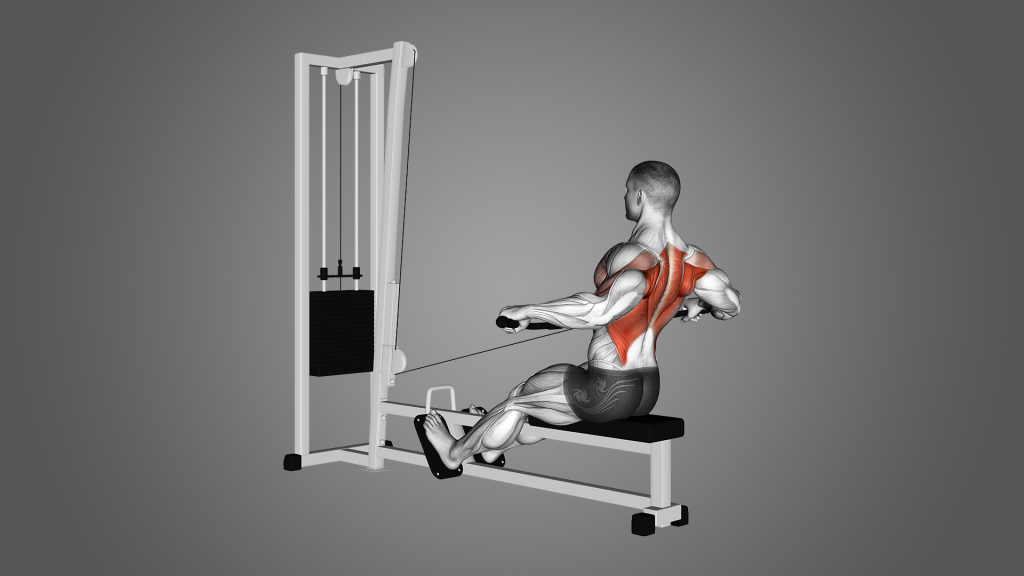
The wide-grip seated cable row shifts the loading pattern upward across the scapular region, helping you develop the “armor plating” of the back.
Primary Movers
- Rhomboids
- Middle trapezius
- Lower trapezius (stabilizing + finishing)
- Rear deltoids
- Upper lats (teres major, lat border)
Secondary Muscles
- Biceps
- Brachialis
- Forearms
- Erectors and core (stabilization only)
Because of the grip width and line of pull, your elbows stay flared and your shoulder blades become the star movers. If you’ve ever struggled to “feel your back,” this exercise is one of the best teachers.
Why the Wide-Grip Cable Row Belongs in a Bodybuilder’s Upper-Back Routine
- Superior scapular retraction → upper-back detail
This row variation forces you to retract and depress your shoulder blades against resistance, which is the exact pattern that builds the 3D look of the mid/upper back.
Bodybuilders who skip this movement often have:
- flat mid-backs
- undertrained rhomboids
- weak lower traps
- poor retraction mechanics
Basically, they’re missing the “density shelf” that makes the back pop in rear lat spreads and rear double biceps shots.
- Constant tension = superior hypertrophy
Unlike free weights, where tension decreases at the top or bottom of the range:
- cables apply evenly distributed load throughout the entire ROM
- no momentum
- no dead spots
- maximum back engagement
This is optimal for muscle growth, especially for muscles like the traps and rhomboids that respond extremely well to continuous tension.
- Easy to adjust for anatomy
You can fine-tune this movement to match your structure by altering:
- torso angle
- grip width
- grip height
- slight cable height elevation
This makes it almost universally effective.
- A perfect balance to lat-dominant rowing
You already built a strong lat-focused series on your site.
This row is the ideal complement—it hits everything above that.
For a complete back, you need both:
- vertical pull width
- lat-focused rows
- upper-back rows (this category)
This exercise anchors the last one.
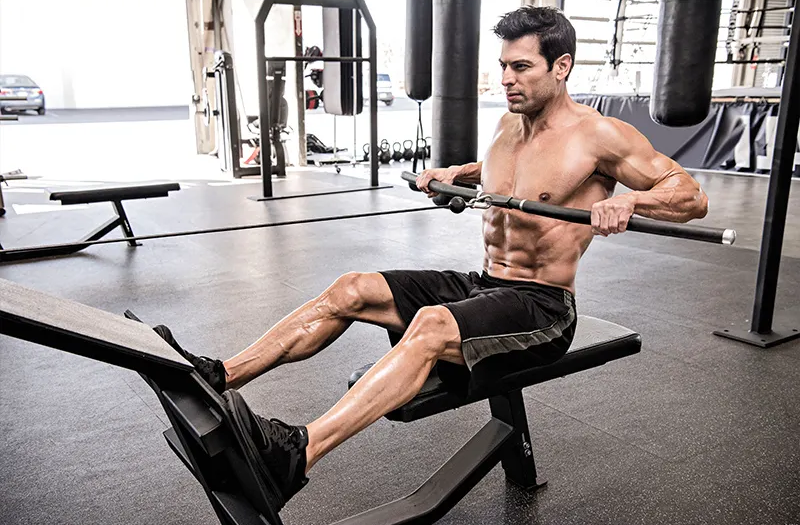
How to Perform the Wide-Grip Seated Cable Row (Perfect Bodybuilder Form)
- Setup
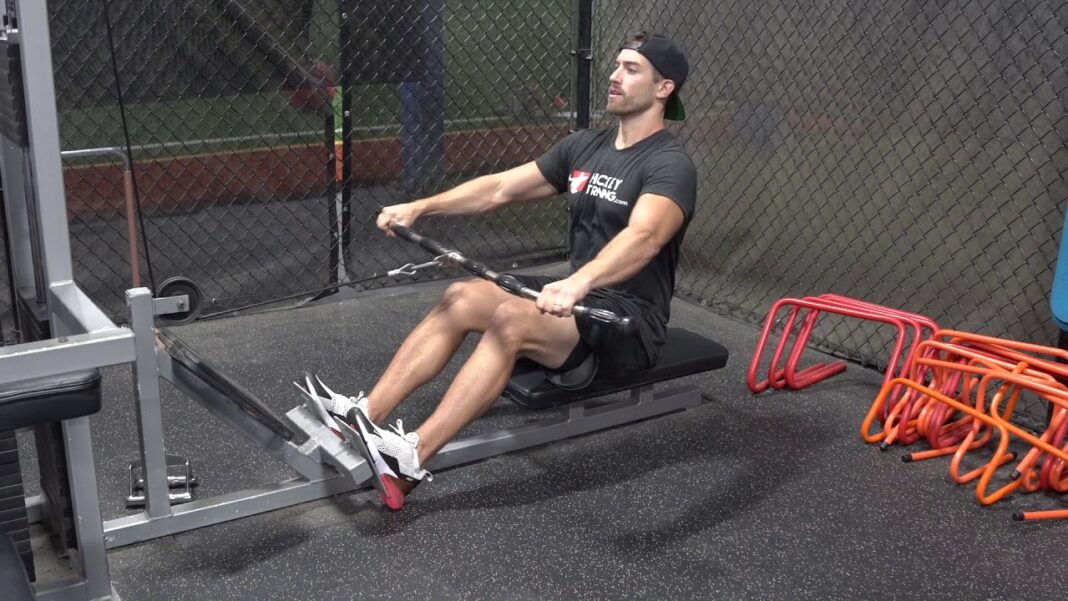
- Attach a wide bar, ideally with angled or neutral end grips
- Sit tall on the bench with feet firmly planted
- Grip the bar wider than shoulder width—hands outside the shoulders by 4–6 inches
- Sit upright with a slightly forward torso lean (not rounded)
- Keep your chest lifted and core braced
- Pulling Phase (Concentric)
- Initiate the movement by retracting your shoulder blades first, before bending the elbows
- Pull the bar toward your upper abs or lower chest
- Keep elbows flared out at 45–60 degrees—don’t tuck them
- Maintain a tall chest with minimal torso swing
- Imagine pulling with your mid-back, not your arms
- Squeeze
At the peak position:
- Drive your elbows back and slightly out
- Pinch your shoulder blades together
- Hold the squeeze for 1–2 seconds
This is where the magic happens.
- Return (Eccentric)
- Control the weight—slow, deliberate movement
- Allow your shoulder blades to protract fully
- Maintain posture (don’t collapse forward)
- Get a full stretch through the traps and rear delts
The eccentric is where a ton of upper-back growth happens.
Let it work.
Common Mistakes (and How to Fix Them)
❌ Mistake 1: Pulling with the arms instead of the back
If elbows bend before the shoulder blades move, you’re losing the purpose of the exercise.
Fix:
Start every rep by pulling the shoulders down and back.
❌ Mistake 2: Using too much weight and swinging the torso
This turns it into a sloppy mid-lat pull with no upper-back stimulus.
Fix:
Stay strict. Let the cable do its job.
❌ Mistake 3: Tucking elbows close to the body
This changes the exercise into a lat row.
Fix:
Keep elbows flared. The wider the line of pull, the more upper-back involvement.
❌ Mistake 4: Not getting full protraction on the stretch
Half reps = half growth.
Fix:
Let the shoulder blades glide forward under control at the bottom.
❌ Mistake 5: Rounding the lower back
A common issue caused by going too heavy.
Fix:
Brace the core and keep the chest up for the entire set.
Best Grip and Body Position for Maximum Upper-Back Activation
Grip Width
- Typically wider than shoulder-width
- Go wider to shift more toward rear delts and mid traps
- Go slightly narrower to hit rhomboids more deeply
Grip Type
Use:
- angled grips
- semi-neutral
- or a straight wide bar
Avoid narrow-grip v-bars—those are lat-focused.
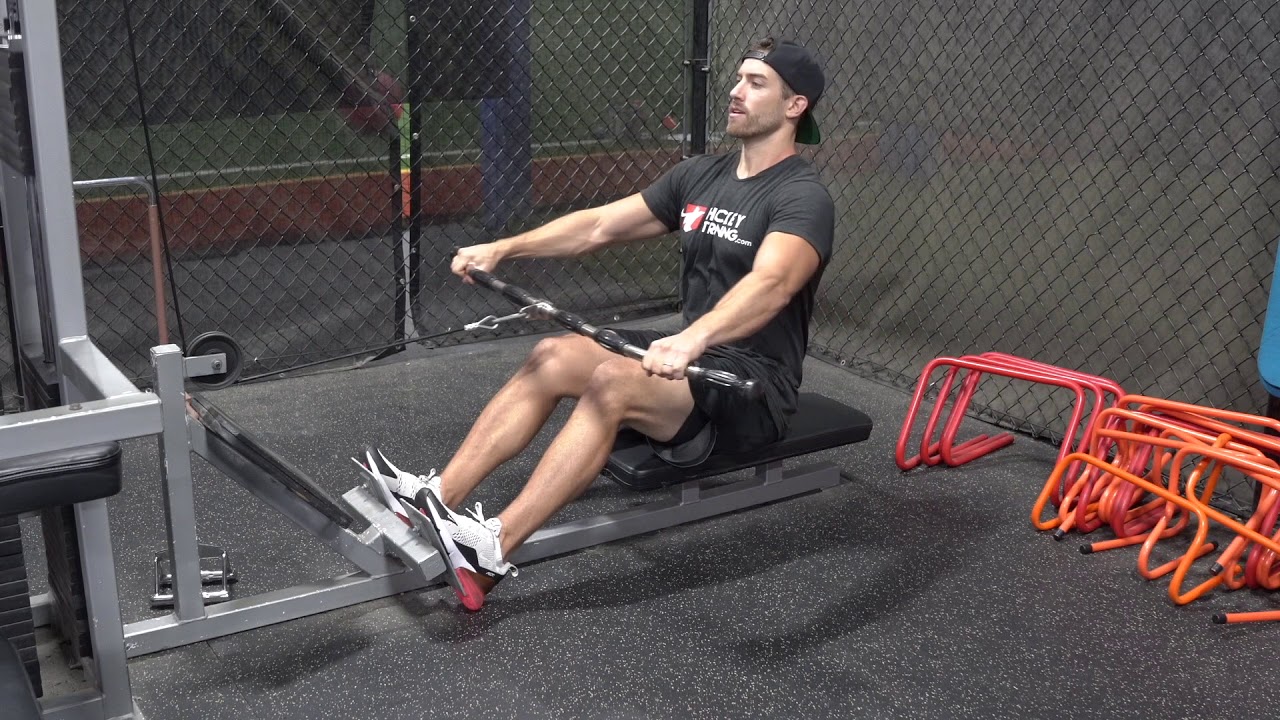
Torso Angle
The sweet spot:
- torso upright or slightly forward (5–10°)
- not leaning excessively backward
Leaning back reduces upper-back engagement and turns it into a lat-dominant row.
Intensity Techniques to Maximize Growth
- Controlled Eccentrics
Slow the lowering phase to 3–4 seconds.
This dramatically increases rhomboid and trap tension.
- Pause Reps
Pause in the peak contracted position for 1–2 seconds.
This is brutal—but it builds detail like nothing else.
- 1.5 Reps
- full rep
- half rep
- repeat
Huge time-under-tension builder.
- High-Rep Burnout Sets
Finish with 15–20 reps to “flood” the upper back with blood.
This brings out muscle separation and detail.
- Technique Sets
Use lighter weight and perfect form—especially useful after heavy rowing.
Hypertrophy Programming Guidelines
Rep Range
- Primary hypertrophy: 8–15 reps
- Detailing: 15–20 reps
- Strength-focused: 6–8 reps (less common for this movement)
Sets
- 3–5 working sets
- Add a final high-rep set for maximum pump
Frequency
Upper-back movements respond well to 2× per week frequency.
Placement in a Workout
Usually placed:
- after heavy free-weight rows
OR
- before isolation work (rear delts, traps)
This is a bread-and-butter mid/upper-back builder.
Who Should Prioritize the Wide-Grip Seated Cable Row?
- Bodybuilders looking for density and detail
This is the “carving” movement of the back routine.
- Lifters who struggle to “feel” their back during rows
The fixed cable path eliminates cheating and forces true upper back activation.
- Anyone with weak scapular retraction
If your posterior chain collapses during deadlifts, squats, or benching—this will help fix it.
- Lifters who need safer alternatives to bent-over rows
No spinal loading
No lower-back fatigue
Just pure upper-back work.
- Late-stage contest prep athletes
High-tension cable rows help bring out deep separation.
Programming Examples
Bodybuilding Hypertrophy Block
- 4×12
- slow negatives
- 2-second peak squeeze
Upper-Back Thickness Focus
- 5×10
- moderate weight
- explosive pull
- controlled return
Detail/Isolation Day
- 3×15–20
- lighter load
- strict form
Superset Option
- Wide-Grip Cable Row – 12 reps
- Face Pulls – 15 reps
Back thickness + rear delt detail in one superset.
Practical Takeaways for All Lifters
- Use a grip wider than traditional rows to fully bias the upper back
- Elbows should flare out—don’t tuck
- Retract your shoulder blades first
- Keep your torso upright or slightly forward
- Control the eccentric; don’t rush it
- Pause at the peak contraction for elite growth
- Use cables for perfect tension and consistent stimulus
- Add high-rep finishing sets to create detailing and definition
Final Thoughts: The Upper-Back Sculptor
The wide-grip seated cable row isn’t just another rowing variation—it’s a core component of a complete back. It builds the thickness you see in rear poses, the depth across the mid-back, and the “3D” look that separates an amateur physique from a professional-level back.
Use it with intention—strict form, full stretch, deep contraction—and it will transform your upper-back density and detail more effectively than almost any other rowing movement.