The Trap Bar Row: The Complete Bodybuilder’s Guide to Neutral-Grip Upper-Back Mass
When bodybuilders talk about the “big back builders,” they usually list the barbell row, T-bar row, and cable variations.
But what often gets overlooked is one of the most joint-friendly, biomechanically powerful upper-back mass builders available: the Trap Bar Row.
It combines the loading potential of a barbell, the joint comfort of dumbbells, the grip strength benefits of neutral handles, and the stability of a mechanically balanced pulling path.
The result? A brutally effective way to overload the upper back, mid traps, rhomboids, rear delts, and upper lats—with far less fatigue on the lower back.
For bodybuilders who want an exercise that builds upper-back density and mountain-range thickness, the Trap Bar Row is a hidden gem.
This tutorial covers everything: anatomy, setup, form, programming, variations, mistakes to avoid, and pro-level strategies for hypertrophy.
Muscles Worked (Primary & Secondary)
Primary Upper-Back Targets
- Rhomboids — responsible for retraction and dense mid-back thickness.
- Middle Traps — create the wide, thick “slab” across the upper back.
- Lower Traps — stabilize the scapula and improve shoulder girdle balance.
- Rear Delts — heavily activated due to the neutral hand position.
- Upper Lats — row path drives tension into the upper lat fibers.
Secondary Muscles
- Brachialis and brachioradialis
- Forearms & Grip Muscles (neutral grip is extremely grip-intensive)
- Erectors (isometric, but far less demand than a barbell row)
- Teres Major & Minor
Why the Trap Bar Row hits differently
The neutral handles bring the elbows close to your torso, improving scapular retraction mechanics and allowing you to row heavy without compressing the shoulders.
It’s essentially the biomechanical “sweet spot” between a dumbbell row and a barbell row—minus the lower-back fatigue that limits progress.

How to Set Up the Trap Bar Row
Step 1 — Choose Your Trap Bar Height
You can row from:
- Floor height (more hip hinge, more lower-lat stretch)
- Raised blocks (more upper-back isolation, less hip hinge strain)
For upper-back emphasis, raised handles or blocks are ideal.
Step 2 — Position Your Feet
Feet should be hip to shoulder width, with toes slightly outward.
Make sure your shins stay vertical—this keeps the pull pure and prevents turning it into a weird deadlift hybrid.
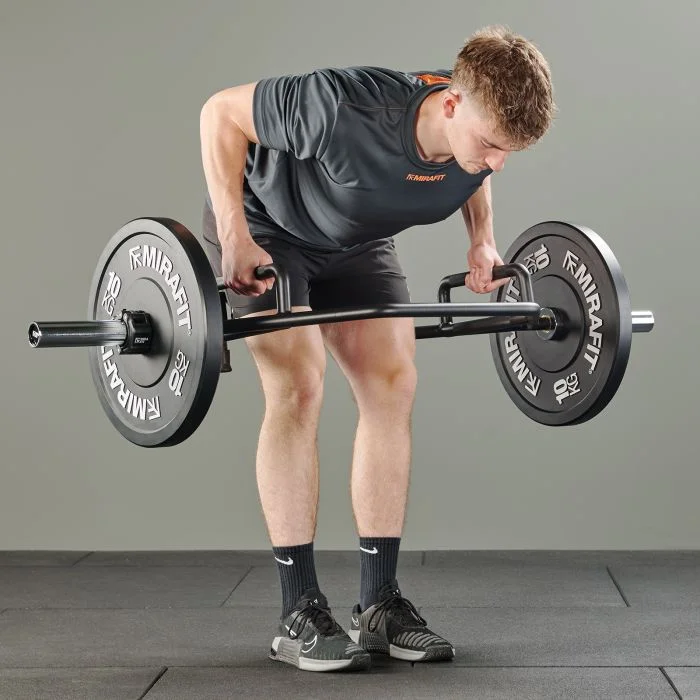
Step 3 — Hinge into Position
- Push hips back.
- Keep your torso angled 30–45 degrees forward.
- Maintain a tight, neutral spine.
- Brace your core.
This posture creates the correct angle for upper-back pulling instead of lower-back grinding.
Step 4 — Grip the Handles
Use the neutral grips.
Squeeze hard—this movement challenges grip strength heavily.
Step 5 — Engage the Back Before You Pull
- Depress the scapula (“anti-shrug”)
- Retract slightly
- Keep your chest open
This primes the traps and rhomboids before the first rep even begins.
How to Perform the Trap Bar Row (Perfect Hypertrophy Technique)
Phase 1: The Pull
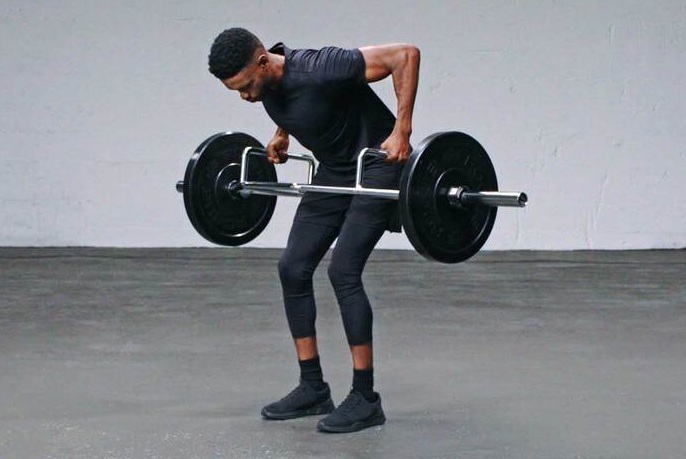
- Begin the rep by pulling your elbows back, not upward.
- Think: “Drive my elbows behind me, not toward my ears.”
- Keep your torso angle fixed.
- Row until the bar reaches about your mid-ribcage.
This maximizes rhomboid and mid-trap activation.
Phase 2: The Squeeze
At the peak contraction:
- Pinch your shoulder blades.
- Hold for one strong second.
- Keep your chin neutral (don’t crane up).
This is where the exercise becomes a true bodybuilding movement instead of a powerlifting one.
Phase 3: The Controlled Eccentric
Lower the weight slowly—2–3 seconds.
Let your shoulder blades protract (spread) at the bottom.
This increases upper-back stretch and helps target the traps and rhomboids through a full range.
Rep Cadence for Best Growth
Pull: 1 sec → Squeeze: 1 sec → Lower: 2–3 sec
This is perfect for bodybuilding goals.
How Heavy Should You Go?
The Trap Bar Row is built for medium-heavy to heavy work, but not sloppy, momentum-based reps.
Ideal Hypertrophy Loading Ranges
- 6–10 reps heavy (strength + mass)
- 10–15 reps moderate-heavy (upper-back thickness)
- 15–20 reps lighter (rear delts & traps pump)
Most bodybuilders thrive by rotating between rep ranges throughout a training cycle.
Benefits of the Trap Bar Row for Bodybuilders
- Reduced Lower-Back Strain
Compared to:
- Bent-over rows
- Pendlay rows
- T-bar rows
…the Trap Bar Row drastically reduces lower-back fatigue. This allows lifters to train the upper back more frequently and with more volume—critical for growth.
- Neutral Grip = Strongest Grip Position
The neutral handles dramatically increase:
- Grip strength
- Brachioradialis involvement
- Forearm recruitment
- Rowing power
You can generally pull more weight safely than with overhand barbell rows.
- Superior Scapular Mechanics
The trap bar allows:
- Clean retraction
- Powerful peak squeezes
- Deep protraction at the bottom
- Less irritation to the AC joint
- Less shoulder impingement risk
It’s one of the most joint-friendly rowing movements in existence.
- Heavier Loading Without Technique Breakdown
The balanced load means:
- Less torso sway
- Less need to stabilize side-to-side
- More predictable movement pattern
- Easier progressive overload
The trap bar almost forces good form.
- Massive Upper-Back Thickness Potential
The movement hits:
- Mid traps
- Rhomboids
- Rear delts
- Upper lats
…all at once, under a heavy load and with a long tension path.
This builds the thick, dense back needed for bodybuilding.
Common Mistakes (And How to Fix Them)
❌ Mistake #1 — Turning it into a mini-deadlift
Rising your torso during the pull turns the exercise into a deadlift variation and takes stress off the upper back.
Fix:
Keep your torso angle locked.
❌ Mistake #2 — Shrugging during the pull
This overloads the upper traps and removes tension from the rhomboids.
Fix:
Think “back and down” with the elbows.
❌ Mistake #3 — Rounding the upper back
This ruins scapular retraction capacity.
Fix:
Chest open, spine neutral, pull shoulders back.
❌ Mistake #4 — Rushing the eccentric
The mid-back grows best under slow, controlled lowering.
Fix:
Use a 2–3 second eccentric.
❌ Mistake #5 — Using too much weight
If your torso moves up, you’re cheating.
Fix:
Lower the weight by 10–20% and commit to strict reps.
Programming the Trap Bar Row for Maximum Growth
Here’s how bodybuilders should fit this into their back program.
Option 1 — Upper-Back Primary Movement
- 4–5 sets
- 6–10 reps
- Focus on heavy neutral-grip strength and row power.
Option 2 — Mid-Back Thickness Builder (Mid Workout)
- 3–4 sets
- 10–15 reps
- Slow eccentrics and strong squeezes.
Option 3 — Upper-Back Finisher
- 2–3 sets
- 15–20 reps
- Constant tension, minimal rest.
Frequency
- 1–2 times per week
- Rotate grip widths, rep ranges, and loading patterns
Where to Put the Trap Bar Row in a Back Day?
Ideal placement:
Option A — After a lat-focused movement
e.g.,
- Lat pulldown → Trap Bar Row
- Dumbbell pullover → Trap Bar Row
- Single-arm pulldown → Trap Bar Row
This ensures the upper back gets its own spotlight.
Option B — As the main upper-back mass movement
Especially if you’re trying to improve mid-back thickness or reduce lower-back fatigue.
Option C — Near the end for high-rep pumps
If you want a deep burn without risking form breakdown.
Advanced Hypertrophy Variations
- Trap Bar Dead-Stop Rows (Rhomboid Power Builder)
Reset each rep on the floor.
Perfect for strength phases.
- Chest-Supported Trap Bar Row
Set a bench at a slight incline under your torso.
Eliminates lower-back involvement entirely.
- Paused Trap Bar Row
Pause 1–2 seconds at the top.
This turns the exercise into a rear-delt and trap destroyer.
- 1.5-Rep Trap Bar Rows
Row → halfway down → back up → full down.
Brutal on the mid traps.
Who Should Prioritize the Trap Bar Row?
Bodybuilders Who:
- Want thick mid-back density
- Have lower-back fatigue from too many bent-over movements
- Need a joint-friendly heavy row
- Want to load the upper back hard without sloppy form
- Are stuck on barbell or dumbbell row progression
Beginners
Perfect because the neutral grip and balanced load teach correct rowing mechanics.
Intermediate Lifters
Great for volume accumulation and consistent overload.
Advanced Bodybuilders
Ideal for periods where you need to cut lower-back fatigue without losing upper-back stimulation.
Practical Takeaways
- The Trap Bar Row is one of the most underrated upper-back mass builders in bodybuilding.
- Neutral grip = safer shoulders + stronger pulls.
- Perfect for lifters dealing with lower-back fatigue.
- Loads rhomboids, mid traps, upper lats, and rear delts extremely effectively.
- Works well across multiple rep ranges.
- Great for both beginners and advanced lifters.
If your goal is to build a thick, wide, dense upper back from every angle, the Trap Bar Row deserves a permanent place in your training arsenal.