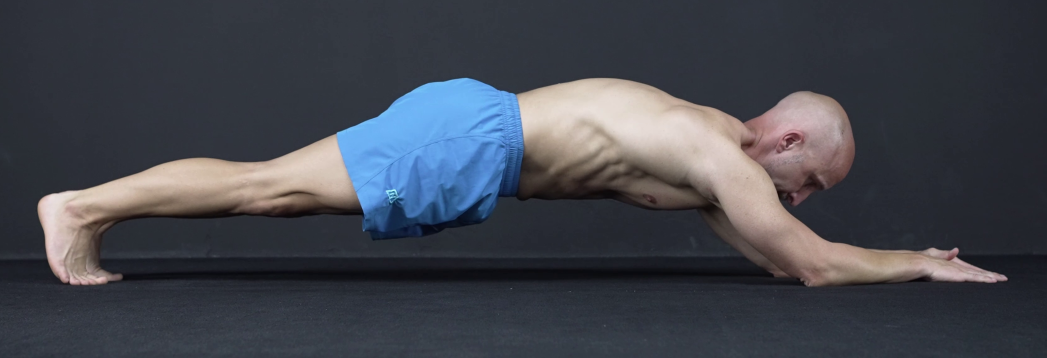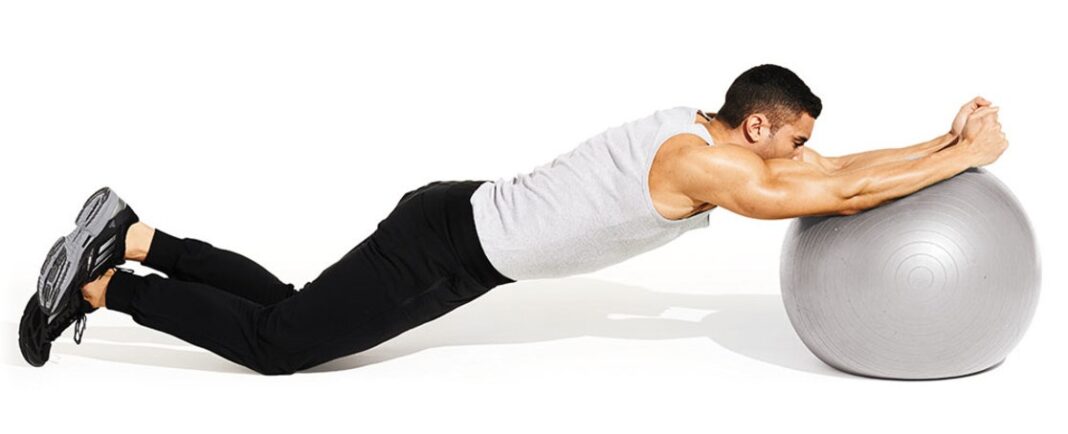
Stability Ball Rollout
Progressive Anti-Extension Builder for Dynamic Control, Core Hypertrophy, and Lumbar Integrity
This is the perfect next step in your hierarchy:
- Less aggressive than standing ab wheel rollouts
- More dynamic than planks
- More loadable and progression-friendly than dead bugs
- Excellent bridge between beginner and advanced anti-extension work
Stability Ball Rollout
Progressive Anti-Extension Builder for Dynamic Control, Core Hypertrophy, and Lumbar Integrity
The Stability Ball Rollout is one of the most effective yet underutilized anti-extension core exercises available. It combines the lever-based challenge of rollouts with the instability of a free-moving implement, forcing the anterior core to resist extension while actively controlling movement through space.
Unlike the ab wheel, which follows a relatively fixed path, the stability ball introduces subtle lateral and rotational demands that punish poor bracing and sloppy mechanics. This makes the exercise exceptionally valuable for developing true dynamic core control, not just brute anti-extension strength.
From a programming standpoint, the Stability Ball Rollout occupies a critical middle ground. It is more demanding than static planks, more dynamic than dead bugs, and more forgiving than standing rollouts. That balance makes it ideal for hypertrophy-focused lifters who want meaningful abdominal tension without excessive spinal stress.
When performed correctly, this exercise lights up the rectus abdominis, transverse abdominis, and obliques while reinforcing the rib–pelvis relationship that underpins all heavy lifting.
Primary Muscles Worked
Rectus Abdominis
The rectus abdominis is the primary anti-extension muscle during the rollout. As the ball moves away from the body, extension torque increases dramatically, forcing the abs to contract isometrically to prevent the lower back from arching.
Transverse Abdominis (TVA)
The TVA maintains intra-abdominal pressure and spinal stiffness throughout the movement. Its role becomes especially important as instability increases with ball movement.
Internal and External Obliques
The obliques assist by preventing unwanted rotation and lateral shift as the ball moves forward and back. This subtle demand differentiates the stability ball rollout from more linear anti-extension drills.
Secondary Muscles and Stabilizers
- Erector Spinae – Maintain spinal alignment
- Gluteus Maximus – Posterior pelvic control
- Serratus Anterior – Scapular stability
- Anterior Deltoids – Shoulder support
This global involvement reinforces why the rollout feels far more demanding than it appears.

What the Stability Ball Rollout Is Best For
- Dynamic anti-extension strength
- Ab hypertrophy through long lever tension
- Improving rollout mechanics
- Teaching bracing under movement
- Reducing lumbar extension compensation
It is especially useful for lifters who feel ab wheel rollouts primarily in the lower back or shoulders.
Why Instability Changes the Stimulus
Instability increases the need for continuous, reactive tension.
As the ball rolls:
- Micro-adjustments are required to maintain alignment
- The obliques and TVA fire more aggressively
- Momentum is harder to control
- Poor bracing is immediately exposed
This makes the stability ball rollout an exceptional teaching and hypertrophy tool when control—not ego—is prioritized.
Proper Setup
Begin kneeling behind a stability ball with your forearms or hands placed on top of it.
Your shoulders should be stacked slightly in front of your elbows, and your knees positioned comfortably on the floor.
Before initiating movement:
- Stack ribs over pelvis
- Lightly tuck the pelvis
- Squeeze the glutes
- Brace the abs hard
The ball should not move until full tension is established.
Execution: Step-by-Step
Slowly roll the ball forward by extending your arms while maintaining a neutral spine.
As the ball moves away, actively resist lumbar extension. The torso should move as a single unit—no sagging or arching.
Roll out only as far as you can maintain perfect alignment. At your end range, pause briefly, then pull the ball back using your abs—not your hips.
Reset fully between reps.
Key Coaching Cues
- “Ribs down, glutes on”
- “Move slow, resist hard”
- “No sag, no stretch”
- “Pull with your abs”
- “End the rep before you lose position”

Common Mistakes and Fixes
Lower Back Sagging
Reduce range of motion and re-establish pelvic control.
Using Momentum
Slow the tempo and add pauses at end range.
Overextending Too Soon
Progress range gradually. Depth is earned.
Arm-Driven Pullback
Think about pulling the ribcage back toward the pelvis.
Stability Ball Rollout for Hypertrophy
This movement is highly effective for hypertrophy when:
- Reps are slow and controlled
- Sets are stopped by form breakdown
- Range is progressively increased
Recommended hypertrophy parameters:
- 6–12 controlled reps
- 2–4 sets
- 60–90 seconds rest
Long eccentrics and pauses dramatically increase tension.
Progressions and Regressions
Regressions
- Shortened rollout range
- Forearms on ball instead of hands
- Slower tempo
Progressions
- Longer rollout range
- Narrow knee stance
- Weighted vest
- Transitioning toward standing rollouts
Who Should Use It
Ideal for:
- Lifters building toward advanced rollouts
- Those prioritizing ab hypertrophy
- Athletes needing dynamic bracing
- Anyone refining anti-extension mechanics
Those with acute lumbar pain should regress to static holds first.
Final Thoughts
The Stability Ball Rollout is one of the most intelligent anti-extension exercises you can program. It builds strength, control, and muscle simultaneously while reinforcing the spinal mechanics that matter most under load.