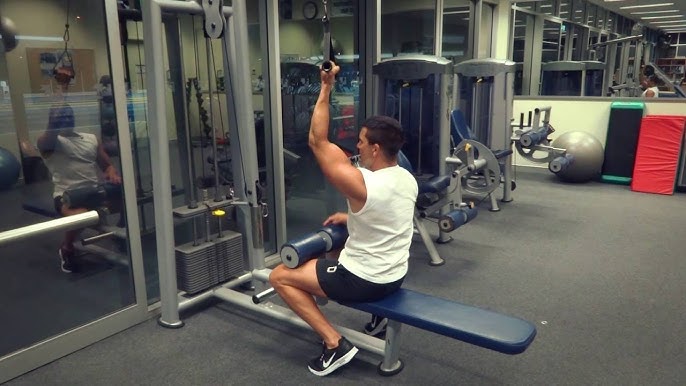
The Single-Arm Lat Pulldown
The Ultimate Unilateral Lat Isolation Movement for Maximum Back Symmetry, Shape, and Mind–Muscle Connection
If the wide-grip and close-grip lat pulldowns give you overall width and thickness, the Single-Arm Lat Pulldown gives you precision.
It’s the lat exercise bodybuilders turn to when they want perfect symmetry, an unmistakable V-taper, and the ability to feel the lats working the way they’re supposed to.
This movement is one of the greatest “lat literacy” builders you can perform. Most lifters struggle to activate the lats because compound back exercises are dominated by stronger secondary movers — biceps, rear delts, traps, rhomboids — leaving the lats under-stimulated.
The Single-Arm Lat Pulldown fixes that problem instantly. You get complete freedom to tailor the path of your elbow, adjust your torso angle, and carve out a deeper range of motion than bilateral pulldowns can ever provide.
For physique-focused lifters, this exercise is a secret weapon:
- It improves lat shape, not just size.
- It enhances mind–muscle connection dramatically.
- It balances out left/right asymmetries.
- And it deepens the lat stretch, one of the biggest hypertrophy drivers.
Whether you’re a beginner struggling to “find your lats,” or an advanced bodybuilder trying to sculpt the lower lats into clean, sweeping lines — the Single-Arm Pulldown is indispensable.
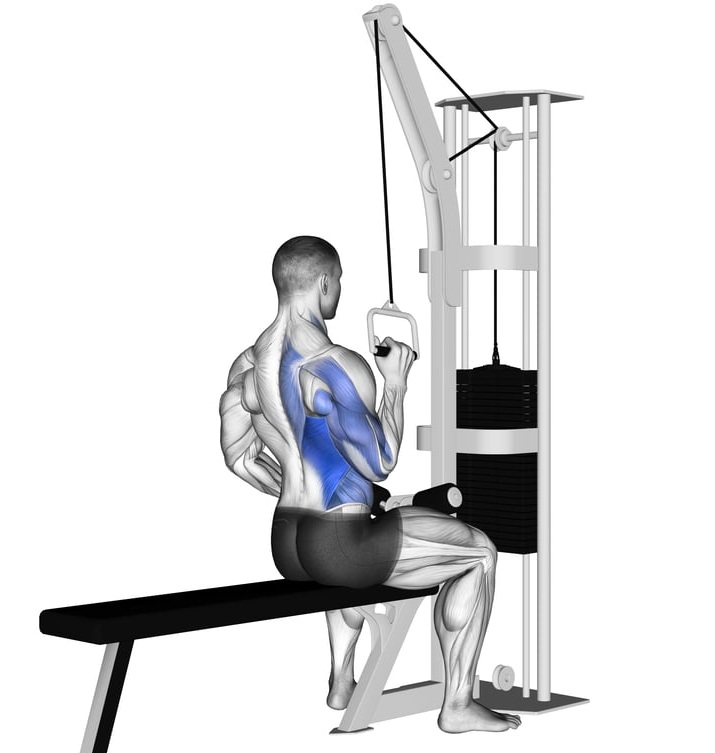
Muscles Worked
Primary Target
- Latissimus dorsi (lower, mid, and outer fibers depending on arm path)
Secondary Muscles
- Teres major
- Rear delts
- Rhomboids
- Lower/mid traps
- Biceps, brachialis, brachioradialis
Stabilizers
- Obliques
- Core
- Grip muscles
Because each hand works independently, your core must stabilize the torso to prevent rotation — a hidden benefit for overall strength.
Exercise Purpose: Why Bodybuilders Love It
Bodybuilders consider the Single-Arm Lat Pulldown one of the closest things to a “true” lat isolation exercise.
With bilateral pulldowns, your torso is fixed and your arms must follow the machine’s groove. But with unilateral pulldowns, your arm path can follow your natural scapular mechanics, which differ from person to person.
That means:
- You can flare or tuck your elbow depending on which lat region you want to target.
- You can lean slightly forward or back to increase stretch or contraction.
- You can pull your elbow past your torso for an intense bottom-end squeeze.
- You can rotate your palm slightly for better alignment with the lat’s fibers.
In short — it allows you to tailor the movement to your body, not the machine.
How to Perform the Single-Arm Lat Pulldown (Step-by-Step)
- Setup
- Sit on the lat pulldown station with the thigh pad tight against your legs.
- Attach a single D-handle to the pulldown cable.
- Sit slightly off-center so the cable aligns vertically with your working shoulder.
- Grab the handle with an overhand or neutral grip depending on preference.
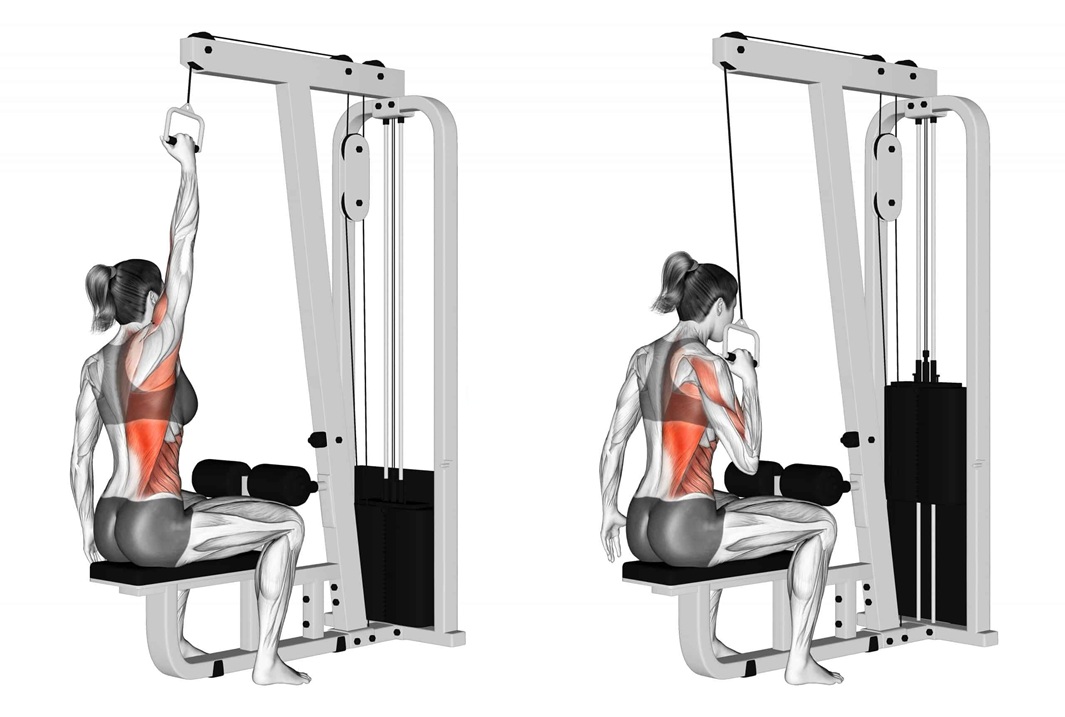
- Start with your arm extended fully overhead.
Torso position:
Lean back 10–20 degrees with chest lifted and shoulders depressed. This position opens the lats and places tension right where you want it.
- Initiate with the Lat
Before bending your elbow, think:
“Shoulder down.”
Depress your scapula to engage the lat first.
This is the biggest mistake lifters skip.
- Begin the Pull
- Pull your elbow downward and slightly back, following the contour of your ribcage.
- Keep your elbow tucked close to the torso — the lat is strongest here.
- Imagine driving your elbow into your back pocket.
- Contraction Phase
- Pull the handle to the top of your chest or even slightly lower.
- Your elbow should finish past your torso for a strong squeeze.
- Pause 1 second at peak contraction.
- Controlled Stretch
- Slowly let the handle rise under control for 2–3 seconds.
- Let your shoulder blade elevate for a full stretch.
- Don’t lean sideways — keep your torso square.
The deep stretch is where this exercise surpasses standard lat pulldowns.
Breathing
- Exhale as you pull down.
- Inhale as you return to the top and stretch the lat fully.
Perfect Rep Form Checklist
- Chest up and ribcage open
- Shoulder stays down
- Elbow drives the pull, not the wrist
- No body sway or trunk rotation
- Full stretch and full contraction
- Slow controlled tempo (no dropping the weight)
Benefits for Bodybuilders
- Improved Lat Mind–Muscle Connection
The unrestricted arm path lets you finally feel the lat rather than the biceps. Most lifters say this movement gives them the strongest lat contraction of any vertical pull.
- Complete Freedom of Motion
Because the lat fibers run diagonally, allowing the arm to travel in a natural arc aligns tension perfectly with the muscle.
- Fixes Imbalances
Almost every physique athlete has one lat that’s thicker or wider. This exercise exposes and corrects discrepancies quickly.
- Superior Stretch
The Single-Arm Pulldown offers one of the deepest lat stretches in all of training, which significantly contributes to hypertrophy.
- Joint-Friendly
Neutral or semi-neutral grips minimize shoulder irritation.
The exercise is excellent for lifters who struggle with wide-grip positions.
Common Mistakes (and How to Fix Them)
❌ Using too much weight
This turns the exercise into a biceps-dominant movement and reduces ROM.
Fix: Use a weight that allows strict control and a deep stretch.
❌ Rotating the torso
This shifts load onto the obliques and traps rather than the lats.
Fix: Keep your torso square; brace your core.
❌ Letting the shoulder shrug
This puts tension into the upper traps.
Fix: Think “shoulder down” the entire set.
❌ Pulling with the hand instead of the elbow
Leading with the wrist activates the biceps too much.
Fix: Imagine your hand as a hook.
❌ Not reaching full extension at the top
Shortening the stretch limits hypertrophy.
Fix: Allow the shoulder blade to elevate at the top before the next rep.
Best Grip Styles
- Neutral Grip (Recommended)
Aligns perfectly with lat anatomy.
Great balance of stretch and contraction.
- Semi-Supinated Grip
Enhances lower-lat recruitment and allows a stronger squeeze.
- Fully Supinated Grip
More biceps involvement but can increase mind–muscle connection for some individuals.
Variations
- Kneeling Single-Arm Lat Pulldown
Increases stability and enhances torso positioning.
- Half-Kneeling Pulldown
Improves core engagement and eliminates body sway.
- Iso-Lateral Machine Single-Arm Pulldown
Great for all-out heavy sets with perfect range of motion.
- Lean-Away Single-Arm Pulldown
Creates an even deeper lat stretch.
- Cross-Body Single-Arm Pulldown
Targets the outer lat sweep uniquely due to altered elbow trajectory.
Programming for Hypertrophy
For Mass & Lower-Lat Size
- 3–4 sets
- 8–12 reps
- 2-second stretch at top
- 1-second pause in contraction
For Lat Density & Control
- 3 sets
- 10–15 reps
- Slow negatives
- Very strict form
As a Finisher
- 2 sets
- 12–20 reps
- Constant tension
- No full lockout at the top

Where It Fits in a Back Workout
Option 1 — Lat Priority Workout
- Straight-Arm Pulldown
- Single-Arm Lat Pulldown
- Close-Grip Pulldown
- Dumbbell Row
- Machine Row
Option 2 — Balanced Back Day
- Barbell Row
- Wide-Grip Lat Pulldown
- Single-Arm Lat Pulldown
- Cable Row
- Rear Delt Fly
Option 3 — Advanced Hypertrophy Day
- Stretchers (DC Training Style)
- Single-Arm Lat Pulldown (heavy)
- Close-Grip Lat Pulldown
- Single-Arm Machine Row
- High-Rep Straight-Arm Pulldown
Practical Tips for Maximum Lat Activation
✔ Use straps
Don’t let grip limit the lat.
✔ Slight forward lean at the top
Creates an insane stretch.
✔ Keep the elbow in the “lat slot”
Tucked, angled down, following your rib line.
✔ Visual cue: “Elbow to hip.”
Not elbow to chest.
✔ Go slow — lats respond best to controlled eccentrics
2–3 seconds on the way up.
Who Should Do This Exercise?
Ideal for:
- Bodybuilders wanting more shape and detail
- Lifters with poor lat activation
- Anyone with back imbalances
- Beginners who struggle to “feel” their back
- Intermediate/advanced lifters wanting a deeper stretch
Skip or modify if:
- You have unstable shoulder mobility
- You cannot keep scapula depressed (practice first!)
Final Thoughts
The Single-Arm Lat Pulldown is the ultimate exercise for lifters who want complete control over their lat development.
It offers unmatched stretch, contraction, and customization — allowing every rep to carve out more width, depth, and symmetry.
When programmed correctly, it becomes a cornerstone lat-builder that pairs perfectly with big compounds and bilateral pulldowns. Few exercises teach you how to activate your lats like this one.
If your goal is a wider back, a deeper V-taper, or balanced lat development — this is a non-negotiable movement in your training.