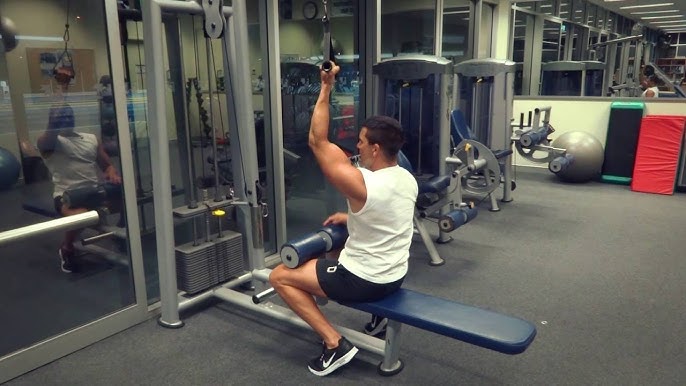
Machine Lat Pulldown (Plate-Loaded or Selectorized) — The Complete Bodybuilding Explainer
The Machine Lat Pulldown is a staple in bodybuilding gyms worldwide because it isolates the lats more consistently than almost any other vertical pulling movement.
Whether it’s a plate-loaded machine (Hammer Strength–style), a selectorized weight stack, or a fixed-path dual-handle design, this exercise provides one thing bodybuilders crave: predictable tension on the lats from start to finish.
Unlike a cable lat pulldown—where body position, momentum, and technique inconsistencies can change the stimulus—machine variations lock you into a fixed movement path.
That fixed arc makes it much easier to drive lat contraction, remove cheating, and apply progressive overload with precision.
For lifters who struggle to “feel their lats” on pulldowns, this machine often becomes the first time the muscle truly fires.
This explainer covers biomechanics, technique, variations, common mistakes, and training strategies for lifters of all levels. By the end, readers will know exactly how to use the Machine Lat Pulldown to build a wider, more detailed back.
Muscles Worked
Primary
- Latissimus dorsi (lats) — all fibers emphasized depending on handle width and path
- Lower lats — especially in machines with a vertical path
- Upper/outer lats — depending on elbow angle and handle position
Secondary
- Teres major
- Rhomboids
- Rear delts
- Biceps (minimal to moderate assist)
- Brachialis
- Forearms
The key reason this machine is valuable: it reduces biceps takeover, which is one of the biggest issues in cable pulldowns.
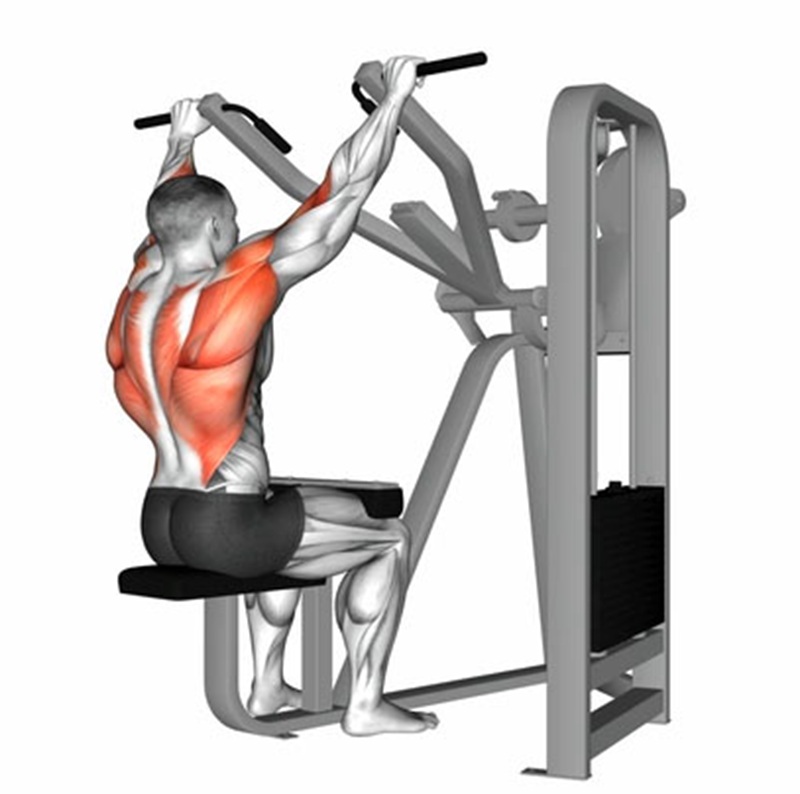
Why Bodybuilders Love the Machine Lat Pulldown
- Fixed Path = Predictable Lat Tension
When the weight travels along a guided track, you remove variables. The lats are forced to do the work without the stabilizer noise or torso rocking that happens on free-path pulldowns.
- Easy to Learn, Hard to Cheat
Beginners get fast lat engagement.
Advanced lifters can push sets deeper without form breakdown.
It’s the perfect combination.
- High Potential for Progressive Overload
Machines allow:
- heavier loading
- microloading on selectorized stacks
- intensity techniques (partials, drops, rest-pause)
All without compromising lat stimulus.
- The Best Pulldown for Lower-Lat Emphasis
Especially with:
- neutral-grip handles
- independent arms
- slightly forward torso leaning
Machines make it easier to pull with the elbows tucked and down, the key to lower-lat involvement.
- Dead-stretch positioning
Some machine designs allow a deep overhead stretch that cables struggle to match—especially plate-loaded models.
How to Perform the Machine Lat Pulldown (Step-by-Step)
- Set the seat height
Your thighs should fit snugly under the pads, locking your lower body in place.
Goal: Your shoulders should be slightly above the handles so you can fully stretch the lats at the top.
- Select your grip
Depends on machine design. Most popular options:
- Neutral grip (palms facing) — best all-around lat activation
- Slightly angled grip — upper and outer lat bias
- Wide grip — back width emphasis
- Independent handles — best for symmetrical recruitment
- Establish your torso angle
Lean back 5–10 degrees.
Not enough to turn it into a row, but enough to spare your shoulders.
- Initiate the pull with the elbows
Think: elbows down → not hands down.
Lead with the elbows to ensure that:
- biceps stay secondary
- lats initiate the pull
- scapulae depress (drop down, not back)
- Pull to your upper chest or collarbone
Range varies by machine.
The goal is a strong short-range lat contraction.
- Squeeze the lats hard
Pause for 0.5–1 second at peak contraction.
- Control the negative
Let the weight stack rise slowly, not explosively.
Do not allow your shoulders to shrug upward during the eccentric.
Let the lats stretch, not the traps.
- Deep stretch at the top
Allow the arms to fully extend without losing tension.
This deep stretch builds lats like few other movements.
Breathing
- Inhale during the stretch phase (top).
- Exhale as you drive the elbows down through the concentric.
If going heavy or close to failure, use a slight Valsalva brace during the initial pull.
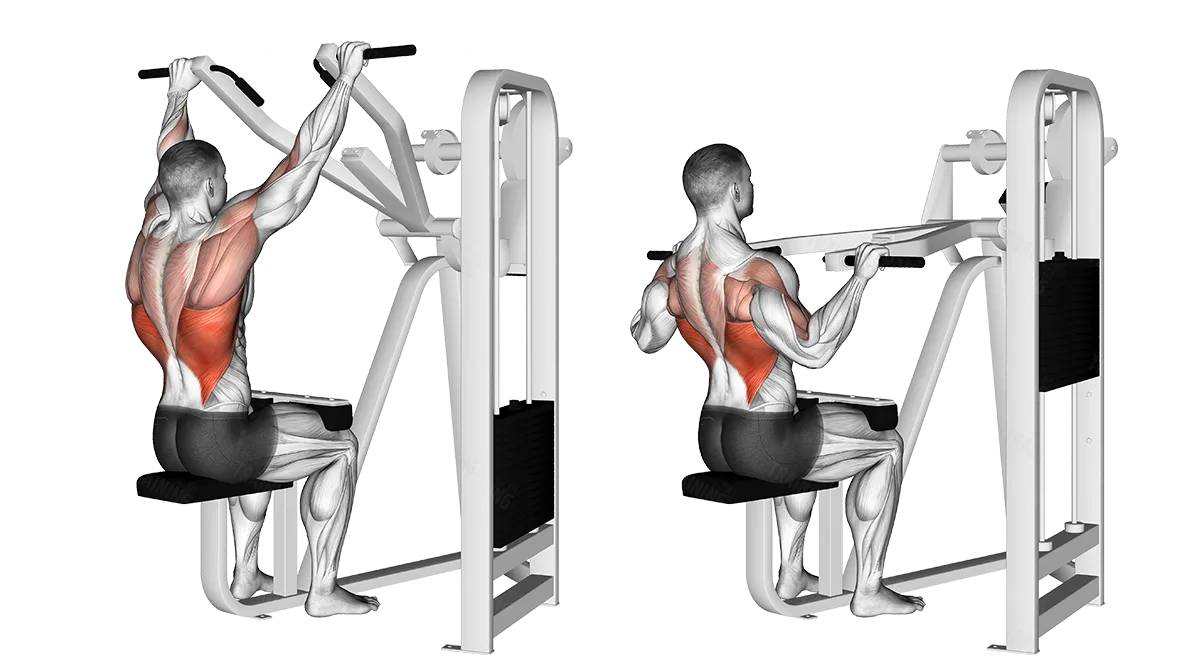
Common Technique Variations and What They Target
- Neutral-Grip Machine Lat Pulldown (Best for Lower Lats)
Using parallel handles encourages elbows to stay tucked.
This maximizes the “V-taper” look.
- Wide-Grip Machine Pulldown (Upper/Outer Lat Width)
More flared elbows = more upper-lat and teres involvement.
Not as strong as neutral grip, but great for back width.
- Independent Arm Handles (Best for Symmetry)
Many plate-loaded machines use separate lever arms.
This:
- fixes imbalances
- improves lat mind-muscle connection
- allows a slight unilateral pullback for even deeper contraction
- Underhand-Grip Machine Pulldown
Not always available, but if your machine has it:
- better stretch
- strong lower-lat involvement
- slightly more biceps
Advanced Cues for Maximum Lat Recruitment
- “Drive your elbows into your back pockets.”
This shifts effort away from the upper back and straight into the lower lats.
- “Soften your grip.”
Death-gripping the handles increases biceps involvement.
Use straps if needed.
- “Keep your chest tall.”
Helps maintain scapular depression and lat tension.
- “Pull from the armpits.”
An elite cue used by high-level bodybuilders.
- “Ribs down during the concentric.”
Prevents excessive arching, which shifts tension to the upper back.
Programming the Machine Lat Pulldown
Best rep range:
- 8–15 reps for hypertrophy
- 12–20 reps for “lat feel”
- 6–8 reps only if the machine is stable and heavy-duty
Ideal for:
- Warm-up sets for lat-focused back days
- Mid-session primary hypertrophy sets
- Finisher sets using lighter weight and slow tempo
Progression approach:
Because the movement is stable and linear, the Machine Lat Pulldown is a great pick for:
- double progression
- load progression
- microloading
- tempo progression
- partial reps at end-of-set

Where This Exercise Fits in a Training Session
Option A: Primary width builder (after heavy rows or pulldowns)
- Barbell Row
- Weighted Pull-Up
- Machine Lat Pulldown
- Cable Row
Option B: First movement (for beginners or those needing lat activation)
- Machine Lat Pulldown
- Dumbbell Row
- Lat Pulldown or Straight-Arm Pulldown
- Machine Row
Option C: End-of-workout finisher
3–4 sets of 12–20 with slow eccentrics.
Common Mistakes (and How to Fix Them)
- Shrugging the shoulders upward
→ This turns the movement into an upper-back exercise.
Fix: Think “shoulders away from ears.”
- Leaning too far back
→ Turns the exercise into a row.
Fix: Keep torso angle at 5–10°.
- Pulling with the biceps
→ A classic beginner mistake.
Fix: Lead with elbows, not hands.
- Letting tension drop at the top
→ No stretch = poor stimulus.
Fix: Control the negative and pause in full stretch.
- Half reps
→ Usually caused by too much weight.
Fix: Drop load by 10–20% and maximize ROM.
How to Use This Exercise for Maximum Hypertrophy
Strategy 1: Stretch-focused sets
4 seconds on the eccentric
1 second pause at stretch
8–12 reps
Huge lower-lat stimulus.
Strategy 2: One-arm focus on independent handle machines
This corrects lat imbalances and improves MMC.
Strategy 3: High-rep burn sets (15–20+)
Great way to finish a workout and build detail.
Strategy 4: Mechanical drop sets
Example:
Wide grip → neutral grip → underhand
No rest between grip changes.
Strategy 5: Post-exhaustion superset
Machine pulldown → Straight-arm pulldown
This crushes the lats through long-range + short-range fatigue.
Who Should Prioritize the Machine Lat Pulldown?
Beginners
Perfect for learning proper lat activation.
Intermediates
Fantastic progression tool thanks to stable movement pattern.
Advanced lifters
Lets them safely push to RIR 0–1 without form breakdown.
Physique athletes
One of the best machine choices for widening the V-taper.
Anyone who struggles to feel their lats
This is usually the FIRST pulldown variation that truly “clicks.”
Summary: Why the Machine Lat Pulldown Belongs in Every Back Program
The Machine Lat Pulldown provides unmatched tension consistency, deep lat stretch, excellent contraction, and the ability to overload safely.
Its fixed path removes momentum and lets bodybuilders isolate the exact lat fibers they want to grow.
Whether you use a plate-loaded Hammer Strength setup or a traditional weight-stack machine, the fundamentals remain the same: drive the elbows down, stretch fully, control the negative, and grow your lats like never before.
For lifters chasing a bigger, wider, more three-dimensional back, this is a must-have movement.