Long Lever Plank
Foundational Anti-Extension Builder for Deep Core Strength, Rib-Pelvis Control, and Bracing Integrity
The Long Lever Plank is one of the most effective—and most misunderstood—anti-extension core exercises available.
On the surface, it looks like a simple plank variation. In reality, it is a precision-based leverage exercise that exposes weaknesses in core bracing, rib–pelvis stacking, and deep abdominal control more honestly than almost any dynamic movement.
Where standard planks often become endurance tests dominated by shoulders and lower back tolerance, the Long Lever Plank shifts the challenge directly onto the anterior core’s ability to resist lumbar extension under increasing lever length.
By moving the elbows farther away from the body, torque on the spine increases dramatically, forcing the abs to work harder without adding load or movement.
From a programming standpoint, this makes the Long Lever Plank indispensable. It acts as a bridge between basic planking and advanced anti-extension work like rollouts, while also standing on its own as a legitimate hypertrophy-capable isometric when tension and progression are applied correctly.
For lifters who struggle to maintain spinal neutrality under load—or who “feel” their lower back more than their abs during rollouts—the Long Lever Plank is often the missing link.
Primary Muscles Worked
The Long Lever Plank targets muscles responsible for preventing spinal extension and maintaining trunk stiffness under leverage.
Rectus Abdominis
The rectus abdominis is the primary anti-extension muscle in this movement. As lever length increases, the rectus must contract isometrically to prevent the ribcage from flaring and the lumbar spine from arching. This sustained, high-tension contraction contributes meaningfully to both strength and hypertrophy.
Transverse Abdominis (TVA)
The TVA plays a crucial stabilizing role by maintaining intra-abdominal pressure and reinforcing spinal alignment. Without effective TVA engagement, the pelvis tilts anteriorly and tension shifts into the lower back.
Internal and External Obliques
Although not the main focus, the obliques assist by stabilizing the ribcage and preventing subtle rotation or lateral drift as fatigue sets in.
Secondary Muscles and Stabilizers
Several additional muscle groups contribute to maintaining position:
- Erector Spinae – Maintain spinal alignment under tension
- Gluteus Maximus – Posterior pelvic control
- Serratus Anterior – Scapular stability and shoulder positioning
- Anterior Deltoids – Support upper-body load
This integrated demand reinforces why the Long Lever Plank is far more than a “beginner” core drill.

What the Long Lever Plank Is Best For
The Long Lever Plank excels in roles that many dynamic ab exercises cannot fill.
- Teaching rib-pelvis stacking
- Developing true anti-extension capacity
- Exposing bracing weaknesses
- Preparing the core for rollouts and heavy lifts
- Building time-under-tension hypertrophy in the abs
It is especially valuable for lifters who rush into advanced core work without mastering positional control.
Why Lever Length Changes Everything
In core training, leverage often matters more than movement.
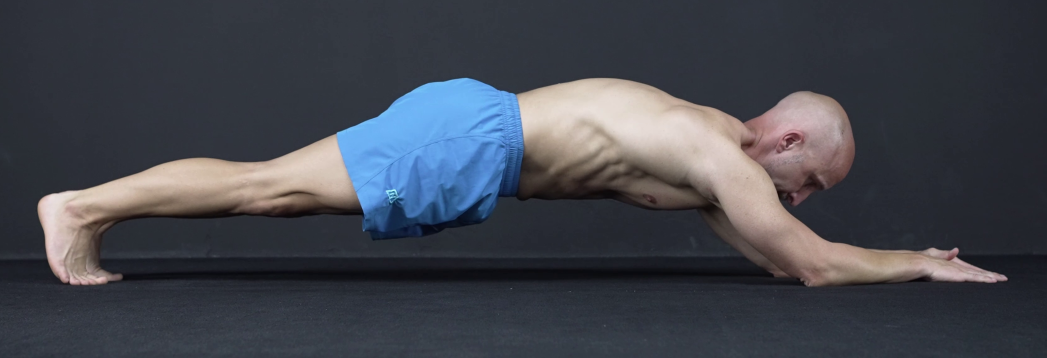
By extending the arms farther forward, the distance between the load (your bodyweight) and the pivot point (your lumbar spine) increases. This creates significantly more extension torque without adding external resistance.
The result:
- More abdominal tension
- Less ability to “cheat” with the lower back
- Greater demand on deep stabilizers
This is why a properly executed Long Lever Plank can feel harder than many weighted ab exercises.
Proper Long Lever Plank Setup
Begin in a forearm plank position on the floor.
From there, slowly walk your elbows forward so they are positioned slightly in front of your shoulders. The exact distance will depend on your strength level—longer is harder, but only if alignment is maintained.
Your feet should be set about hip-width apart. Wider stance increases stability; narrower stance increases difficulty.
Before lifting into position, set your alignment:
- Stack your ribcage over your pelvis
- Lightly tuck the pelvis
- Squeeze the glutes
- Brace the abs as if preparing for a heavy lift
Only once tension is established should you lift into the plank.
Execution: Step-by-Step Breakdown
With elbows extended forward, press your forearms into the floor and lift your body into a straight line from head to heels.
Maintain a neutral neck and keep your gaze slightly ahead of your hands.
Actively exhale to pull the ribcage down, then breathe shallowly through the nose while maintaining tension.
The goal is not to survive the hold—it is to actively resist extension for the entire duration.
When alignment begins to degrade, the set is over.
Key Coaching Cues
- “Pull your ribs down”
- “Crush your abs, not your lower back”
- “Glutes on, spine long”
- “Push the floor away”
- “End the set before you lose position”
These cues reinforce intent and prevent endurance-based compensation.
Common Mistakes and How to Fix Them
Lower Back Arching
This is the most common failure. Shorten the lever length and reinforce rib-pelvis stacking.
Overreaching the Arms
Too much leverage too soon leads to breakdown. Progress gradually.
Passive Holding
If you’re just “hanging out” in the plank, tension is too low. Actively brace and shorten the set.
Neck Strain
Often caused by looking too far forward. Keep the neck neutral.
Long Lever Plank for Ab Hypertrophy
Despite being isometric, the Long Lever Plank can contribute meaningfully to hypertrophy when treated correctly.
Hypertrophy drivers here include:
- High tension
- Extended time under tension
- Progressive leverage
To bias growth:
- Use challenging lever lengths
- Keep sets in the 20–45 second range
- Perform multiple quality sets
- End sets based on form, not time targets
When performed with intent, the abs experience sustained mechanical tension comparable to slow eccentric work.
Programming Recommendations
Hold Duration:
- 20–45 seconds
Sets:
- 2–4
Rest:
- 45–75 seconds
Place the Long Lever Plank:
- Before dynamic anti-extension work as a primer
- Or after heavy lifts as a focused core strength movement
It pairs exceptionally well with rollouts and dead bugs.
Progressions and Regressions
Regressions
- Standard forearm plank
- Shortened lever plank
- Wider foot stance
Progressions
- Longer lever length
- Narrow foot stance
- Long Lever Plank with shoulder taps
- Weighted Long Lever Plank (plate on upper back)
Progress only when spinal position remains uncompromised.
Who Should Use the Long Lever Plank
This exercise is ideal for:
- Lifters building anti-extension capacity
- Individuals struggling with rollouts
- Athletes needing bracing endurance
- Anyone prioritizing spinal integrity under load
Those with acute lumbar pain should master basic planking first.
Final Thoughts
The Long Lever Plank is a deceptively powerful anti-extension exercise that rewards precision over ego. It teaches the core to do what it is designed to do: resist movement, maintain alignment, and transmit force efficiently.
When mastered, it makes every rollout, deadlift, and overhead press safer and stronger.
Treat it with the same respect you give your compound lifts. Control the leverage, own the position, and let tension—not time—dictate progression.