The Kneeling Single-Arm Cable Lat Pulldown: The Ultimate Lat-Isolation Exercise for Sweep, Symmetry & Full-Range Growth
The Kneeling Single-Arm Cable Lat Pulldown might be the most biomechanically perfect lat exercise you’re not doing. While pulldowns, rows, and machines build tremendous back mass, this movement isolates the lat in a way almost nothing else can.
It’s the purest combination of stretch, direct line of pull, unilateral control, and full-range lat shortening you can get without a dedicated lat-isolation machine.
If you want exaggerated lat sweep, balanced development, and a deeper contraction than straight-bar pulldowns or rows can provide, this lift belongs in your routine.
This explainer will show you how to master it like a bodybuilder, avoid common mistakes, integrate it into your programming, and use it to unlock a thicker, wider, more symmetrical back.
Why the Kneeling Single-Arm Cable Lat Pulldown Is So Effective
This exercise is built around a biomechanical truth:
The lats pull downward AND inward — not in a straight vertical line.
Most pulldown machines and bars don’t follow this natural path. Even fixed machines force your hands and elbows into a linear track that rarely matches your individual shoulder structure.
The Kneeling Cable Lat Pulldown allows you to move freely in a natural arcing motion:
- elbow travels in (adduction)
- arm travels down (extension)
- shoulder remains stable
- lat fibers shorten completely
- scapula depresses naturally
Because you’re kneeling, you’re also pulling from a lower angle, which allows the lat to extend even further at the top — giving this movement the longest possible lat range of motion outside of a pullover.
That’s why bodybuilders use it for:
- lat sweep development
- back symmetry
- isolated lower-lat emphasis
- building the ability to “pull with your lat” on rows/pulldowns
- fixing strength imbalances
- enhanced mind–muscle connection
This is not a “bro trick” — it’s backed by biomechanics.
Muscles Worked: More Than Just Lats
This is primarily a lat exercise, but several supporting muscles contribute to the movement.
Primary Muscle: Latissimus Dorsi
The kneeling position maximizes stretch.
The single-arm path maximizes contraction.
The cable angle maximizes tension.
It hits:
- lower lats (strongest emphasis)
- mid lats
- teres major (deep armpit muscle)
Secondary Muscles
Although the lats do 80–90% of the work if performed correctly, these muscles also contribute:
Teres Major
Big-time involvement in adduction-heavy patterns.
Lower & Mid Traps
Help with scapular depression.
Rhomboids
Assist in stability and the finishing part of the pull.
Rear Delts
Assist slightly in humeral extension.
Biceps & Brachialis
Minimal, as long as you keep your elbow traveling inward and down — not curling forward.
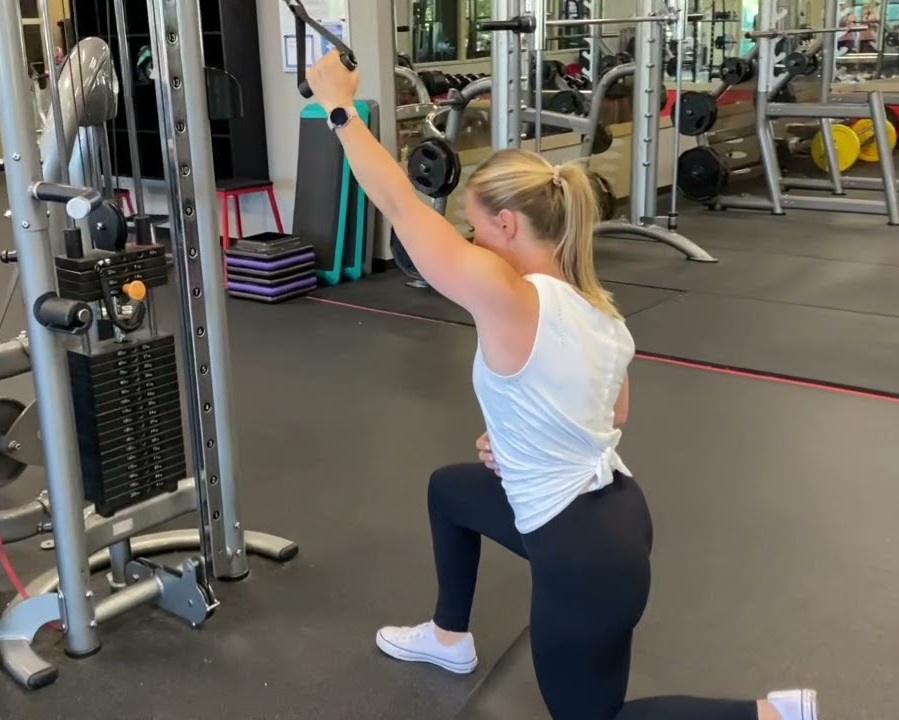
How to Perform the Kneeling Single-Arm Cable Lat Pulldown Like a Bodybuilder
This is a precision movement. Small adjustments make huge differences in lat activation.
Step 1 — Set Up the Cable Height
You want the cable anchored HIGH — ideally near the top of the machine.
If the pulley is too low:
- You lose the overhead stretch
- The angle becomes too row-like
Top-of-the-stack is ideal.
Step 2 — Kneel in Line With the Cable
Place your kneeling position so your working arm is directly in line with the pulley.
Tips:
- Sit back slightly
- Keep your hips behind your knee
- Angle your torso forward 5–15 degrees
This gives the lat a full overhead stretch.
Step 3 — Grab the Handle With a Neutral Grip
A D-handle works perfectly.
Neutral grip allows:
- smoother shoulder path
- minimal biceps involvement
- more natural lat activation
Step 4 — Start in a Full Lat Stretch
Let the arm travel overhead.
Let the scapula upwardly rotate.
Feel your lat “open up.”
Your lower lat should feel like it’s lengthening — almost like a pullover stretch.
Step 5 — Initiate the Pull With Your Lat
This is EVERYTHING.
Imagine:
- “Drive elbow down and in toward your hip.”
- “Drag your elbow into your back pocket.”
- “Pull with your armpit.”
Your biceps should feel like stabilizers, not prime movers.
Step 6 — Get a Deep Contraction
At the bottom:
- your hand ends up near your ribcage or hip
- elbow tucked tight
- shoulder down and stable
- lat fully shortened
Hold the squeeze for a 1-second peak.
This is the part that grows the lat — don’t skip it.
Step 7 — Slow, Controlled Eccentric
Let the cable pull your arm upward slowly.
Don’t relax the shoulder into a shrug.
Think:
- “Reach long while keeping tension.”
Advanced Cues for Maximum Lat Activation
These are the cues bodybuilders use to turn this from a simple pulldown into a lat-growth machine.
Cue #1 — “Elbow into the hip, not behind you.”
If the elbow drifts backward, the rear delts and upper back take over.
Cue #2 — “Shoulder stays down, even at the top.”
Let it rotate upward — but never allow elevation.
Cue #3 — “Pull your ribcage away from the cable.”
A slight lean creates more lat stretch.
Cue #4 — “Stop curling. Drive.”
If your hand moves first, you’re curling.
If your elbow moves first, you’re activating your lats.
Cue #5 — “Use a soft handle grip.”
Don’t death-grip the handle.
A looser grip decreases biceps dominance.
This exercise is all about precision.
Common Mistakes That Kill Lat Activation
❌ Mistake 1 — Bending the elbow too early
This turns the exercise into an awkward biceps curl.
❌ Mistake 2 — Leaning back excessively
Your torso should stay relatively still.
❌ Mistake 3 — Not achieving a full overhead stretch
This is the entire point of the kneeling angle.
❌ Mistake 4 — Pulling the elbow behind you
Leads to rear delt dominance.
❌ Mistake 5 — Using too much weight
Form > ego.
This is a precision lat movement.
Programming the Kneeling Single-Arm Cable Lat Pulldown
Because this is a high-precision isolation movement, it’s best used strategically.
For Lat Hypertrophy
3–4 sets
10–15 reps
1–2 sec peak contraction
Control every inch
For Lat Activation Before Heavy Rows
2 light sets
12–15 reps
Focus on MMC
Use as a primer
As a Finisher
2–3 sets
15–20 reps
Short rest (45–60 sec)
Constant tension
For Symmetry and Imbalances
Start with the weaker side
Match the reps on the stronger side
Avoid going heavier on the dominant arm
Variations You Can Use
Kneeling Low-Cable Lat Pulldown (Lean Away)
Leaning laterally increases lower-lat stretch.
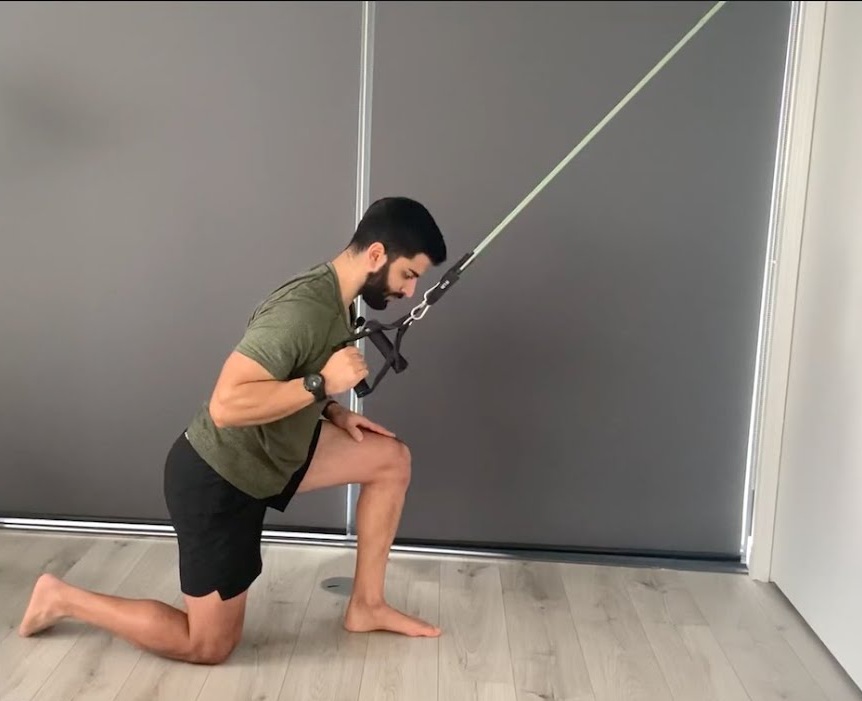
Half-Kneeling Cable Pulldown
One knee down, one foot forward — improves stability.
Kneeling Cable Pulldown With Rope
Allows wrist rotation — better peak contraction.
Kneeling Pulldown From a Pullover Angle
Move farther back to create more shoulder-extension bias.
Each variation emphasizes a different part of the lat.
How It Fits Into Your Back Day
The Kneeling Single-Arm Cable Lat Pulldown is excellent:
After a heavy compound (rows or pulldowns)
It deepens fatigue directly in the lats.
Before a heavy compound
Perfect for improving mind–muscle connection.
As a mid-workout lat stretcher
Great between row variations.
As a finisher
Because the stretch + contraction combo is phenomenal.
A sample placement:
- Barbell row / T-bar row
- Diverging Lat Pulldown
- Kneeling Single-Arm Cable Lat Pulldown
- Machine row
- Rear delts
Or:
- Straight-arm pulldown
- Kneeling Single-Arm Cable Lat Pulldown
- One-arm dumbbell row
- Seal row
- Face pulls
It’s extremely versatile.
Who Should Prioritize This Exercise?
Bodybuilders
Especially those with:
- weak lat sweep
- difficulty feeling lats
- biceps dominance
- asymmetrical back development
Physique & Classic Physique Competitors
This movement helps create that dramatic V-taper.
Beginners
It teaches proper lat recruitment early.
Advanced Lifters
Exceptional as an accessory during high-volume phases.
Practical Takeaways
- This is one of the BEST isolation exercises for the lats
- It builds sweep, symmetry, and mind–muscle connection
- Kneeling provides greater stretch than seated pulldowns
- Single-arm path matches natural lat mechanics
- Works incredibly well as a primer, builder, or finisher
- Precise execution is more important than heavy loads