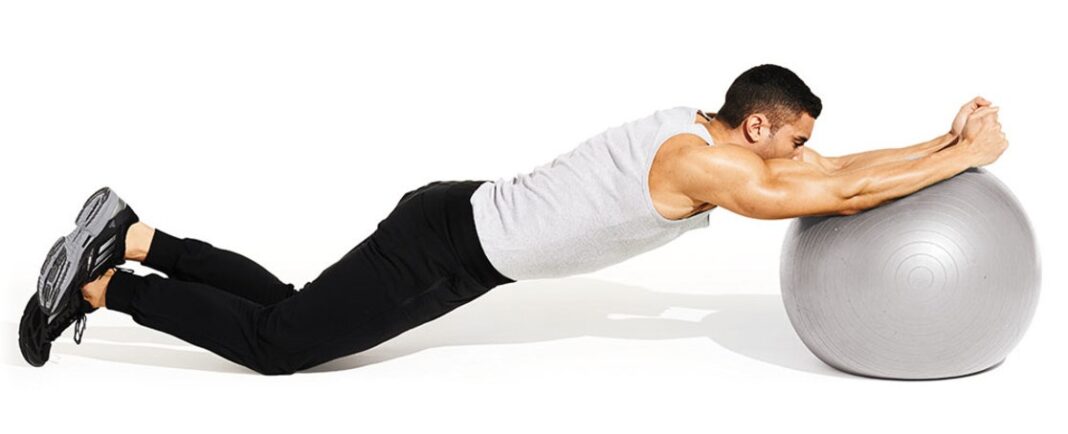
Hollow Body Hold
Pure Anti-Extension Core Builder for Anterior Chain Strength, Bracing Control, and Total-Body Tension
The Hollow Body Hold is one of the most deceptively difficult core exercises in existence. It involves no movement, no external load, and no visible complexity—yet it exposes weaknesses in anti-extension strength, rib–pelvis control, and total-body tension faster than almost any other drill.
Originating from gymnastics training, the Hollow Body Hold teaches the body to maintain a globally flexed, anti-extended position under sustained tension.
Unlike rollouts or planks, where leverage or instability drives difficulty, the hollow position demands that the core actively pull the body into alignment and hold it there without external feedback.
For muscle-building athletes, this makes the Hollow Body Hold uniquely valuable. It strips core training down to first principles: can you keep your lower back flat, ribs down, and pelvis controlled while your limbs extend away from your center of mass?
If the answer is no, every heavy lift you perform leaks force through the spine. If the answer is yes, everything from squats to overhead presses becomes more efficient and resilient.
Primary Muscles Worked
The Hollow Body Hold targets muscles responsible for preventing spinal extension and maintaining anterior chain tension.
Rectus Abdominis
The rectus abdominis is the primary driver. It works isometrically to posteriorly tilt the pelvis and keep the lower back pressed into the floor. Unlike crunch-based movements, this tension is sustained and uncompromising.
Transverse Abdominis (TVA)
The TVA plays a critical stabilizing role by maintaining intra-abdominal pressure and reinforcing the hollow position. Without TVA engagement, the ribcage flares and the lower back arches.
Internal and External Obliques
The obliques assist by stabilizing the ribcage and pelvis, preventing subtle rotation or lateral shifting as fatigue accumulates.
Secondary Muscles and Stabilizers
Although the hollow hold is core-dominant, maintaining full-body tension recruits several additional muscles:
- Hip Flexors – Maintain leg position against gravity
- Quadriceps – Keep the knees extended
- Serratus Anterior – Stabilizes the scapulae
- Latissimus Dorsi – Contributes to trunk stiffness when arms are extended
- Gluteus Maximus – Assists posterior pelvic tilt
This whole-body involvement is why the exercise feels far harder than its static appearance suggests.

What the Hollow Body Hold Is Best For
The Hollow Body Hold excels in areas where many anti-extension exercises fall short.
- Teaching true posterior pelvic tilt
- Reinforcing rib–pelvis stacking
- Developing anterior chain endurance
- Improving bracing for compound lifts
- Preparing the body for advanced gymnastic and rollout work
It is particularly valuable for lifters who rely heavily on external resistance but lack internal positional control.
Why Floor Contact Changes the Demand
Unlike planks or rollouts, the hollow body position provides immediate positional feedback. The floor tells the truth.
If the lower back lifts even slightly, tension is lost. This removes ambiguity and forces precise execution.
Because gravity acts directly on the extended limbs, lever length becomes the primary progression variable. The farther the arms and legs extend, the greater the anti-extension demand on the core.
Proper Hollow Body Hold Setup
Begin by lying flat on your back with arms extended overhead and legs straight.
Before lifting anything, establish your hollow position:
- Exhale fully to pull the ribs down
- Posteriorly tilt the pelvis
- Press the entire lower back into the floor
- Brace the abs hard
This position must be established before the limbs leave the ground.
Execution: Step-by-Step Breakdown
Once your lower back is firmly pressed into the floor, lift your shoulders and arms slightly off the ground.
Next, lift your legs together, keeping them straight and low to the floor. The lower the legs, the harder the exercise—but only if spinal position is maintained.
Your body should form a shallow “banana” shape, with the lower back glued to the floor.
Hold this position while breathing shallowly and under control. The moment the lower back lifts or ribs flare, the set is over.
Key Coaching Cues
- “Crush your lower back into the floor”
- “Ribs down, abs tight”
- “Long body, tight core”
- “Legs low only if you can control them”
- “End the set early, not sloppy”
These cues emphasize quality over ego.
Common Mistakes and How to Fix Them
Lower Back Arching
This is the defining failure. Shorten lever length by bending knees or raising legs.
Rib Flare
Usually caused by poor exhalation. Focus on long, controlled exhales to re-stack the ribcage.
Neck Strain
Often caused by over-lifting the head. Keep the neck neutral and shoulders just off the floor.
Holding the Breath
Breath-holding limits endurance. Practice controlled breathing without losing tension.
Hollow Body Hold for Ab Hypertrophy
Although isometric, the Hollow Body Hold can contribute to hypertrophy through sustained high tension and extended time under load.
To bias growth:
- Use challenging lever positions
- Keep sets in the 20–45 second range
- Accumulate multiple quality sets
- Progress lever length before adding external load
When performed with intent, the rectus abdominis experiences constant mechanical tension comparable to slow eccentrics.
Programming Recommendations
Hold Duration:
- 15–45 seconds (advanced athletes may exceed this, but quality matters more than time)
Sets:
- 2–4
Rest:
- 45–75 seconds
The Hollow Body Hold works best:
- As a foundation exercise early in a program
- Or as a finisher after dynamic anti-extension work
It pairs exceptionally well with rollouts and body saws.
Progressions and Regressions
Regressions
- Tuck hollow (knees bent)
- One leg extended, one bent
- Arms by sides
Progressions
- Straight legs held lower
- Arms fully overhead
- Weighted hollow hold (light plate overhead)
- Hollow rocks (advanced dynamic progression)
Progress only when lower-back contact is never compromised.
Who Should Use the Hollow Body Hold
Ideal for:
- Lifters building anti-extension fundamentals
- Athletes seeking gymnastics-grade core control
- Individuals improving bracing mechanics
- Anyone preparing for advanced rollout variations
Those with acute lumbar pain should regress until pelvic control is established.
Final Thoughts
The Hollow Body Hold is the most honest anti-extension exercise you can perform. It demands precision, discipline, and total-body engagement—qualities that directly translate to safer, stronger lifting.
If you can own the hollow position, every rollout, carry, and heavy lift becomes more efficient.
This is not an exercise to rush or outgrow. Mastery here pays dividends everywhere else.