
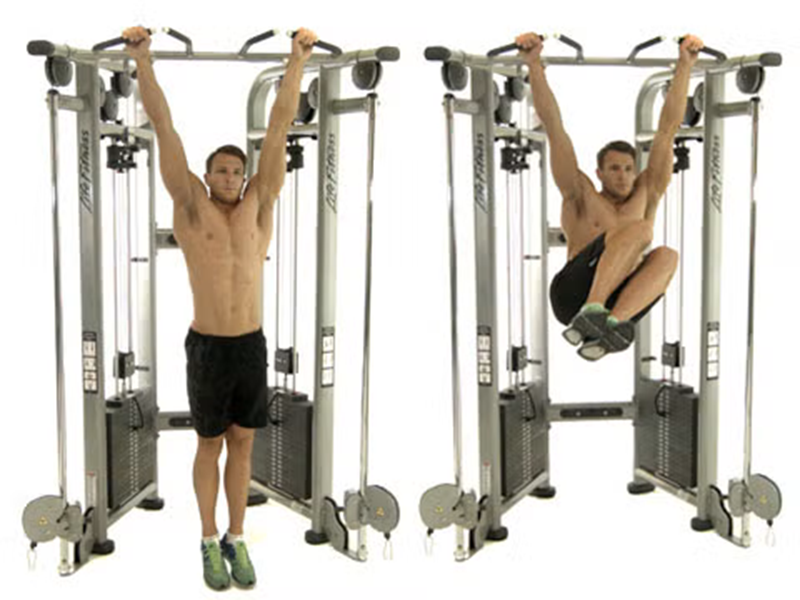
Hanging Oblique Knee Raise
Unilateral Core Control for Visible Oblique Development & Athletic Stability
The Hanging Oblique Knee Raise is one of the most underrated yet visually powerful oblique builders in bodybuilding.
While standard hanging leg raises are known for carving out the lower abs, adding a rotational or side-biased knee raise shifts the stimulus directly onto the internal and external obliques, the muscles responsible for waist detail, trunk rotation, and torso stability.
From a physique perspective, well-developed obliques create the sharp “frame” around the abs — enhancing separation, taper, and depth without thickening the waist when trained correctly.
From a performance standpoint, this movement builds anti-extension, anti-sway, and rotational control, making it invaluable for compound lifts and athletic strength.
This exercise sits at the intersection of aesthetic core training and functional strength, making it a staple for advanced lifters who want visible obliques and rock-solid midline control.
Muscles Worked
Primary Muscles
- External Obliques – Visible side abs responsible for trunk rotation and lateral flexion
- Internal Obliques – Deeper stabilizers that control rotation and pelvic alignment
Secondary Muscles
- Lower Rectus Abdominis – Especially active during knee elevation
- Hip Flexors (Iliopsoas) – Assist in knee lift (managed through control)
- Transverse Abdominis – Bracing and spinal stabilization
- Forearms & Grip – Isometric grip strength from hanging
👉 Bodybuilder’s Insight:
Unlike weighted side bends, hanging oblique knee raises emphasize control and contraction, not load. This allows you to build sharp oblique definition without adding unnecessary thickness to the waist.
Why the Hanging Oblique Knee Raise Deserves a Place in Your Program
- Builds Visible Oblique Detail Without Waist Thickening
Because the resistance is bodyweight and gravity-based, this movement prioritizes muscle activation and time under tension, not spinal compression. That’s ideal for physique athletes who want lines, not blockiness.
- Forces Anti-Swing Core Control
Any momentum immediately reduces effectiveness. The hanging position exposes weak links in:
- Pelvic control
- Rotational strength
- Core-to-limb coordination
- Improves Total Core Integration
This isn’t just an oblique exercise — it teaches your abs, obliques, and deep core to work together while the body is suspended. That carries over directly to:
- Squats
- Deadlifts
- Overhead pressing
- Loaded carries
- Scales With Skill, Not Just Strength
Progression comes from:
- Slower tempo
- Greater range of motion
- Cleaner unilateral control
Not just adding weight.
Proper Execution: Step-by-Step
Setup
- Hang from a pull-up bar using an overhand or neutral grip
- Engage your lats slightly to stabilize the shoulders
- Brace your core and posteriorly tilt your pelvis (flatten the lower back)
- Legs start straight or slightly bent, feet together
Execution
- Initiate the movement by pulling your knees up and slightly toward one side
- Think “rib cage down, hips up” — not swinging the legs
- At the top, pause briefly and squeeze the obliques on the working side
- Lower the knees slowly back to the starting position under full control
- Alternate sides or complete all reps on one side before switching
Breathing
- Exhale as you raise the knees
- Inhale slowly during the controlled descent

Common Mistakes (And How to Fix Them)
❌ Excessive Swinging
Fix: Start each rep from a dead hang. If you can’t control momentum, regress to bent-knee raises or captain’s chair variations.
❌ Turning It Into a Hip Flexor Exercise
Fix: Posterior pelvic tilt is key. If your lower back arches, the hip flexors take over.
❌ Rushing the Reps
Fix: Slow the eccentric to 3–4 seconds. Obliques respond best to control, not speed.
❌ Twisting the Torso Instead of the Hips
Fix: Keep shoulders relatively square. The rotation should come from the pelvis and rib cage working together.
Programming for Hypertrophy & Definition
Rep Ranges
- 8–12 reps per side (controlled and strict)
- Advanced lifters may use 10–15 reps per side with slower tempo
Sets
- 3–4 working sets
Tempo
- 1–2 seconds up
- 3–4 seconds down
- Optional 1-second pause at peak contraction
Rest Periods
- 60–90 seconds between sets
Progression Strategies
Instead of adding weight too early, progress by:
- Increasing Range of Motion
- Raise knees higher toward the ribs
- Slowing the Eccentric
- Longer negatives = more oblique tension
- Pausing at the Top
- 2–3 second holds light up the obliques
- Straight-Leg Oblique Raises (Advanced)
- Dramatically increases difficulty and leverage
👉 Rule of Thumb:
If you’re swinging, you’re regressing — not progressing
Best Placement in Your Training Split
Option 1: Dedicated Core Day
- Pair with Cable Woodchops and Decline Sit-Ups
Option 2: End of Pull Day
- Grip already fatigued = higher core demand
Option 3: After Lower Body Training
- Helps reinforce pelvic control after squats or deadlifts
Sample Oblique-Focused Finisher
- Hanging Oblique Knee Raise — 3×10–12/side
- Cable Woodchop — 3×12–15/side
- Side Plank — 2×30–45 sec/side
Who Should Use This Exercise?
Beginners:
- Start with captain’s chair oblique raises or bent-knee variations
Intermediate Lifters:
- Perfect strict hanging knee raises with minimal swing
Advanced Lifters / Bodybuilders:
- Slow tempo, long pauses, straight-leg variations
Final Takeaway
The Hanging Oblique Knee Raise is one of the cleanest ways to build visible, functional obliques without compromising waist aesthetics. It rewards control, precision, and patience — qualities that separate elite physiques from average ones.
If you want abs that don’t just look good head-on but pop from every angle, this exercise deserves a permanent spot in your oblique training arsenal.


