Dumbbell Pullover — The Deep-Stretch Lat Builder for Expansion, Sweep, and Upper-Body Power
A Classic Bodybuilding Movement for Lats, Chest, and Ribcage Development
The Dumbbell Pullover is one of bodybuilding’s most legendary movements. For decades, physique icons like Arnold Schwarzenegger, Frank Zane, and Franco Columbu used pullovers not only as a lat and chest builder, but as a tool for ribcage “expansion,” serratus development, and deep upper-body mobility.
While we now understand that true ribcage expansion is mostly limited by genetics and age, the pullover remains one of the most biomechanically unique and productive movements for developing the lats, serratus anterior, and upper chest — all while delivering a stretch stimulus that is unmatched by nearly any other back exercise.
The long-range resistance curve, the enormous stretch across the lats, the ability to overload the shoulder extension pattern, and the stability provided by a bench make the Pullover a hybrid between a back and chest exercise. For physique-focused lifters, it fills a gap that rows and pulldowns simply cannot.
This tutorial breaks down everything from correct technique to variations, programming, common mistakes, and advanced bodybuilding strategies for maximizing growth.
Muscles Worked
Primary Targets
- Latissimus dorsi (especially the long head)
- Serratus anterior
Secondary Muscles
- Teres major
- Lower chest (sternal fibers depending on arm path)
- Intercostals
- Triceps long head (as a stabilizer)
- Rhomboids and lower traps (light stabilizing)
The Dumbbell Pullover is rare because it trains the lats in shoulder extension, not elbow flexion — meaning the biceps are almost completely removed from the movement. Few exercises allow this kind of isolation.
Why Bodybuilders Use the Dumbbell Pullover
✔ Unmatched Lat Stretch
The main driver of hypertrophy for the lats is stretch-mediated tension. The Pullover places the lats under extreme stretch at the top of the movement, loading the long head through its full length.
✔ Unique Movement Pattern
Most back exercises involve pulling the elbow down or back. The Pullover trains a completely different pattern:
Shoulder extension while the arm stays straight.
This hits the lats differently from rows or pulldowns, providing complementary growth.
✔ Serratus & Upper Body Aesthetics
Well-developed serratus muscles create the iconic “shark gill” look on stage. Pullovers train these fibers more directly than almost any other resistance exercise.
✔ Pairs Perfectly with Rows and Pulldowns
Because it doesn’t stress the biceps or mid-back, it won’t interfere with heavy compound back training. Instead, it fills the “long-range lat stretch” niche most programs lack.
✔ Chest + Lat Hybrid (Depending on Form)
A slight adjustment in torso angle or arm path can bias the movement toward either chest or lats. The version in this explainer is the lat-focused bodybuilding technique.
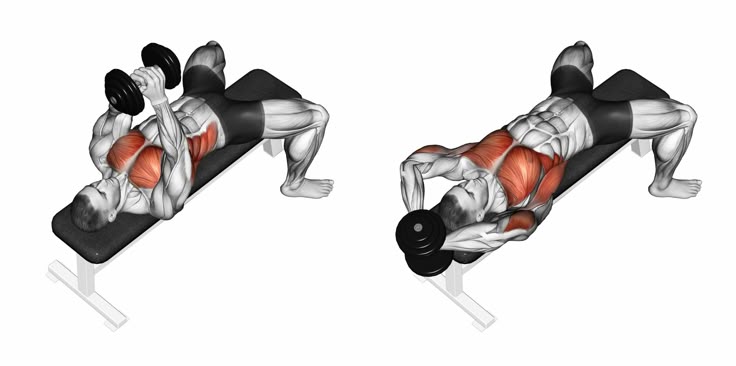
How to Perform the Dumbbell Pullover (Lat-Focused Technique)
- Setup
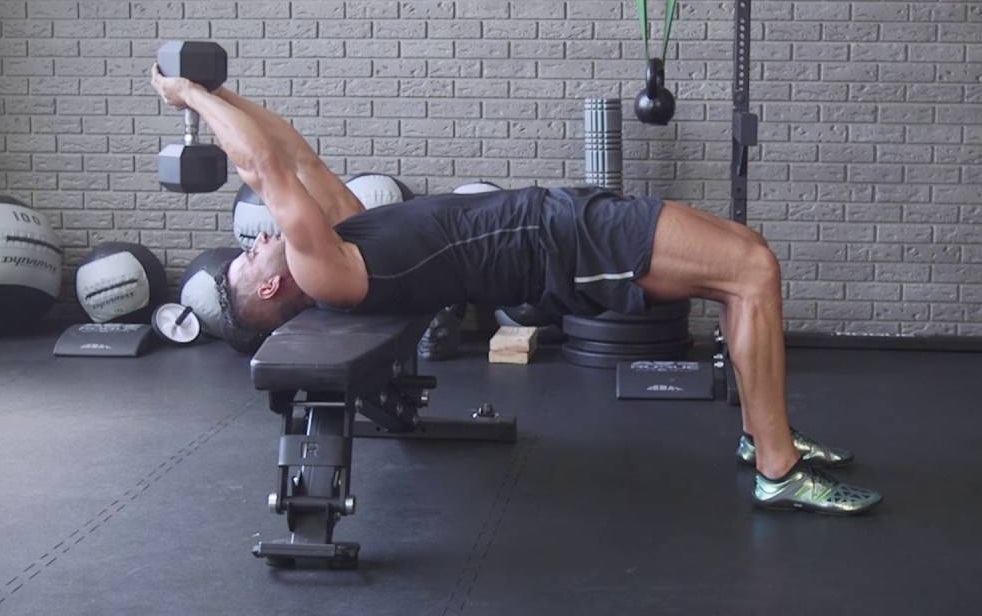
- Lie perpendicular on a flat bench with only your shoulders supported.
- Hips drop slightly below bench level for a deeper stretch.
- Feet planted firmly.
- Hold one dumbbell with both palms pressed against the inside plate.
Arm position:
- Elbows soft (10–15° bend) but fixed.
- Arms start extended above your chest.
- Initiate the Descent (The Stretch Phase)
- Slowly lower the dumbbell backward behind your head.
- Keep elbows locked in their soft bend — don’t let them flare out.
- Let your ribcage rise as the load stretches the lats.
- Stop when you feel a deep stretch but no shoulder discomfort.
This phase should take 3–4 seconds.
- Pull Through the Lats
- Think: “Drive the elbows down, not the hands.”
- Contract the lats to bring the dumbbell back over your chest.
- Maintain your elbow angle — do not tricep-press the weight.
- Peak Contraction
- Stop the dumbbell directly above your upper chest.
- Do not bring it too far forward; this loses lat tension.
- Squeeze the lats for 1 second.
- Repeat Under Full Control
Tempo recommendation:
- 3–4 sec eccentric
- 1 sec stretch hold
- Powerful but controlled concentric
Breathing
- Inhale deeply during the stretch (top/back of movement).
- Exhale as you pull the dumbbell toward the chest.
Deep breathing enhances ribcage lift, increasing the stretch effect.
Key Cues to Maximize Lat Recruitment
- “Arms are levers — elbows do the pulling.”
Your biceps should do nothing.
- “Ribcage up.”
This protects the shoulders and loads the lats.
- “Stretch, don’t drop.”
The descent should never be fast.
- “Don’t bend the elbows more at the bottom.”
That transfers tension away from the lats and onto triceps/chest.
- “Stop the dumbbell above your head, not your chest.”
Too far forward shifts tension to the pecs.
Common Mistakes (And How to Fix Them)
❌ Elbows bending during the eccentric
This makes it a lying triceps extension.
Fix: Lock the elbow angle from rep 1 to rep 12.
❌ Lowering the dumbbell too far behind the head
This can stress the shoulder joint.
Fix: Only go until the lats are maximally stretched without pain.
❌ Hips rising too high
This flattens the ribcage and kills the lat stretch.
Fix: Keep your hips slightly dropped.
❌ Rushing the movement
Pullovers demand slow, controlled reps.
Fix: 3–4 second negative, every set.
❌ Turning it into a chest exercise unintentionally
Bringing the dumbbell too far forward or flaring elbows shifts tension to the pecs.
Fix: End the rep with the dumbbell above the head, not the sternum.
Lat-Focused Variations
- Bent-Arm Pullover (Dumbbell or Barbell)
Allows heavier loading; good for intermediate lifters.
- Cable Pullover on Bench
Provides constant tension across the entire ROM.
- Machine Pullover
Classic Nautilus machine — the best biomechanical version ever designed.
- Decline Dumbbell Pullover
Enhances lower-lat stretch; great variation for advanced lifters.
Programming for Hypertrophy
Primary Muscle-Building Zone
- 3–4 sets
- 8–12 reps
- 3-sec eccentrics
- 1–2 reps shy of failure
Stretch-Focused Hypertrophy
- 3 sets
- 10–15 reps
- 2–3 second stretch pause
- Lighter weight, slow tempo
As a Finisher
- 2 sets
- 15–20 reps
- Continuous tension, no resting at top
Where the Dumbbell Pullover Fits in a Back Workout
Option 1 — Lat Emphasis Day
- Straight-Arm Pulldown
- Dumbbell Pullover
- Close-Grip Lat Pulldown
- One-Arm Machine Row
- Seated Cable Row
Option 2 — Upper-Body “Expansion” Day
- Incline Fly
- Dumbbell Pullover
- Wide-Grip Lat Pulldown
- Chest-Supported Row
Option 3 — After Heavy Rows
Place it after loading the lats with compounds for a stretch-based finisher.
Who Should Use This Exercise?
✔ Highly Recommended For:
- Bodybuilders shaping the lats and serratus
- Lifters wanting bigger upper backs and ribcage aesthetics
- Anyone lacking lat stretch in their program
- People who struggle with lat activation in standard pulldowns
- Intermediate and advanced lifters looking to diversify their lat training
✔ Great for Beginners When Taught Properly
The movement pattern is simple once you understand elbow positioning.
✘ Avoid or Modify If:
- You have shoulder impingement
- You lack overhead mobility
- You consistently lose elbow position
- You cannot control eccentric loading yet
Advanced Bodybuilding Tips
- Use Straps
Allows you to focus on the stretch without worrying about grip.
- Add a Deep 2–3 Second Stretch Pause
One of the greatest lat hypertrophy techniques available.
- Stop 3–4 Inches Before Full Vertical Lockout
Maintains lat tension and eliminates chest takeover.
- Superset With Straight-Arm Pulldowns
Increases metabolic stress and back detail.
- Use the Pullover as a Pre-Exhaust
Try performing it before heavy pulldowns to bias the lats further.
Final Thoughts: Why the Dumbbell Pullover Still Matters
The Dumbbell Pullover remains one of the most valuable lat developers in bodybuilding. It trains the lats through a massive range of motion, provides a hypertrophy-inducing stretch, develops the serratus, and works the body in a plane of motion that rows and pulldowns simply cannot replicate.
For bodybuilders, physique athletes, or anyone chasing a wider back with more dramatic lat sweep, the Pullover is an essential accessory movement. Use it correctly and consistently, and it will dramatically improve your back’s depth, aesthetics, and overall muscularity.