
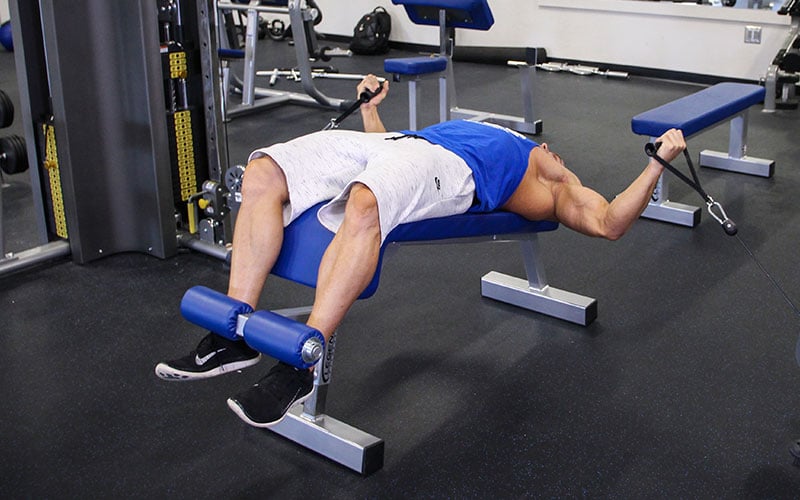
Decline Cable Fly (High-to-Low Cable Fly for Lower Chest Mass & Definition)
Introduction: Why the Decline Cable Fly Deserves a Place in Your Chest Training
If you’re building a complete chest — not just upper chest lines or mid-chest fullness — the lower pecs need direct attention. While movements like dips and decline presses build strength and mass, they don’t always deliver the full isolation and deep fiber stretch required for complete lower-chest development.
The Decline Cable Fly (also known as the High-to-Low Cable Fly) solves this problem perfectly. Because the cables come from above and pull downward on a sweeping arc, the resistance lines up almost perfectly with the fiber direction of the sternocostal (lower) pec fibers. That makes this an elite hypertrophy movement for:
- Lower pec mass
- Chest “shelf” shape
- Inner-lower pec definition
- Full chest tie-in to the serratus and upper abs
- Total chest aesthetics
If you want the lower chest to pop — the kind of development that looks impressive even in a relaxed posture — the Decline Cable Fly is one of the best tools in the bodybuilding toolkit.
Muscles Worked
Primary:
- Pectoralis major (sternal / lower fibers)
Secondary:
- Inner chest fibers
- Serratus anterior
- Anterior deltoids (minimal if done correctly)
- Triceps (minimal stabilization only)
Why This Fly Is Unique:
Unlike dumbbell flies, where resistance fades at the top, cables maintain constant tension through:
- stretch
- mid-range
- contraction
That tension profile produces the type of hypertrophy stimulus isolation movements are supposed to deliver.
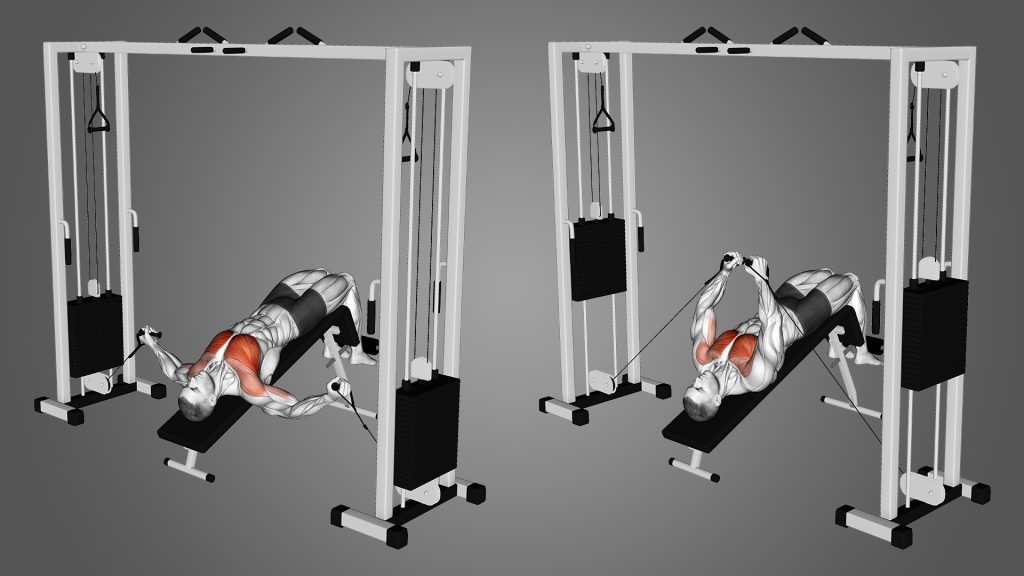
How to Perform the Decline Cable Fly
Setup
- Set the cable pulleys to the highest or near-highest setting on the machine.
- Stand in the center with a slight forward lean.
- Take a small step forward to load the cables.
- Keep a slight bend in the elbows — don’t lock or overly bend.
- Chest up, shoulders down and back.
Execution
- Start With Arms Out Slightly Above Shoulder Level
You should feel a stretch across the chest immediately.
- Sweep the Arms Down and Inward
Imagine you’re drawing a wide arc — not a straight line.
The hands should meet around the line of your navel or slightly higher depending on your angle and limb length.
- Squeeze the Lower Chest Hard at the Bottom
Think of trying to “fold” the lower pecs inward.
Hold for 1–2 seconds.
- Control the Return
Let your arms rise up slowly, maintaining tension.
This eccentric stretch is where much of the muscle-building magic happens.
- Repeat Without Using the Shoulders or Leaning Excessively
Minimal torso movement equals maximal pec tension.
Breathing
- Inhale as you let the cables rise back up into the stretch.
- Exhale as you sweep down and contract the pecs.
Stable, controlled breathing keeps tension on the pecs rather than the traps or shoulders.
Essential Technique Cues
- “Lead with the elbows, not the hands.”
Prevents turning it into a triceps or shoulder movement.
- “Squeeze the pecs together as if closing elevator doors.”
Perfect mental image for getting the feel right.
- “Keep your ribcage high, shoulders low.”
Opens the chest and locks tension in.
- “Keep the arc wide, not short and choppy.”
A wider arc equals a deeper pec stretch.
- “Hands should finish around the beltline, not at chest height.”
This is what makes it a decline fly — that slight downward finish angle.
Common Mistakes & Fixes
❌ Turning It Into a Press
If elbows bend and arms start pushing, it’s a press — not a fly.
Fix: Keep elbows slightly bent but “fixed” in position.
❌ Using Too Much Weight
This shifts the effort to the anterior delts and traps.
Fix: Drop the load until the pecs are doing all the sweeping.
❌ Lack of Stretch at the Top
Shortening the range kills hypertrophy.
Fix: Let hands rise above shoulder height and feel the stretch.
❌ Rounding the Shoulders Forward
This disengages the chest.
Fix: Retract and depress your scapula before every rep.
❌ Leaning Too Far Forward
This turns it into a downward press.
Fix: Lean only slightly — just enough to stay balanced.
Variations & Ways to Target Different Fiber Angles
- Standing High-to-Low Cable Fly (Standard)
The classic version for lower pec mass.
- One-Arm High-to-Low Cable Fly
Perfect for:
- Focusing on symmetry
- Increasing inner-lower chest activation
- Avoiding torso rotation and shoulder imbalances
- Kneeling High-to-Low Cable Fly
Increases stability.
Removes lower-body compensation.
Enhances pec isolation.
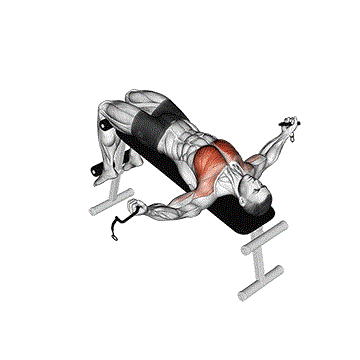
- Decline Bench Cable Fly
Place a decline bench between the pulleys.
This combines the advantages of decline pressing and cable tension.
- Low-Incline to Low Fly
Set the bench at a very low incline.
This targets mid-to-lower chest and serratus.
Programming Guidelines
Hypertrophy (Best Use)
- 3–4 sets
- 10–15 reps
- Moderate weight, controlled tempo, full range stretch
Perfect sweet spot for lower-chest isolation.
Pure Pump / Finisher Work
- 2–3 sets
- 15–20 reps
- Light weight, minimal rest
This creates the “burn” bodybuilders love.
Lower Chest Emphasis Workout Example
- Decline Barbell Press — 4×6–8
- Chest Dips — 3×8–12
- Decline Cable Fly — 3–4×12–15
- Machine Chest Press — 3×10–12
- Low Cable Crunch (optional chest tie-in) — 3×12–15
This hits the lower pecs from heavy, moderate, and light angles.
Who Should Use the Decline Cable Fly?
Ideal For:
✔ Bodybuilders seeking lower-chest sharpness
✔ Anyone whose chest looks “top-heavy”
✔ Lifters with poor mind–muscle connection in the lower pecs
✔ Physique-focused athletes aiming for full chest density
✔ Beginners learning chest tension and fiber direction
Not Ideal For:
❌ People with shoulder impingement tendencies
❌ Those seeking max strength
❌ Lifters who already do too many fly variations in one session
Bodybuilding Wisdom & Advanced Tips
- Slight torso lean forward = more tension, not momentum
Just 10–15° is enough.
- Think “press your sternum up” as you sweep
This elevates the lower pecs into the path of resistance.
- Slow the eccentric to 2–3 seconds
That’s where the lower chest really grows.
- Try a 1-second pause at the bottom contraction
This maximizes fiber recruitment.
- Pair with heavy dips for an elite superset
Killer combination for lower pec development.
Practical Takeaways
- The Decline Cable Fly is one of the best isolation movements for the lower chest.
- Perfect finishing exercise for shaping the chest shelf and building inner-lower pec detail.
- Works well in growth phases where you need more precise tension.
- Best used with moderate weight, slow tempo, and full range of motion.
- A must-have movement for a complete, aesthetic chest.
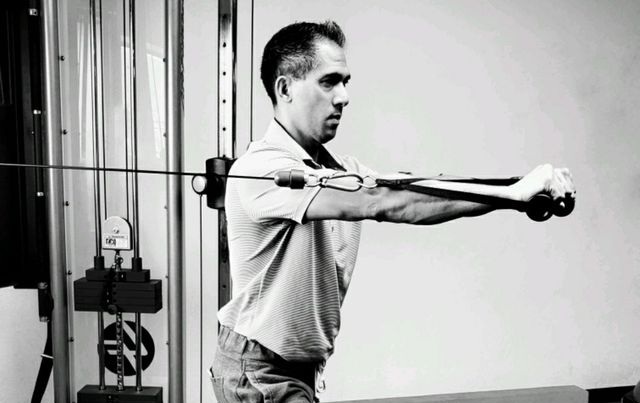

 solves this problem perfectly. Because the cables come from above and pull)