Copenhagen Side Plank
High-Tension Unilateral Oblique and Adductor Builder for Lateral Stability and Core Integration
The Copenhagen Side Plank is one of the most demanding anti-lateral flexion exercises you can perform. At first glance, it resembles a standard side plank variation.
In reality, it is a high-tension unilateral stability drill that places extreme demands on the obliques, adductors, and deep core by forcing them to work together under sustained load.
What separates the Copenhagen Side Plank from simpler side plank variations is lever length and load distribution.
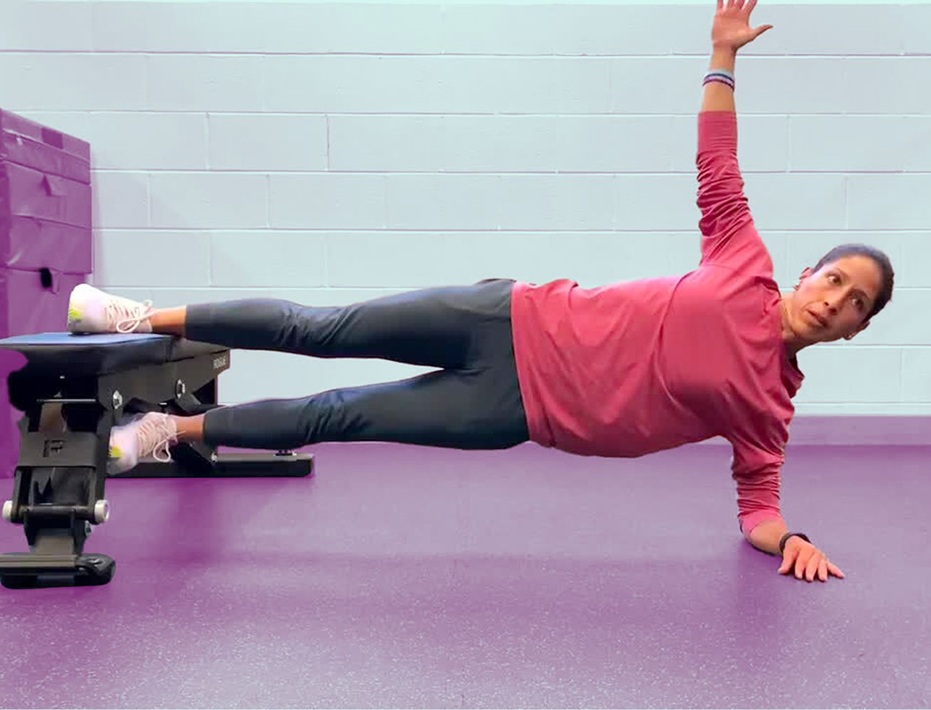
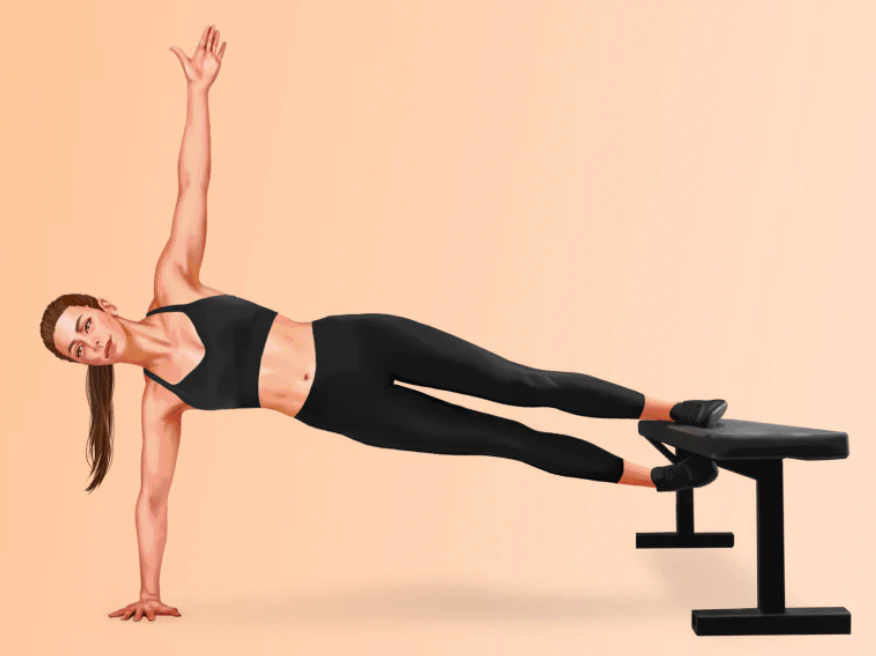
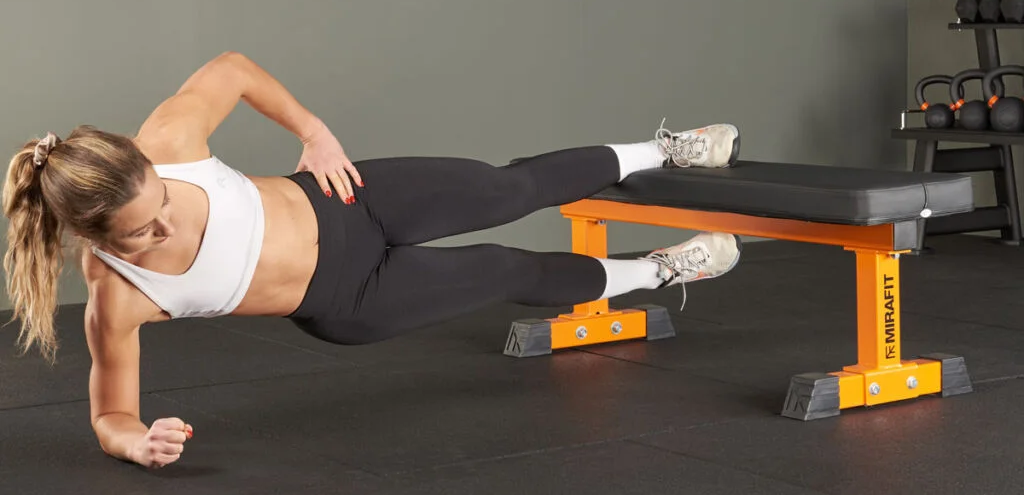
By elevating the top leg on a bench or box and suspending the bottom leg, the body is forced to maintain alignment while resisting lateral collapse from multiple directions.
The obliques are no longer just holding position—they are actively coordinating with the hips and pelvis to maintain structural integrity.
From a muscle-building and performance standpoint, this exercise fills a critical gap. It trains the obliques not through rotation or carrying load, but through pure unilateral tension and integration with the lower body.
This makes it an invaluable tool for developing lateral core strength, injury resilience, and visible oblique thickness when executed and progressed correctly.
The Copenhagen Side Plank is not a beginner movement. But for lifters who already have a foundation of core strength, it is one of the most efficient ways to elevate oblique development to the next level.
Primary Muscles Worked
The Copenhagen Side Plank is dominated by muscles responsible for anti-lateral flexion, pelvic stability, and force transfer between the torso and lower body.
Obliques (Internal and External)
The obliques are the primary drivers of the movement. They work isometrically to prevent the torso from collapsing toward the floor while maintaining a straight line from shoulders to hips. The extended lever created by the elevated leg dramatically increases oblique tension compared to a standard side plank.
Adductors (Adductor Longus, Brevis, Magnus)
The adductors play a major role by supporting the suspended lower body and maintaining leg alignment. Their involvement is not incidental—it is a defining feature of the exercise. Strong adductors enhance pelvic stability and improve overall core integration.
Quadratus Lumborum (QL)
The QL assists the obliques in maintaining lateral spinal alignment. High activation of this muscle contributes to improved spinal resilience and reduced injury risk under load.
Transverse Abdominis (TVA)
The TVA maintains intra-abdominal pressure and helps keep the pelvis neutral throughout the hold. Without proper TVA engagement, the lower back compensates and alignment deteriorates.
Secondary Muscles and Stabilizers
Several additional muscle groups contribute to maintaining position and tension:
- Gluteus Medius and Minimus – Pelvic stabilization
- Shoulder Stabilizers – Deltoids, rotator cuff, serratus anterior
- Erector Spinae – Spinal alignment
- Hip Flexors – Assist in leg positioning
This full-body involvement is why the Copenhagen Side Plank feels disproportionately difficult relative to its static appearance.
What the Copenhagen Side Plank Is Best For
The Copenhagen Side Plank excels in areas where other oblique exercises are limited.
- High-tension oblique hypertrophy
- Anti-lateral flexion strength
- Hip–core integration
- Pelvic stability for unilateral lifts
- Injury resilience for groin and lower back
It is particularly effective for athletes and lifters who rely on strong lateral stability, such as those performing heavy squats, lunges, single-leg work, or rotational sports.
Equipment and Setup Options
This exercise requires minimal equipment:
- Bench, box, or sturdy platform for leg elevation
- Mat for elbow support (optional)
Height matters. A bench height that places the elevated leg roughly parallel to the floor is ideal. Too low reduces tension; too high increases difficulty prematurely.
Proper Copenhagen Side Plank Setup
Begin by lying on your side with your elbow directly under your shoulder. Your forearm should be perpendicular to your body, palm flat on the floor.
Place your top leg on the bench or box, either with the foot or shin supported depending on difficulty level. Your bottom leg hangs freely underneath.
Before lifting, stack your shoulders vertically and align your hips so they are directly on top of each other. This stacked position is critical—any rotation reduces oblique demand.
Brace your core, squeeze your glutes lightly, and prepare to lift.
Execution: Step-by-Step Breakdown
Press your forearm into the floor and your elevated leg into the bench as you lift your hips off the ground.
Once elevated, your body should form a straight line from head to ankle. Avoid bending at the hips or letting the torso drift forward or backward.
Hold this position while breathing under control. Each breath should expand the ribcage without allowing the spine to shift.
After the prescribed time, lower with control, reset, and repeat on the opposite side.
Key Coaching Cues
- “Stack shoulders and hips”
- “Push the bench away with your leg”
- “Stay long through the spine”
- “Breathe without losing tension”
- “No sag, no twist”
These cues help maintain alignment and maximize oblique engagement.
Common Mistakes and How to Fix Them
Hip Sagging
This indicates insufficient oblique or adductor strength. Shorten the hold or regress the variation.
Rotating Toward the Floor
Rotation shifts tension away from the obliques. Focus on stacking and slow, controlled setup.
Shoulder Discomfort
Often caused by poor elbow placement. Ensure the elbow is directly under the shoulder and actively push into the floor.
Holding the Breath
Breath-holding reduces endurance and control. Practice controlled diaphragmatic breathing under tension.
Copenhagen Side Plank for Oblique Hypertrophy
Although isometric, the Copenhagen Side Plank is highly effective for hypertrophy due to intensity and lever length.
To bias muscle growth:
- Use longer lever variations (foot vs. knee support)
- Increase hold duration gradually
- Add external load only once perfect alignment is maintained
The obliques respond strongly to sustained high-tension holds, particularly when recovery and progression are managed intelligently.
Programming Recommendations
Hold Duration:
- 15–30 seconds per side (advanced lifters may progress beyond this)
Sets:
- 2–4 per side
Rest:
- 60–90 seconds between sets
Place the Copenhagen Side Plank after dynamic oblique movements or as a finisher in an oblique-focused session.
Progressions and Regressions
Regressions
- Bent-knee Copenhagen plank
- Shorter hold durations
- Lower bench height
Progressions
- Full foot support instead of shin
- Extended hold times
- Weighted Copenhagen plank (plate on hip)
- Copenhagen plank with bottom-leg lift
Progress only when alignment remains uncompromised.
Who Should Use the Copenhagen Side Plank
This exercise is ideal for:
- Lifters seeking advanced oblique development
- Athletes needing hip–core integration
- Individuals addressing side-to-side imbalances
- Those building injury-resistant lateral stability
Those with acute shoulder or groin injuries should approach cautiously and regress as needed.
Final Thoughts
The Copenhagen Side Plank is one of the most challenging and rewarding oblique exercises available. It demands total-body coordination, precise alignment, and sustained tension—qualities that define effective core training beyond aesthetics alone.
As the final piece in your obliques cluster, it completes the picture: rotation, anti-rotation, loaded anti-lateral flexion, and now high-tension unilateral stability.
When executed correctly and progressed with intent, the Copenhagen Side Plank builds obliques that are not only visible, but strong, resilient, and functionally integrated with the rest of the body.