Calf Workouts That Actually Work: A Bodybuilder’s Guide to Real Growth
Let’s be honest — calves are one of the most stubborn muscle groups in bodybuilding. You can deadlift triple bodyweight and bench press a small car, yet your calves may still resemble upside-down Coke bottles.
But here’s the truth most lifters don’t want to hear: you can build great calves, but only if you stop training them like an afterthought.
This guide will show you how to train calves with the same intensity, precision, and progression as any other muscle group.
you’ll learn why calves are often unresponsive, how to program your workouts for real hypertrophy, and the best calf exercises to maximize growth — whether you’re a beginner or a stage-ready competitor.
Calf Anatomy: Know What You’re Up Against
To train calves effectively, you need to understand the muscle architecture.
🔹 The Gastrocnemius
- The “visible” calf muscle — the outer diamond shape.
- Has two heads (medial and lateral).
- Crosses the knee and ankle joints.
- Best targeted with straight-leg exercises.
🔹 The Soleus
- Lies underneath the gastrocnemius.
- Doesn’t cross the knee joint.
- Composed predominantly of slow-twitch fibers.
- Best targeted with bent-knee exercises like seated calf raises.
🔹 The Achilles Tendon
- Acts as a spring; stores and releases elastic energy.
- Great for jumping, but not useful for hypertrophy.
- Bouncing reps use this tendon instead of the muscle — a huge mistake for bodybuilders.
Training Takeaway: If you want size, you must remove the spring effect and focus on muscular tension, not rebound.
Why Calves Don’t Grow for Most Lifters
Mistake #1: Rushing Through Reps
Calves love to cheat. Most lifters bounce through sets with no tension in the muscle belly. That’s not hypertrophy — that’s cardio.
Mistake #2: Low Volume and Frequency
Training calves once per week with three sets won’t cut it. They’re used to hundreds of steps per day. To grow, they need intense overload, frequency, and fatigue beyond everyday activity.
Mistake #3: Ignoring the Soleus
The soleus is buried under the gastrocnemius but contributes to overall thickness. It’s slow-twitch dominant and thrives on high reps, high volume, and long tension.
Mistake #4: Incomplete Range of Motion
Half-repping the top or bottom of a calf raise leaves growth on the table. Full stretch at the bottom, hard squeeze at the top — that’s where muscle happens.
Principles That Actually Build Calves
To make your calves grow, apply the same progressive overload and hypertrophy principles that you use for chest, back, and legs:
Full Range of Motion
Drop the heel until you feel a stretch in the Achilles and gastrocnemius. Rise onto the ball of your foot and squeeze hard at the peak. Every rep should take 2–3 seconds up, 1–2 second hold, 3 seconds down.
High Frequency
Train calves 2–4 times per week, ideally with alternating emphasis on seated and standing movements to target both major muscles.
Volume
Aim for 12–20 total sets per week. Mix heavy sets (6–10 reps) and high-rep sets (15–30 reps), adjusting for soreness and recovery.
Mind-Muscle Connection
Focus on contraction. Don’t let your Achilles tendon dominate. Calves are small, but they respond best to intense focus and isolation.
Top Calf Exercises That Work
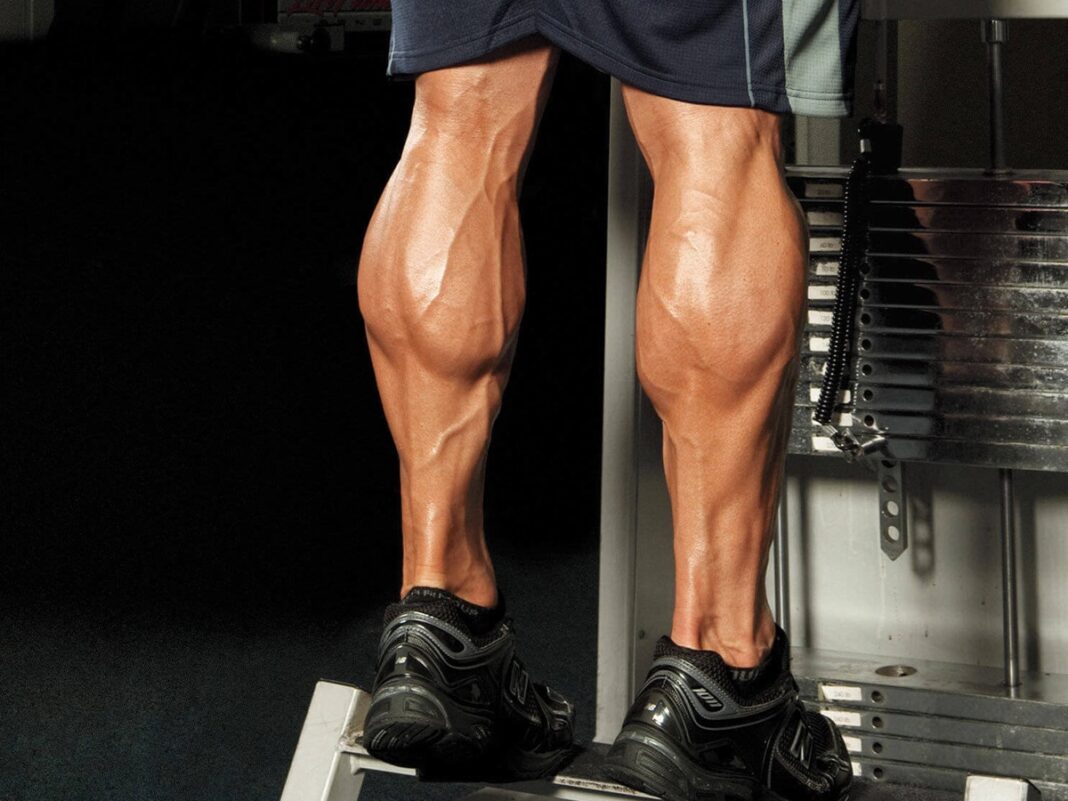
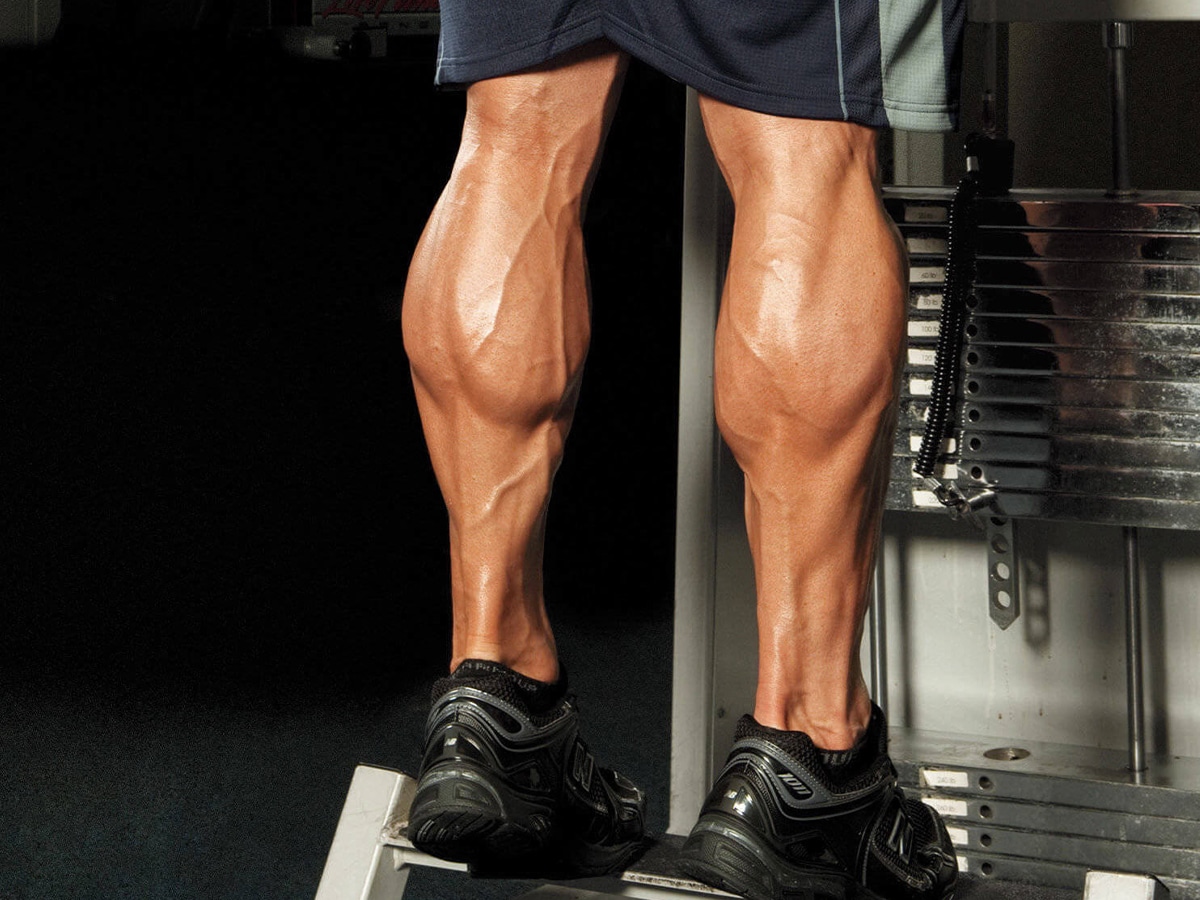
🔹 1. Standing Calf Raise
This is your heavy compound for the gastrocnemius. Can be done on a machine, Smith machine, or with a barbell.
Pro Tip: Drive through the big toe for max contraction. Lock out the knee but don’t hyperextend.
✅ Best for: Gastrocnemius, overall mass
🔹 2. Seated Calf Raise
Targets the soleus due to bent knees. Use strict form and high reps here.
Pro Tip: Lean forward slightly to get deeper at the bottom of the movement.
✅ Best for: Soleus hypertrophy and base thickness
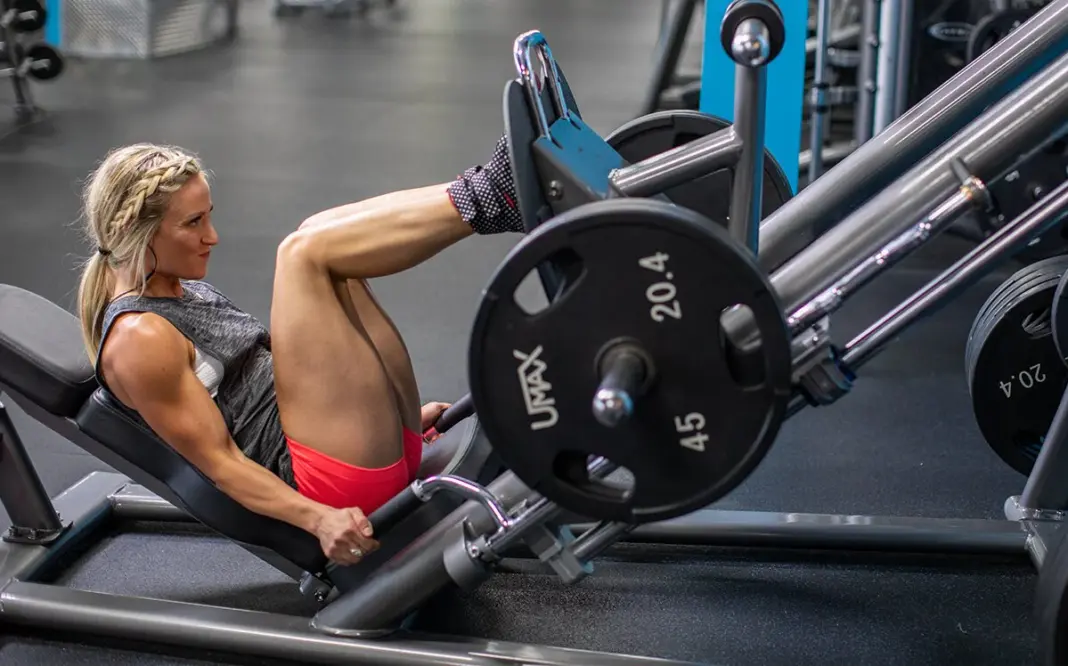
🔹 3. Leg Press Calf Press
A safer way to load heavy without spinal compression. Keep your hips still and press only with your ankles.
Pro Tip: Don’t rush the eccentric. This movement is perfect for pause reps at the bottom.
✅ Best for: Mixing in volume and progressive overload
🔹 4. Donkey Calf Raise
Old-school and effective. The stretch from a bent waist increases range of motion.
Pro Tip: Use a machine or a partner, but don’t bounce — it’s about the stretch and contraction.
✅ Best for: Complete gastrocnemius activation
🔹 5. One-Leg Calf Raise (Bodyweight or Weighted)
Unilateral training helps correct imbalances and improves control.
Pro Tip: Hold a dumbbell in one hand and use the other for light balance assistance. Use slow eccentrics.
✅ Best for: Stability, balance, and control
Calf Training Programs by Experience Level
🔰 Beginner Program (2x/Week)
Day 1
- Standing Calf Raise – 3×15
- Seated Calf Raise – 3×20
- Leg Press Calf Press – 3×15
Day 2
- Seated Calf Raise – 4×15
- One-Leg Standing Calf Raise – 3×10/leg
- Bodyweight Calf Raise Hold – 3×30 seconds
🔁 Intermediate Program (3x/Week)
Day 1 – Heavy Emphasis
- Standing Calf Raise – 5×8–10 (3-sec eccentrics)
- Leg Press Calf Press – 4×12
- Seated Calf Raise – 3×20 (pause at top)
Day 3 – High Volume
- Seated Calf Raise – 5×20
- Donkey Calf Raise – 4×15
- Bodyweight Standing Raise – 3x failure
Day 5 – Isolation & Unilateral
- One-Leg Calf Raise – 3×15/leg
- Leg Press Calf Press – 4×12 (narrow stance)
- Standing Calf Raise – 3×25 (light, pump set)
🧠 Advanced Calf Specialization (4x/Week, Short Sessions)
- Day 1: Standing + Leg Press
- Day 2: Seated + One-Leg
- Day 3: Rest or light pump circuit
- Day 4: Donkey + Seated
- Day 5: Standing + Drop Sets
Use intensification techniques:
- Rest-pause
- Drop sets
- Supersets (e.g., Seated + Standing)
- Iso holds at peak contraction
Sample Finisher: “Calf Annihilator”
- Seated Calf Raise x 15 (moderate weight)
- Drop 25%, x 15 more
- Drop 25%, x 15 more
- Bodyweight raises to failure
- Hold bottom stretch for 30 seconds
➡️ Burnout sets like this can be tacked onto any leg day for a serious hypertrophy kick.
Bodybuilder’s Tips for Next-Level Calves
🔸 Use Calves to Warm Up Lower Body
Pre-leg-day activation with bodyweight calf raises increases ankle mobility and blood flow — a smart primer.
🔸 Train Calves First (If They’re a Weak Point)
You train your weak points when you’re fresh. Don’t save calves for the last five minutes when you’re exhausted.
🔸 Track Every Set
Don’t wing it. Log your weights, reps, and techniques. Just like you do for chest, back, or delts.
🔸 Prioritize Stretching
Post-training calf stretches can improve range of motion and reduce tightness that limits depth in squats and lunges.
Recovery & Nutrition for Calf Growth
- Protein: Aim for 1g/lb of bodyweight daily
- Hydration: Calves cramp fast when dehydrated
- Rest: Don’t overload calves four days in a row without adequate sleep or deloading
- Mobility: Foam roll the soleus and gastrocnemius regularly to maintain tissue quality
Don’t Fall for Calf Myths
Myth: “Calf size is all genetics.”
Truth: Genetics affect insertions, not effort. Every bodybuilder with great calves earned them with volume, frequency, and precision.
Myth: “Just walk or run more.”
Truth: Daily walking doesn’t provide enough tension or overload to spark hypertrophy.
Myth: “Heavy weight is all that matters.”
Truth: Load without range, control, or volume is just joint stress. Combine heavy, slow, and high-rep work for best results.
🏁 Final Word: Build Calves Like You Mean It
Calves are stubborn — not impossible. You can build them, shape them, and bring them up to match your quads, glutes, and hamstrings. But you have to treat them like any major muscle group: with intensity, variety, and progressive overload.
So stop phoning in your calf training. Make it intentional. Make it strategic. And most importantly — make it consistent.
Train calves with the same passion you train arms or chest, and they’ll grow.