Cable Shrug: The Constant-Tension Trap Builder for Full Upper-Trap Density
When bodybuilders talk about direct trap training, the conversation usually starts with barbell shrugs, dumbbell shrugs, or heavy machine work.
But one of the most underrated and underused trap-builders in the gym—especially for bodybuilders chasing full muscular development—is the Cable Shrug.
If your goal is upper traps that rise like mountains when you hit a front double biceps, or 3D trap thickness that makes your physique look powerful from every angle, cable shrugs deserve a permanent spot in your routine.
They’re not as flashy as loading 500 pounds on a barbell, but in terms of stimulus quality, tension curve, and mind-muscle connection, very few shrug variations compete.
This guide breaks down everything you need to know about cable shrugs: how to perform cable shrugs correctly, the biomechanics involved, how they compare to other shrug variations, progressive overload strategies, programming for beginners through advanced lifters, common mistakes, and practical takeaways grounded in bodybuilding experience.
What the Cable Shrug Trains (Primary Muscles Worked)
Primary Muscle: Upper Trapezius
The upper traps elevate the scapulae (shrugging motion) and support upper-back posture and shoulder girdle stability. Cable shrugs create a unique upward tension pull that keeps these fibers loaded through the entire range.
Secondary Muscles
- Middle traps
- Rhomboids
- Levator scapulae
- Forearms and grip
- Spinal stabilizers (isometric role)
While barbells and dumbbells rely on gravity—which decreases tension at the top—cables maintain resistance even in the fully contracted shrug position, making them ideal for hypertrophy.
Why Bodybuilders Should Use Cable Shrugs
- Constant Tension = Superior Peak Contraction
In free-weight shrugs, the resistance drops as the weight gets closer to your center of gravity at the top. With cables, resistance is applied in the direction of the pulley, not the floor, so the peak contraction is massively amplified.
Bodybuilders who struggle to “feel” their traps during heavy free-weight shrugs often find cable shrugs instantly solve the problem.
- Perfect for Higher-Rep, Growth-Focused Trap Work
While barbell shrugs shine with heavy, power-building loads, cable shrugs thrive in:
- 12–20 rep hypertrophy ranges
- Drop sets
- Extended sets
- Constant-tension finishers
Their joint-friendly nature makes them ideal for additional volume without beating up the neck, shoulders, or spine.
- Better Mind-Muscle Connection
The directed resistance of the cable encourages lifters to shrug up and slightly in, which lines up more precisely with the fibers of the upper traps.
If your goal is maximal hypertrophy, feeling the contraction matters—and cables deliver.
- Great for Lifters With Lower-Back Discomfort
Because you stand upright and the load is lower to the ground, cable shrugs minimize:
- Lower-back compression
- Shear forces
- The tendency to lean forward under heavy loads
This makes them excellent for bodybuilders who can’t handle heavy barbell shrugs.
- Conducive to Clean, Strict Form
Heavy free-weight shrugs often turn into mini-deadlifts and bouncing messes. Cables enforce smooth reps and remove momentum, keeping the traps doing the work.
How to Perform the Cable Shrug With Perfect Bodybuilder Technique
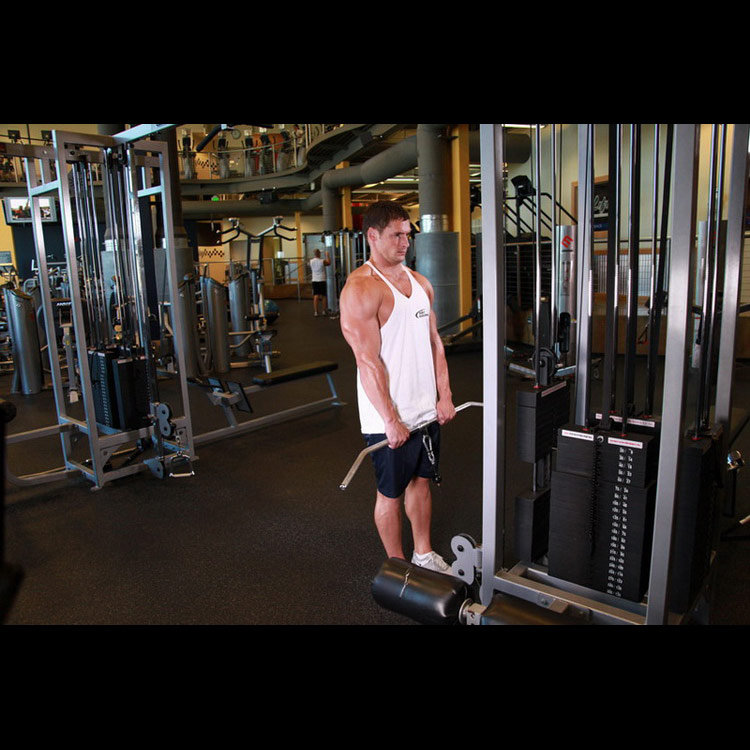
You can use either:
- A dual cable station (best option)
- A single cable with a rope or straight bar attachment
- A low-pulley cable setup with a long bar
The following instructions assume the dual-cable version, which gives the best biomechanics and range of motion.
Step-by-Step Technique
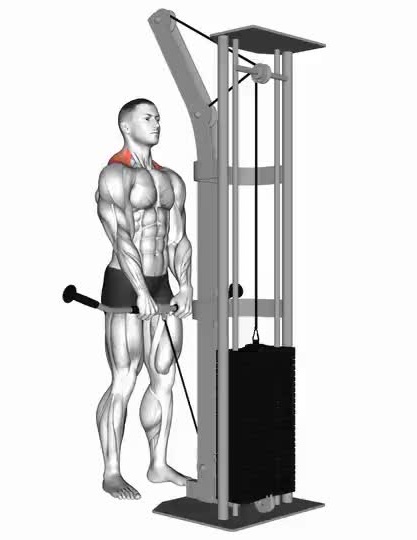
- Set the pulleys at the lowest setting
Handles should sit just outside your thighs when you stand in the center.
- Stand tall and grip the handles
Keep:
- Chest up
- Shoulders slightly back
- Core braced
- Feet shoulder-width apart
Arms should hang naturally at your sides.
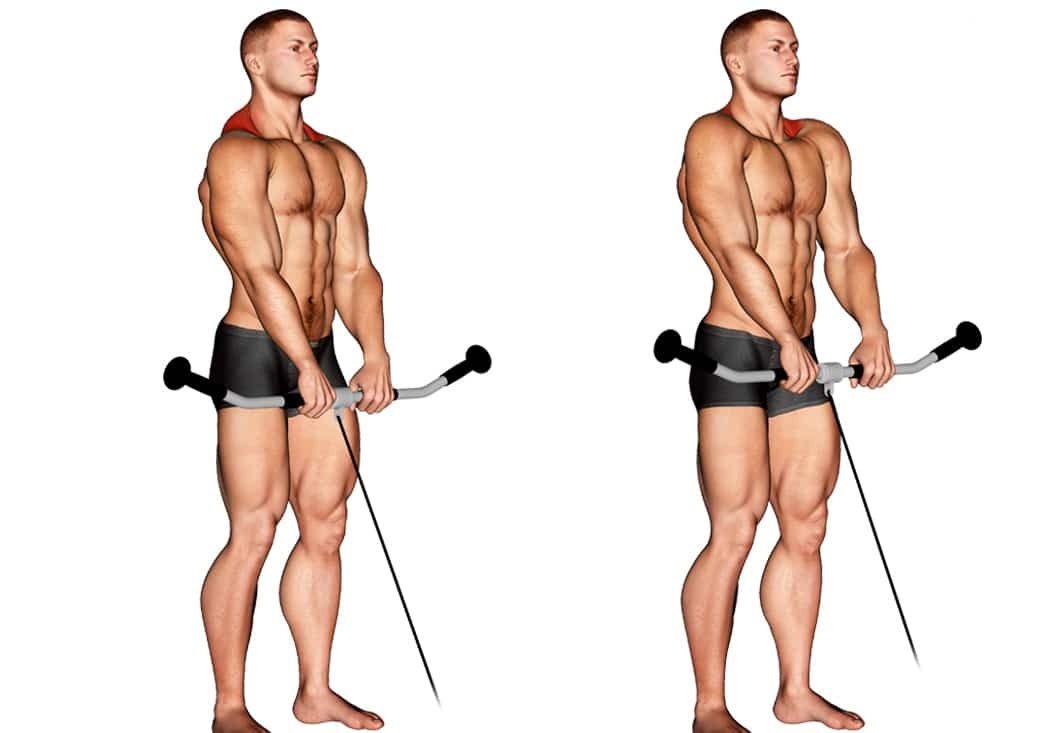
- Begin with the traps fully stretched
Let the shoulders drift downward without relaxing your posture. This creates a loaded stretch ideal for hypertrophy.
- Shrug the shoulders straight up, not forward or backward
Your goal is a pure scapular elevation motion.
Think:
- “Ears to shoulders”
- “Lift the traps UP, not back”
Avoid over-rolling the shoulders—this doesn’t improve activation and may irritate the joint.
- Pause hard at the top
Hold the peak contraction for 1–2 seconds.
This is the magic of cable shrugs—the tension at the top is real, and you should milk it.
- Lower under control
Let the shoulders stretch downward for a smooth 2–3 second eccentric.
- Maintain constant tension
Don’t let the weight stack slam down or fully deload.
Common Mistakes and How to Fix Them
❌ Using momentum
Bouncing through reps turns the shrug into a back-and-leg movement.
Fix:
Lighten the weight and drive the motion entirely from the traps.
❌ Rolling the shoulders
This is outdated bro-science and doesn’t improve trap activation.
Fix:
Keep the shrug vertical. Up-and-down.
❌ Leaning back excessively
This shifts tension off the traps and onto the erectors.
Fix:
Stand tall, ribs down, core braced.
❌ Going too heavy to feel anything
Cable shrugs shine with control and tension—not max loads.
Fix:
Use weights that allow slow reps with a strong peak contraction.
❌ Cutting the range short
If the shoulders aren’t rising high, the traps aren’t working.
Fix:
Reduce weight and focus on maximum elevation.
Training Tips for Maximum Trap Growth
- Use slower eccentrics
Lowering the weight slowly intensifies time under tension and stimulates fiber growth.
Recommended tempo: 1–2 seconds up, 2–3 seconds down
- Add isometric holds
Peak contraction holds improve motor unit recruitment.
Try:
- 1-second holds for normal sets
- 3-second holds for finishers
- Use moderate reps
Cable shrugs respond best to:
- 12–20 reps for hypertrophy
- 20–30 reps for finishers
Lower reps don’t work well here.
- Incorporate dropsets
Because cables allow smooth transitions, they’re perfect for:
- Triple drops
- Running the stack up or down
- Extended mechanical sets
- Train traps 1–2 times per week
They recover quickly but still benefit from quality volume.
Programming Cable Shrugs Into Your Routine
Beginner (1–2 years training)
Do after your main back or shoulder exercises:
- 2–3 sets of 12–15 reps
- Keep form strict and avoid rushing tension.
Intermediate Bodybuilders
Rotate cable shrugs with dumbbell or machine shrugs:
- 3–4 sets of 12–20 reps
- Add slow eccentrics or 1-second peak holds.
Advanced Lifters
Use cable shrugs to finish a heavy trap or pull day:
- 4–6 sets of 15–25 reps
- Incorporate dropsets, supersets, or brutal lengthened-to-contracted sequences.
Example superset:
- Heavy barbell shrug → Cable shrug with 2-second holds
How Cable Shrugs Compare to Other Shrug Variations
Cable Shrug vs Barbell Shrug
- Barbell: superior for maximal load.
- Cable: superior for tension quality and the peak contraction.
Combination is ideal.
Cable Shrug vs Dumbbell Shrug
Dumbbells give freedom of movement, but cables keep tension at the top, where dumbbells lose it.
Cable Shrug vs Machine Shrug
Machines allow heavy loading, but cables give a better contraction and more natural scapular path.
Cable Shrug vs Behind-the-Back Shrug
Behind-the-back shrugs bias the upper traps differently. Cables allow you to mimic that angle with less joint strain.
Variations Worth Using
- Rope Attachment Cable Shrug
Allows a more natural, neutral-grip shrug.
- Single-Arm Cable Shrug
Focuses on unilateral trap strength and fixes imbalances.
- Long-Bar Cable Shrug
Allows a barbell-like feel with cable tension.
How to Know You’re Doing Cable Shrugs Right
You should feel:
- A deep contraction at the top
- A strong stretch at the bottom
- Little to no involvement from the lower back
- A pump that hits quickly and intensely
If you don’t feel the traps working:
- Lower the weight
- Slow down the rep speed
- Pause longer at the top
- Adjust stance slightly forward or backward to match pulley angle
Sets, Reps, and Intensities
Here are three proven schemes:
Hypertrophy Standard
- 4 × 12–15 reps
- 1-second peak contraction on each rep
High-Rep Pump Work
- 3 × 20–25 reps
- Smooth, constant tension (no lockout)
Bodybuilder Finisher
- 1 × 30 reps
- followed by
- Drop 20–30% → 15 reps
- Drop again → max reps with 3-second top holds
Brutal but unbelievably effective.
Who Should Prioritize Cable Shrugs?
✔ Bodybuilders seeking upper-trap shape, not just strength
✔ Lifters who can’t feel their traps from barbell shrugs
✔ Those experiencing lower-back fatigue during heavy shrugs
✔ Anyone needing safer, high-volume trap work
✔ Physique athletes needing a stronger front-double-biceps silhouette
Cables are especially useful in contest prep, where joint-friendly volume matters.
Final Takeaway: The Cable Shrug Is a Must-Have for 3D Trap Growth
Cable shrugs might not be the ego lift that barbell shrugs are, but in terms of:
- Tension quality
- Peak contraction
- Controlled hypertrophy stimulus
- Mind-muscle connection
- Joint-friendly volume
- Shape building rather than brute strength
…they’re unrivaled.
If you want traps that stand tall, fill out poses, and complete a dominating upper-back look, the Cable Shrug belongs in their weekly training––either as a main hypertrophy movement or an end-of-workout finisher.