Behind-the-Body Cable Lat Row: The Ultimate Isolation Row for Deep Lat Engagement
If you’re trying to build wide, sweeping lats — the kind that hang like wings and create the unmistakable V-taper that defines a bodybuilding physique — you need movements that truly isolate, shorten, and overload the latissimus dorsi. And the Behind-the-Body Cable Lat Row is one of the most underrated, most biomechanically advantageous tools for exactly that purpose.
Most variations of rowing emphasize the upper back. Chest-supported rows, barbell rows, even cable rows: they all involve substantial shoulder-blade retraction (scapular retraction), which naturally shifts tension toward the rhomboids, mid-traps, and rear delts.
But the lats don’t care about scapular retraction — their primary job is shoulder extension and adduction. They’re activated most strongly when the elbow travels down, in, and behind the torso, without excessive squeeze between the shoulder blades.
That is exactly what this exercise delivers.
This movement is not for ego lifting, not for maximal loading, and definitely not for casually throwing weight around.
It is a precision lat-builder, designed for deep fibers, long-range tension, and elite lat hypertrophy. If you’ve ever struggled to feel your lats in other row variations, this will change everything.
Below is your complete expert guide.
What Is the Behind-the-Body Cable Lat Row?
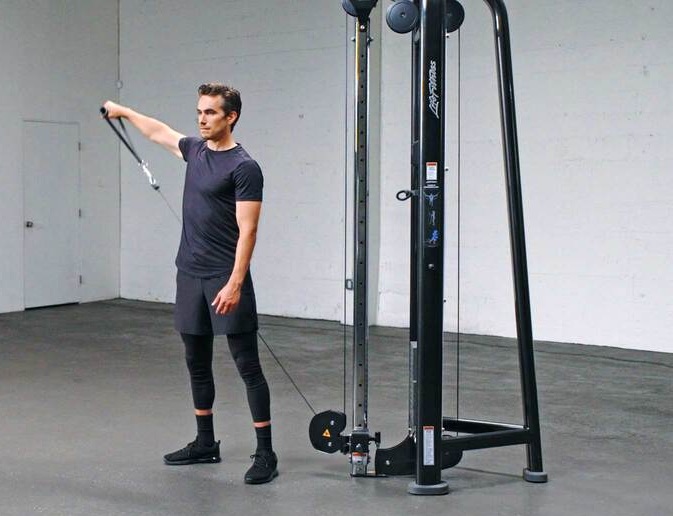
The Behind-the-Body Cable Lat Row is a single-arm (or bilateral) cable pulling movement performed with the cable running behind your hips instead of in front of your torso. This changes the line of pull, placing the lats in their strongest and most biomechanically efficient path of motion.
In simpler terms:
- Your arm moves behind the body.
- Your elbow travels downward and backward.
- Your torso stays still — no need to hinge or lean.
- The movement becomes almost pure shoulder extension, which is a primary lat action.
- There is minimal scapular involvement compared to regular rows.
The result?
A concentrated, lat-dominant row with an unmatched contraction at the bottom.
It’s effectively a hybrid between:
- a straight-arm pulldown
- a row
- and a behind-the-back cable extension
…all merged into one.

Muscles Worked
Primary
- Latissimus dorsi (upper, mid, and especially lower fibers)
- Teres major
Secondary
- Long head of the triceps (as a shoulder extender)
- Rear delts (minor involvement)
- Rhomboids (minimal)
- Mid-traps (minimal)
- Obliques/core (stability)
- Forearm flexors (grip)
Why This Is a Pure Lat Movement
Because the cable runs behind the torso, the resistance pulls the arm into flexion — and you fight that by performing shoulder extension, the lat’s strongest function.
Scapular retraction is optional, not required. If anything, excessive retraction reduces lat tension.
This is why bodybuilders love this variation:
It forces lat dominance, and removes most upper-back takeover.
How to Perform the Behind-the-Body Cable Lat Row (Step-by-Step)
Set-Up
- Set a cable pulley to around mid-thigh height.
- Attach a D-handle.
- Stand facing away from the cable machine.
- Let the cable run along the outside of your hip, not between your legs.
- Take a step forward to create tension at full arm extension.
Execution
- Start with your arm slightly in front of your torso and your palm facing backward or inward.
- Keep your chest tall and ribs stacked — do NOT lean forward.
- Initiate the movement by driving your elbow down and back, letting it pass slightly behind your hip.
- Feel the lat contract as your arm extends past your torso.
- Hold the bottom position for one full second.
- Slowly return the handle forward with full control until the lat is fully lengthened.
- Repeat for 10–15 reps.
Key Cues
- “Pull with your elbow, not your hand.”
- “Keep your shoulder down and away from your ear.”
- “Don’t twist — keep hips square.”
- “Elbow travels back, not in toward the ribs.”
- “Think ‘lat stretch, lat squeeze’ every rep.”
Common Technical Mistakes to Avoid
❌ Leaning forward or hinging at the hips
This shifts tension toward the upper back and removes the isolated shoulder extension pattern.
❌ Using too much weight
The ego is the enemy here. A weight that’s too heavy forces:
- torso rotation
- excessive momentum
- upper back takeover
- shortened range of motion
This is a precision hypertrophy movement — keep it controlled.
❌ Letting the shoulder roll forward excessively
A little stretch is good; too much internal rotation destabilizes the shoulder.
❌ Turning it into a standard row
If the elbow comes sideways into the ribs, you’ve lost the lat line of pull.
❌ Standing too close to the machine
You need tension in the stretched position — step forward enough to create it.
Biomechanics Breakdown: Why This Variation Is So Effective for Lat Growth
To understand why this exercise hits differently, you need to look at the lat’s primary functions:
- Shoulder extension
(e.g., bringing the humerus behind the body) - Shoulder adduction
(arm down toward the torso) - Internal rotation
Most rows overly emphasize scapular retraction — which involves mid-traps and rhomboids — instead of pure shoulder extension.
The Behind-the-Body Cable Lat Row corrects that by:
✔ Keeping the shoulder fixed in a depressed, neutral position
This avoids upper trap dominance.
✔ Forcing the elbow path directly backward
The perfect line for isolating the lat.
✔ Lengthening the lat at the start
Cable tension pulls the arm slightly forward, giving a massive stretch.
✔ Maximally shortening the lat at the bottom
Because the elbow passes behind the hip, the lat reaches full contraction.
✔ Maintaining constant tension
Cables don’t lose tension like dumbbells do — the strength curve stays consistent.
All of these combined make this one of the most biomechanically efficient lat isolation moves you can program.
Programming for Maximum Lat Hypertrophy
Ideal Rep Range
- 10–15 reps for most sets
- Up to 20 reps for metabolic stress blocks
- Rarely below 8 reps — too heavy = loss of form and lat emphasis
Training Tempo
- 3–4 seconds eccentric to feel the stretch
- 1-second squeeze at the bottom
- Smooth, controlled concentric — no jerking the weight
Volume
As a lat isolation exercise:
- 3–4 sets is enough per session
- Include it 1–2 times per week

Where It Belongs in Your Workout
This exercise works best:
- After your big compounds
(like lat pulldown, pull-ups, or heavy rows) - Before smaller detail work
(like straight-arm pulldowns or full-stretch cable work)
Good Pairings
- Straight-arm pulldown
- Single-arm lat pulldown
- Chest-supported row
- Dumbbell pullover
- Kneeling cable pulldown
Everything that reinforces long-range lat tension pairs beautifully here.
Variations Worth Using
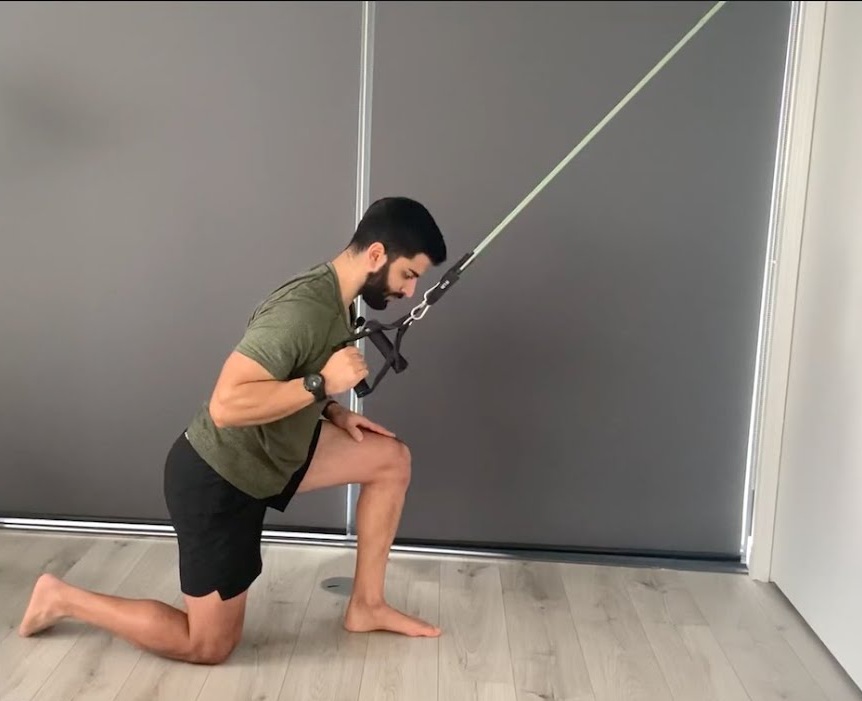
- Kneeling Behind-the-Body Lat Row
- More stability
- Reduced cheating
- Deeper lat isolation
Great for beginners or anyone correcting form.
- Bilateral Behind-the-Body Cable Row
- Requires two cable towers
- Harder to stabilize
- Excellent for symmetry and control
Better for advanced bodybuilders.
- High-Pulley Behind-the-Body Row
- More downward elbow path
- Slightly more lower-lat activation
A rare but potent twist.
Who Should Use This Exercise?
Bodybuilders
Perfect for:
- Lat thickness
- Lower lat development
- Better mind-muscle connection
- Improved symmetry
- Fixing imbalances
Physique Athletes (Men’s Classic, Men’s Physique)
This exercise directly enhances:
- V-taper
- Lower lat drop
- Back pose sharpness
General Lifters
Great for learning how to feel your lats, especially if pull-ups and rows always feel like “just arms and upper back.”
Strength Athletes
Helpful for:
- Stabilizing the shoulder
- Improving lat engagement for deadlifts
- Building stronger arm drive
Beginners
One of the best early-stage teaching tools for isolating the lats correctly.
Practical Takeaways
- This is a pure lat isolation movement — treat it as such.
- The goal is long-range control, not heavy weight.
- Keep your chest high and torso stable — no leaning.
- Drive the elbow down and back, not inward.
- Pause at the bottom for a full squeeze.
- Use moderate reps and slow eccentrics.
- Works best after your main compounds.
When performed correctly, this exercise delivers an intense, undeniable lat contraction that many lifters have never felt before — even after years of rowing and pulldowns. For anyone hunting that wide-winged look, the Behind-the-Body Cable Lat Row is an essential tool.