Behind-the-Back Barbell Shrug — Upper Trap Mass, Thickness & Peak Developer
The bodybuilder’s secret weapon for 3D trap development and upper-back density
If you’ve spent enough time in old-school bodybuilding gyms, you’ve seen at least one massive lifter cranking out Behind-the-Back Barbell Shrugs with plates rattling and traps practically touching their ears.
This is one of those exercises that survived decades in bodybuilding culture for a reason: it works. Not just moderately well — absurdly well.
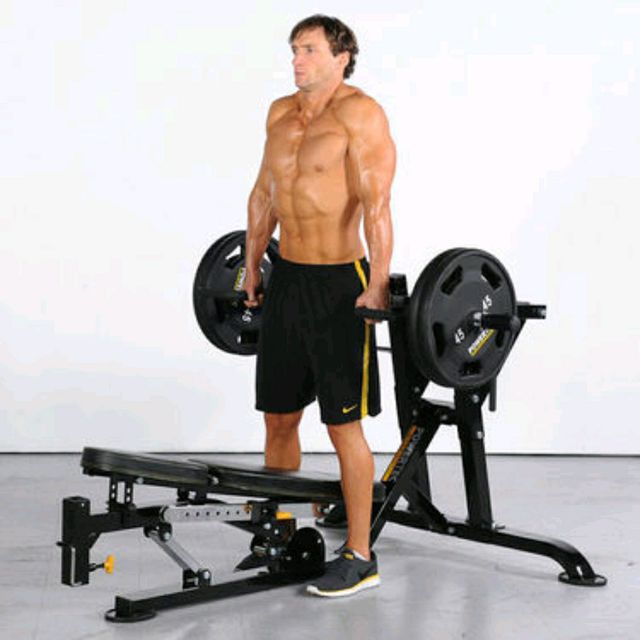
The Behind-the-Back Barbell Shrug is a high-precision trap-builder that places the bar behind your hips, creating an angle and line of pull that’s simply impossible to replicate with front-loaded shrugs.
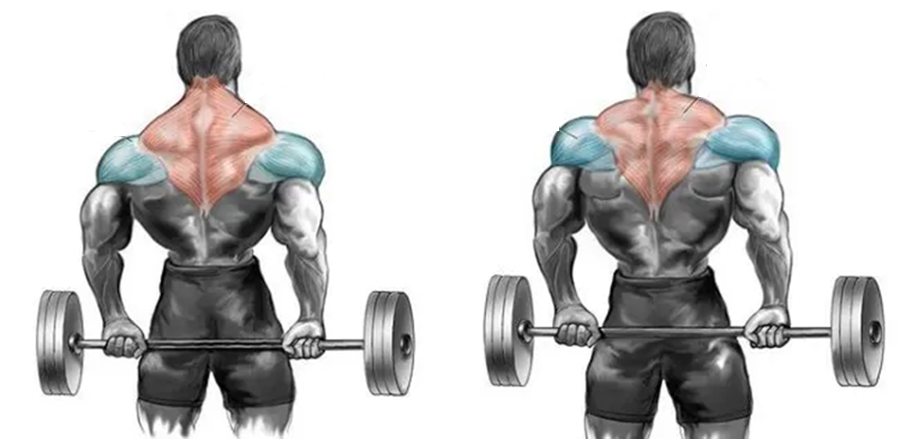
The result is a movement that lights up the upper traps, mid traps, levator scapulae, and upper spinal stabilizers with a tension profile that bodybuilders often describe as “a different kind of trap pump.”
This exercise is particularly useful for lifters who want:
- Taller, fuller trap peaks
- A thicker upper back for stage presence
- Better yoke development for strength sports
- A strong neckline and shoulder-to-ear density
- A shrug variation that doesn’t rely on grip strength as heavily
When programmed intelligently, Behind-the-Back Barbell Shrugs can rapidly enhance upper-trap hypertrophy and create the kind of trap mass that visually transforms the physique from the rear and side.
Muscles Worked
Primary Muscles
- Upper trapezius — the star of the show
- Levator scapulae — elevates the shoulder girdle
- Middle trapezius — stabilizes and retracts
- Upper spinal erectors — isometric stabilizers
Secondary Muscles
- Forearms & grip
- Rhomboids
- Rotator cuff stabilizers
- Upper serratus anterior
- Scalenes & deep neck stabilizers
While the traps get the attention, it’s the combination of upper-back stabilizers that makes this variation so effective for total yoke development.
Why Behind-the-Back Shrugs Hit the Traps Differently
Traditional shrugs load the traps from directly beneath you — vertical resistance, vertical shrug.
Behind-the-back shrugs change the equation.
- The bar path moves behind your center of mass
This shifts your torso slightly forward and moves the scapular line of pull into a tighter, more natural upward rotation. It becomes more of a “squeeze up and back” than a pure vertical shrug.
- Shoulder blades retract automatically
Because the bar is behind you, you must maintain a mild scapular retraction just to hold the bar. This adds mid-trap engagement.
- Greater upper trap stretch
The shoulders drift slightly forward at the bottom, pulling the trapezius fibers into a deeper stretch than most front-loaded shrugs allow.
- Less reliance on grip
Your hands are in a neutral-ish position behind you, meaning you can lift heavier loads without your grip giving out first.
- Superior peak contraction
Lifters often describe the top of a behind-the-back shrug as sharper, tighter, and fuller than traditional shrugs. This creates insane metabolic stress — a key hypertrophy trigger.
How to Perform the Behind-the-Back Barbell Shrug (Perfect Form Guide)
- Setup
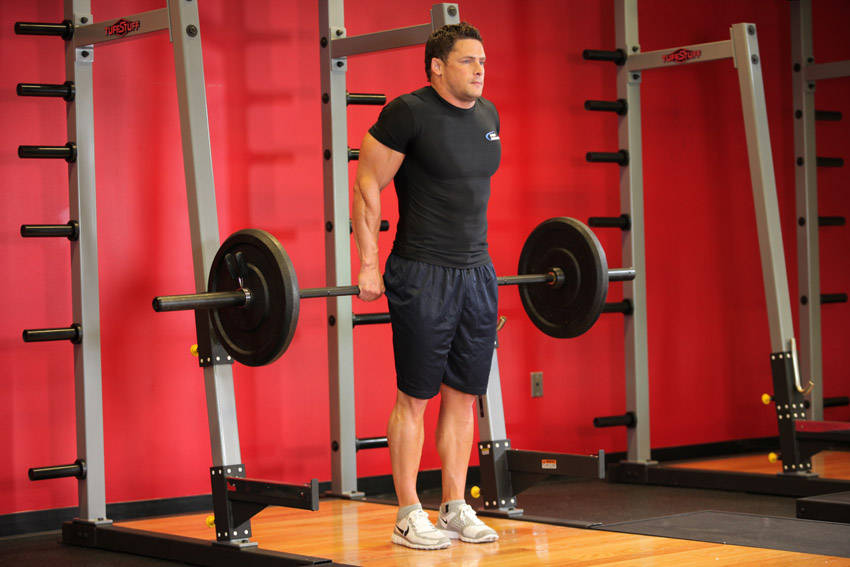
- Set a barbell on a rack around glute or fingertip height.
- Stand in front of the bar, step back, and grab it with a shoulder-width grip.
- Allow the bar to settle just behind your glutes/hamstrings.
- Stand tall with soft knees and chest lifted slightly.
- Starting Position
- Arms fully extended
- Shoulders relaxed
- Bar resting lightly behind your thighs
- Neck neutral — no looking up
- Brace the core as if preparing for a deadlift
Execution
- Raise your shoulders up and slightly backward
Think of pulling your shoulders toward your ears and back in a smooth arc. - Hold and squeeze hard at the top
Pause for 1 full second and contract the traps violently. - Lower with control
Let the shoulders stretch downward.
Don’t let the bar bounce off your glutes. - Breathing
- Inhale at the bottom
- Exhale when contracting at the top
- Maintain consistent bracing
- Rep Cadence
- 1-second squeeze
- 2–3-second negative
- Full stretch at the bottom
The magic is in the tempo. Momentum ruins this lift.
Common Mistakes (and How to Fix Them)
❌ Using too much weight
If the bar is lurching, bouncing, or barely moving, you’re training your ego — not your traps.
Fix:
Choose a load that allows a full peak contraction. Heavy doesn’t mean sloppy.
❌ Shrugging forward instead of up-and-back
This shifts load into the levators and neck instead of the traps.
Fix:
Imagine “tucking your shoulder blades into your back pockets.”
❌ Bending the elbows
This turns the movement into a half-upright-row — dangerous and ineffective.
Fix:
Keep elbows locked and relaxed. The arms are cables, not levers.
❌ Leaning too far forward
Slight forward lean = good
Torso collapse = bad
Fix:
Hinge only 5–10 degrees.
❌ Rushing the eccentric
The lowering phase provides the trap stretch that drives hypertrophy.
Fix:
Use a 2–3 second negative on every rep.
Training Cues for Maximum Trap Hypertrophy
- “Up and back.” Not straight up.
- “Long neck at the top.” Imagine growing taller during the squeeze.
- “Touch your traps to your ears.” Push for full elevation.
- “Spread your collarbones at the bottom.” Increases the stretch.
- “Pause until it burns.” The static squeeze is everything.
Sets, Reps, and Programming for Bodybuilders
Hypertrophy (Best Option)
- 4–5 sets of 10–15 reps
- 1–2 second squeeze
- 2–3 second eccentric
This is the “trap pump protocol.” Perfect for mass.
Strength-Endurance / Density
- 4 sets of 15–20 reps
- Lighter weight
- Short rest (~60–90 seconds)
This routine builds neck and trap endurance — great for combat athletes or strongman conditioning.
Heavy Shrugging (Advanced)
- 5–6 sets of 6–8 reps
- Straps recommended
- Big squeeze mandatory
- Maintain strict control
Great for thickness but requires good form discipline.
When to Use Behind-the-Back Shrugs in Your Workout
Option 1: After Heavy Back Work
Perfect finisher after rows, deadlifts, RDLs, etc.
Option 2: After Shoulder Pressing
Your traps are already warm — prime time to hit them.
Option 3: Dedicated Trap Day / Yoke Day
For lifters who want a truly dominant upper-back.
Option 4: Superset with Face Pulls or High Rows
Creates a back-to-back upper-trap & upper-back hypertrophy blast.
Variations & Alternatives
- Smith-Machine Behind-the-Back Shrug
More stability → more ability to isolate and squeeze.
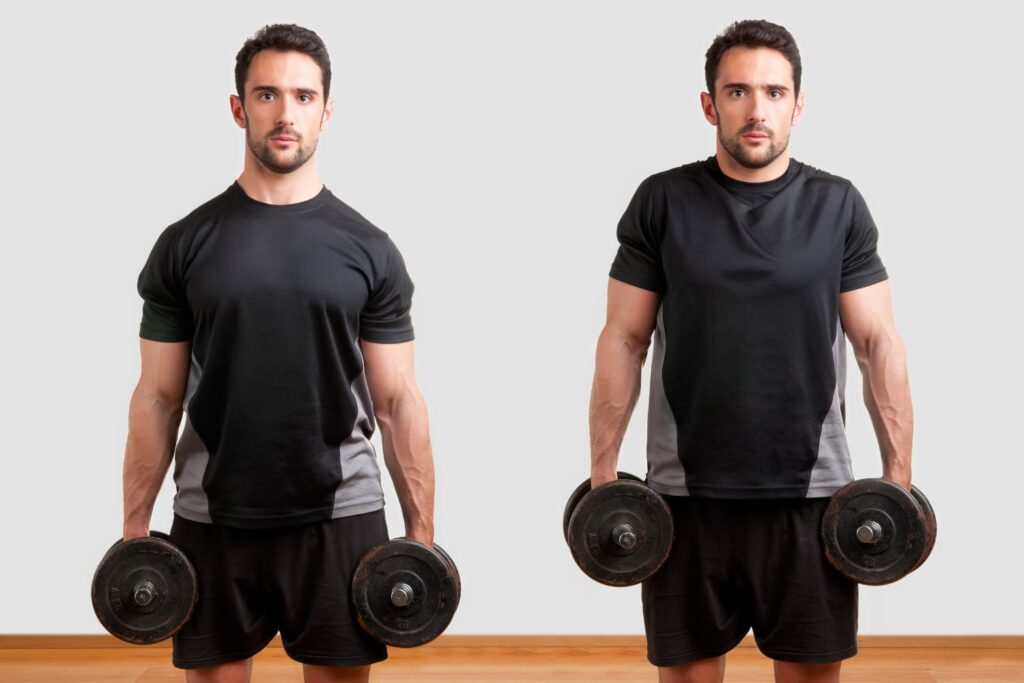
- Dumbbell Behind-the-Back Shrug
Great for lifters with mobility limitations.
- Cable Behind-the-Back Shrug
Continuous tension + easy peak contraction.
- Trap Bar Behind-the-Back Shrug
Neutral grip and less joint stress.
Who Should Do Behind-the-Back Shrugs?
Ideal for:
- Bodybuilders
- Strongman competitors
- Powerlifters needing extra trap strength
- Anyone wanting a thicker yoke
- Athletes requiring shoulder girdle stability
Not ideal for:
- Lifters with severe shoulder impingement
- Anyone who struggles to externally rotate the shoulders
- Beginners who haven’t mastered conventional shrugs yet
Practical Tips to Maximize Results
✔ Use straps
Grip shouldn’t be the limiting factor — the traps should.
✔ Don’t rush the reps
The stretch and squeeze are non-negotiable.
✔ Don’t shorten the ROM
Every rep should be full elevation → full stretch.
✔ Train traps twice per week
They recover quickly and respond well to frequency.
✔ Pair with upright rows or face pulls
This hits both the vertical and horizontal fibers.
Example Trap-Building Finisher with Behind-the-Back Shrugs
A1. Behind-the-Back Shrug — 12 reps
A2. Face Pull — 15 reps
A3. Smith-Machine Shrug — 10 reps
3–4 rounds
Minimal rest
Savage pump guaranteed.
Final Thoughts: Why Behind-the-Back Shrugs Deserve a Place in Your Program
The Behind-the-Back Barbell Shrug isn’t just a minor variation — it’s a completely different trap stimulus that hits the upper fibers from an angle no other shrug replicates. It emphasizes:
- Deep stretch
- Ferocious peak contraction
- Upper-back stability
- Neck and yoke density
- Consistent tension
If you want the iconic “bodybuilder trap shelf,” this movement is essential.
It’s simple.
It’s brutal.
And it works every single time.