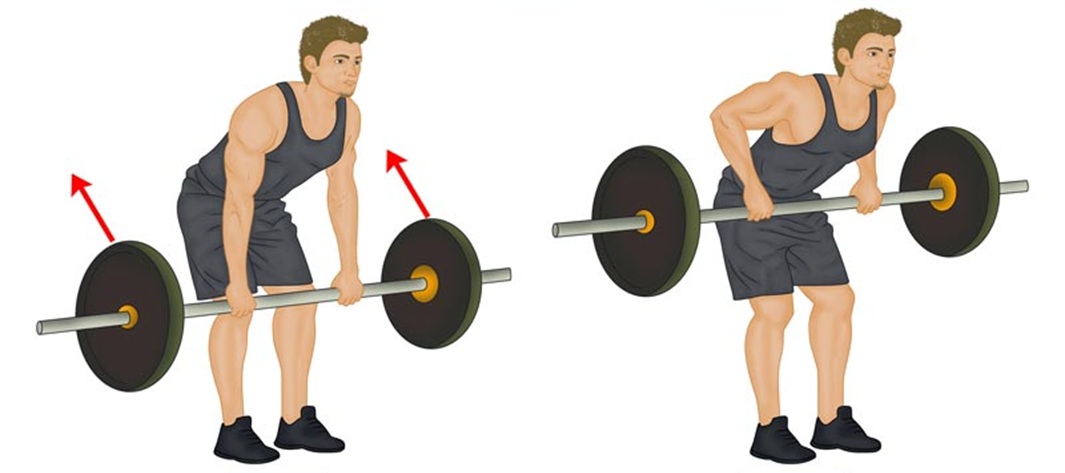
THE BARBELL BENT-OVER ROW
When you look at the backs of legendary bodybuilders — Dorian Yates, Ronnie Coleman, Franco Columbu — there’s one exercise that shows up so consistently, so relentlessly, that it has become synonymous with back mass:
The Barbell Bent-Over Row.
Whether performed strict like a bodybuilder or explosively like a power athlete, the barbell bent-over row is one of the most brutally effective ways to build:
- A thick upper back
- Dense mid-back musculature
- Powerful spinal erectors
- Strong forearms and grip
- A complete, armor-plated posterior chain
Some exercises build width.
Some build detail.
Some build strength.
The bent-over row builds everything.
In the Upper Back series, this movement becomes your foundation — your flagship compound lift that sets the tone for back thickness and dense, grainy muscle growth.
Let’s break down how to use the barbell bent-over row like a serious bodybuilder, not a casual lifter.
Why the Barbell Bent-Over Row Is Irreplaceable
- It Loads the Entire Back With Heavy, Sustainable Weight
The barbell row is one of the few movements that lets you overload:
- Lats (upper fibers)
- Rhomboids
- Rear delts
- Mid traps
- Lower traps
- Erectors
- Biceps and brachialis
- Forearms
…all at once.
Very few exercises stimulate this much musculature in one pattern.
This makes it incredibly efficient for hypertrophy — you get more growth per rep than almost any other lift.
- It’s the Best Builder of Back Thickness
If pull-ups and pulldowns build back width, rows build thickness — the deep, rugged density that makes a physique look powerful from every angle.
The barbell row is the heaviest form of row most lifters can perform, which means:
- High mechanical tension
- High loading potential
- Excellent progressive overload
- Tremendous hypertrophic stimulus through the whole back
This is why bodybuilders include it in every mass-building phase.
- It Strengthens the Posterior Chain for Every Other Lift
Few “back” exercises carry over to:
- deadlifts
- RDLs
- squats
- Olympic lifts
- strongman movements
…but the barbell row absolutely does.
It reinforces the hip hinge, trains the erectors isometrically, and strengthens the upper back for heavy compound lifting.
This is a movement that makes everything else in your program better.
- It Teaches True Back Engagement
Because the lift demands control, positioning, and tension, it teaches beginners and intermediates how to actually use their backs — not just their arms — to pull weight.
That mind–muscle connection carries over to:
- machines
- dumbbells
- pulldowns
- cable rows
The barbell row “coaches” you into strong back mechanics.
Muscles Worked
Primary Targets
- Rhomboids
- Mid traps
- Lower traps
- Rear delts
- Upper lats
Secondary Targets
- Spinal erectors
- Biceps
- Brachialis
- Forearms and grip
- Long head of triceps (stabilization role)
Stabilizers
- Hamstrings
- Glutes
- Core musculature
This combination makes the bent-over row a hybrid between an upper-back exercise and a posterior-chain strength builder.
How to Perform the Barbell Bent-Over Row (Bodybuilding Style)
There are two primary styles:
- Strict bodybuilding style (hinge fixed, minimal momentum)
- Power style (slight hip snap, heavier loads)
This explainer focuses on the strict bodybuilding variation for maximum upper-back and mid-back hypertrophy.
- Set Your Stance and Grip
Feet: shoulder-width
Grip: just outside shoulder-width
Bar position: directly over mid-foot
For upper-back focus, a slightly wider, pronated grip is ideal.
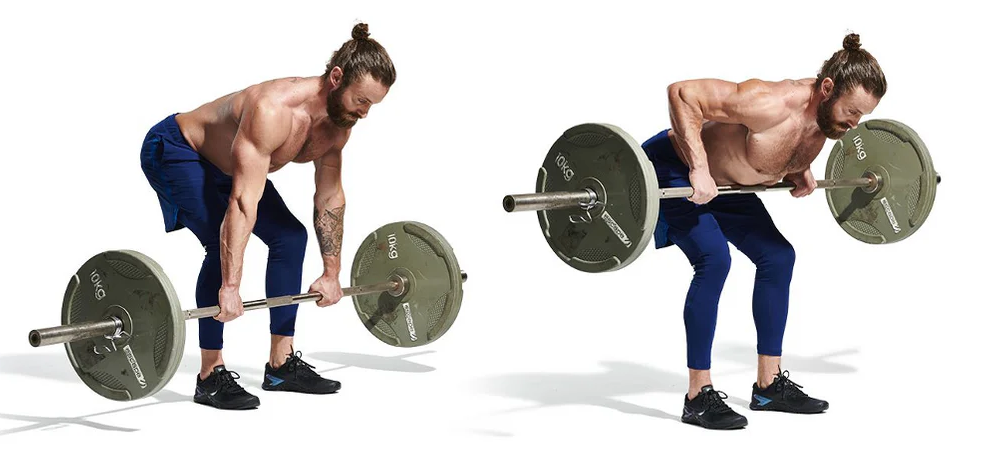
- Hinge Into Position
Push your hips back until your torso is roughly:
30–45 degrees from parallel
(not fully horizontal)
Your spine stays neutral.
Your core is braced.
Your hamstrings should feel tension.
This lean angle shifts emphasis into:
- rhomboids
- traps
- rear delts
- upper lats
Lower angles (closer to parallel) recruit more lats — but for an upper-back guide, the mid-lean works best.
- Let the Bar Hang and Set Your Scapula
Arms straight.
Shoulder blades “open.”
Chest slightly elevated.
Neck in neutral alignment.
You should feel a deep stretch across the upper back.
- Drive the Elbows Back (Not Up)
The key cue:
“Elbows back toward the hips, not up toward the ceiling.”
This ensures:
- less trap dominance
- more rhomboid engagement
- reduced biceps takeover
- a fuller upper-back contraction
Squeeze the shoulder blades together at the top.
- Lower the Bar Slowly
Use a controlled 2–3-second eccentric.
Feel the stretch.
Don’t let the bar crash downward.
The eccentric phase is where most hypertrophy happens in the barbell row.
- Maintain Torso Position Throughout
Your hips should stay locked.
Your back angle should stay fixed.
Your torso shouldn’t rise as fatigue sets in.
If your torso starts creeping upward, drop the weight.

Common Mistakes (and How They Kill Your Back Gains)
❌ Mistake 1: Standing too upright
This turns the movement into a shrugging half-row.
Fix: Aim for a consistent 30–45° hinge.
❌ Mistake 2: Relying on momentum
If the bar is flying around, your upper back isn’t doing the work.
Fix: Add time under tension. Slow down.
❌ Mistake 3: Pulling with the hands instead of the elbows
This creates biceps-dominant rows.
Fix: Mind–muscle cue: “Elbows lead.”
❌ Mistake 4: Not engaging the core
A loose core = spinal instability.
Fix: Brace as if you’re preparing for a punch.
❌ Mistake 5: No full stretch
The stretch portion is one of the biggest hypertrophy drivers.
Fix: Let the scapulae protract fully on each rep.
How to Bias the Upper Back vs the Lats
For Upper Back / Mid-Back Thickness:
✔ Torso: 30–45° angle
✔ Grip: medium–wide, pronated
✔ Elbows: flared 45–60°
✔ Bar path: toward mid-to-upper stomach
✔ Squeeze traps/rhomboids at peak
For More Lat Involvement:
✔ Torso: closer to parallel
✔ Grip: neutral or underhand
✔ Elbows: tight to ribs
✔ Bar path: lower abdomen
✔ Focus: elbow to hip
Even though this is your upper-back series, it’s useful to explain both patterns — readers love customizability.
Programming the Barbell Bent-Over Row
For Hypertrophy (Upper Back Focus):
3–4 sets
6–10 reps
1–2 RIR
Heavy enough for tension, strict enough for clean reps.
For Back Density & Strength-Endurance:
3–5 sets
8–12 reps
Controlled tempo
Minimal torso movement
For Advanced Lifters (Power + Hypertrophy Hybrid):
4 sets
6 heavy reps (power row)
immediately followed by
10 strict reps (lighter)
This contrast method is one of the best ways to stimulate new growth.
Training Strategies for Maximum Upper-Back Growth
- Use straps when needed
Your grip will fail before your back does.
Straps allow pure back stimulation.
- Use progressive overload — carefully
Increase weight in small increments and only when form is perfect.
- Keep your hinge locked
Any upward torso drift kills tension.
- Combine with a vertical pull
Your upper-back workout might begin with:
- Wide-grip pull-ups
- Diverging pulldown
- Machine pullover
…then finish with rows to build thickness.
- Add a “stretch set” at the end
After your last work set:
- Use a lighter load
- Perform 12–15 controlled reps
- Hold the bottom stretch for 1–2 seconds
This massively improves rhomboid and lat fiber recruitment.
Who Should Prioritize the Barbell Bent-Over Row?
✔ Bodybuilders
For maximum upper-back density and grainy detail.
✔ Strength Athletes
To build strong traps, lats, and spinal erectors for deadlifts.
✔ Intermediates
To learn heavy hinged pulling mechanics.
✔ Advanced Lifters
To overload the back with serious weight in a free-weight pattern.
Practical Takeaways
- The barbell bent-over row is one of the best upper-back/mid-back hypertrophy tools in existence.
- Keep your torso locked and your hinge fixed for maximum tension.
- Pull with your elbows, not your hands, to avoid biceps takeover.
- Use straps if grip is limiting.
- Progress slowly — the movement is technical.
- Pair with vertical pulls for balanced back development.
This exercise deserves a permanent spot at the top of your thickness-focused back days.