T-BAR ROW (UPPER-BACK & MID-BACK THICKNESS BUILDER)
The Complete Bodybuilder’s Guide
If you ask any old-school bodybuilder what built their back thickness, two movements show up nearly every time: the barbell bent-over row… and the T-bar row.
Where the barbell row demands maximum body control, the T-bar row lets you brace, dig in, and move serious weight—making it one of the most effective mass-builders for the upper back, mid-back, spinal erectors, and rear delts.
Whether you’re chasing an elite V-taper, dense traps, or that thick, grainy back that screams “advanced lifter,” the T-bar row earns its place in any bodybuilding program.
This guide breaks down everything you need to build a physique-altering back with the T-bar row: proper execution, biomechanics, variations, grip choices, programming strategies, and takeaways for lifters at every level.
What Makes the T-Bar Row Special? (Why Bodybuilders Swear by It)
The T-bar row hits a rare combination in back training:
① You can load it extremely heavy
The landmine lever action reduces the technical demands of barbell rowing.
Translation: you can load plates without your technique falling apart.
② It trains the upper back AND mid-back simultaneously
Used correctly, it builds:
- Upper traps
- Middle traps
- Rhomboids
- Rear delts
- Lats (depending on grip)
- Spinal erectors
- Teres major/minor
- Mid-back density
This is the kind of exercise that builds the deep, carved-out “Christmas tree” look and boulder-like upper-back mass.
③ It’s more stable than free rows but still challenges the posterior chain
You can hinge, brace, and pull without being as limited by low-back strain.
④ It works with multiple grips—each shifting the emphasis
Wide, medium, close, neutral, overhand, underhand…
The T-bar row can be tailored to any back goal.
⑤ It provides both stretch AND contraction focus
The arc of the bar forces a full stretch at the bottom and a strong squeeze at the top.
Muscles Worked (Upper-Back Biomechanics Breakdown)
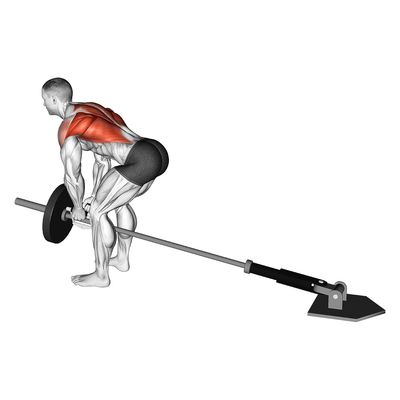
Primary Movers
- Middle trapezius
- Rhomboids
- Rear deltoids
- Teres major/minor
- Latissimus dorsi (depending on grip)
Secondary Muscles
- Spinal erectors / lower back
- Biceps & brachialis
- Forearms and grip
- Lower traps (to stabilize scapula)
Goal of the T-bar row:
Build back thickness—especially through the mid-back and upper-back musculature.
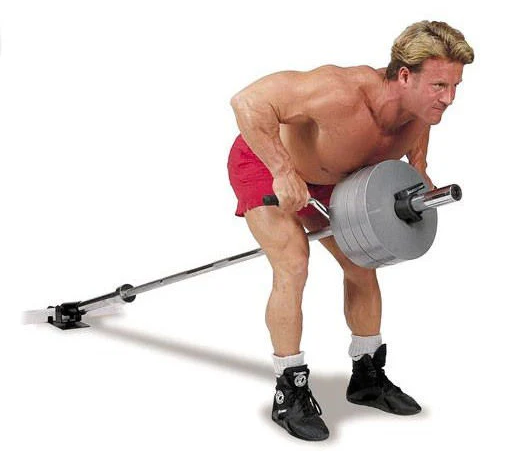
- How to Do the T-Bar Row (Bodybuilder Precision Execution)
Below is the version that maximizes upper-back and mid-back thickness.
Step-by-Step Technique
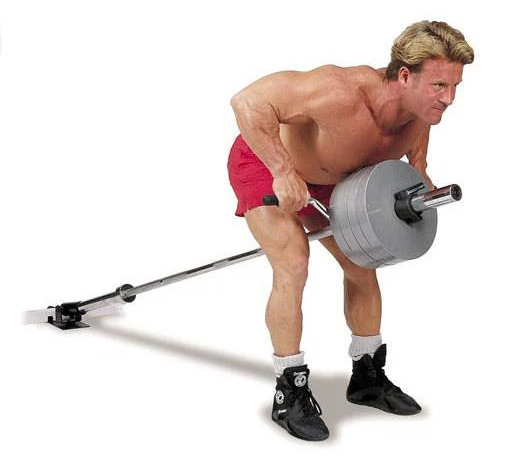
- Set Up the Machine or Landmine
If using a landmine:
- Load the free end of the bar with plates.
- Use a T-bar handle, V-bar, or neutral-grip attachment.
- Stand over the bar with feet shoulder width.
- Hinge Into Position
This is a hip-hinge row:
- Push hips back.
- Maintain a 25–45° torso angle (not fully upright).
- Keep the spine neutral—no rounding.
- Grip the Handle
Choose the attachment based on your emphasis:
- Neutral grip: upper-back + lats
- Wide grip: upper-back dominance
- Close grip: lat bias, but still lots of mid-back
- Brace the Core
Before pulling:
- Lock your ribs down
- Engage your glutes slightly
- Keep your chest proud without hyperextending the spine
- Pull the Weight Toward Your Chest/Upper-Stomach
- Lead the pull with your elbows, not your hands.
- Drive elbows back and out slightly
- Keep the bar close to your body
- Do NOT shrug—think “row, not lift.”
- Squeeze Hard at the Top
Hold the peak contraction for 1 full second.
Imagine trying to crack a walnut between your shoulder blades.
- Control the Weight Down
The eccentric is where back thickness is built.
- Lower slow (2 seconds)
- Feel the stretch
- No bouncing, no torso jerking
T-Bar Row Grip Variations & What They Train
The T-bar row is incredibly customizable. Every grip changes recruitment drastically.
- Close Neutral Grip (V-Bar Handle)
Best for: lat focus + mid-back density
Why: elbows stay tighter, pulling angle shifts toward the lower lats
- Medium Neutral Grip (Typical T-Bar Handle)
Best for: balanced mid-back + upper-back development
The “classic” T-bar pull.
- Wide Grip Neutral or Overhand
Best for: upper traps, rhomboids, rear delts
This creates a more horizontal pulling angle with elbows flaring out.
Bodybuilders use this grip to build upper-back roundness and width.
- Underhand Grip
Best for: lower lats + biceps involvement
Use lighter weight—tougher on elbows.
Common Mistakes (And How to Fix Them)
Mistake 1: Standing Too Upright
This turns the movement into a half-row, half-shrug.
Fix: hinge more. Aim for a 35–45° torso angle.
Mistake 2: Rounding the Lower Back
You lose tension and risk injury.
Fix: brace hard, widen your stance, and bend knees slightly.
Mistake 3: Jerking the Weight
Momentum destroys back tension.
Fix: lower the weight, pull smoothly, and emphasize the eccentric.
Mistake 4: Letting the Elbows Drop Too Low
This turns the row into a lat-only movement.
For upper-back emphasis, elbows should travel outward slightly—not pinned to your sides.
Mistake 5: Too Many Plates
Many lifters treat this like a strongman event.
Fix: Use weight you can control through a full ROM, especially the bottom stretch.
How to Train the T-Bar Row for Your Goal
➤ For Upper-Back & Mid-Back Thickness (Bodybuilding Priority)
- 4–5 sets
- 8–12 reps
- Medium to wide neutral grip
- 2–3 seconds of eccentric control
This builds the “3D back” look.
➤ For Strength (Powerbuilding Focus)
- 3–5 sets
- 5–8 reps
- Heavier weight
- More hip hinge, slightly more body English allowed
Great complement to deadlifts.
➤ For Hypertrophy Burnout / End of Workout
- 2–3 sets
- 12–20 reps
- Constant tension, minimal rest
This variation leaves the upper back pumped and engorged.

Advanced Bodybuilder Variations
These take the T-bar row from “great” to “elite-level back training.”
Strict Chest-Supported T-Bar Row
If your gym has the plate-loaded version with chest support:
Benefits:
- Eliminates cheating
- Zero lower-back strain
- Laser-targets the mid-back
Great for lifters with fatigue-limited erectors.
1.5 Rep T-Bar Rows
Technique:
- Pull all the way up
- Lower halfway
- Pull again
- Lower fully
Goal: maximum upper-back time under tension.
Pause Reps
Hold the contraction at the top for 2–3 seconds.
Result:
Insane rhomboid and trap activation.
Wide Grip T-Bar Row on a Lat Bar Attachment
Attach a wide handle to the landmine.
This becomes a hybrid between a T-bar row and a bent-over barbell row:
- More rear delts
- More upper-back
- Massive mid-back squeeze
Programming the T-Bar Row in a Back Routine
Example: Upper-Back / Thickness Day
- Barbell Rows – 4×6–8
- T-Bar Rows – 4×10–12
- Chest-Supported Row – 3×12
- Face Pulls – 3×15–20
Example: Lat-Focused Day (Accessory Role)
- Wide-Grip Lat Pulldown – 4×8–12
- Single-Arm Lat Pulldown – 3×10
- Straight-Arm Pulldown – 3×12–15
- T-Bar Rows (close-grip) – 3×10–12
- Dumbbell Rows – 3×10
Example: Powerbuilding Back Day
- Deadlift – 3×3
- Barbell Rows – 4×5
- T-Bar Rows – 3×6–8 (heavy)
- Pull-Ups – 3×8
Who Should Use the T-Bar Row?
Perfect for:
✔ Bodybuilders wanting mid-back and upper-back density
✔ Powerbuilders who want both size and strength
✔ Intermediates who have mastered basic rows
✔ Lifters needing a heavy but stable row variation
✔ Those who struggle to feel upper-back engagement in other rows
Maybe avoid or modify if:
✘ You have active lower-back injuries (use chest-supported version)
✘ You round excessively during pulls
✘ You rely too much on momentum
Practical Takeaways for Lifters of All Levels
Beginners
- Use a chest-supported version or light free version
- Focus on learning the hinge position
- Keep reps controlled; no heavy loading yet
Intermediate Lifters
- Start rotating grips (medium, wide, close)
- Use progressive overload
- Begin integrating intensity techniques (paused reps)
Advanced Lifters
- Use multiple variations in one periodized program
- Integrate 1.5 reps, paused reps, or heavy power rows
- Use T-bar rows as a power movement or hypertrophy movement depending on the phase
- Train with intention: choose the variation that matches your focus (upper-back vs lat)
Final Thoughts — Why No Back Routine Is Complete Without T-Bar Rows
The T-bar row is more than a “variation”—it’s a cornerstone.
It’s one of the few movements that can build:
- upper-back roundness
- deep mid-back density
- thick rear delts
- powerful spinal erectors
- and overall back authority
Few exercises allow you to train the back with:
- heavy load
- stability
- full range of motion
- adjustable grip emphasis
- both stretch and contraction
If you want a back that looks like armor plating—layered, dense, and undeniably muscular—the T-bar row should be a staple in your weekly programming.