THE KROC ROW
The Brutally Heavy, High-Rep Row for Lat Thickness, Upper-Back Power & Grip Endurance
The Back-Building Staple of Powerlifters and Bodybuilders Alike
Introduction: The Myth, the Method, the Mass-Building Reality
Some exercises become famous because they look cool.
Others because they fit nicely into a program.
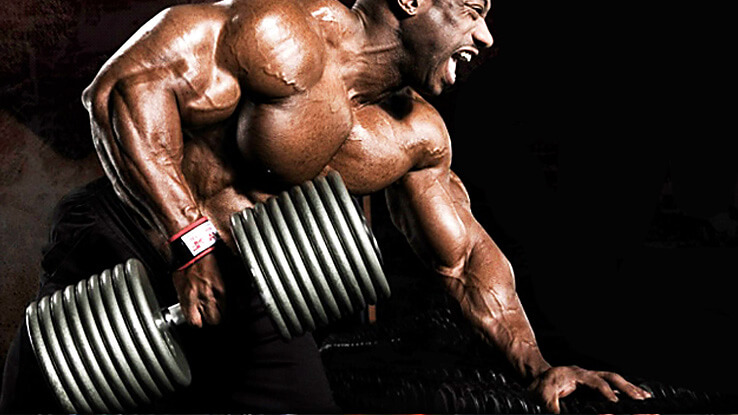
The Kroc Row, however, became legendary because it flat-out builds back mass like almost nothing else on earth. Originally developed and popularized by elite powerlifter and bodybuilder Matt Kroczaleski, this movement is a heavy, high-rep, intensity-driven one-arm dumbbell row—but that description barely scratches the surface.
A proper Kroc Row is:
- Heavier than any one-arm dumbbell row you’ve ever done
- Performed for brutally high reps (15–40+)
- Executed with maximum intensity and controlled momentum
- Not strict, not sloppy—just brutally effective
- Focused on back mass, grip strength, and raw pulling power
This is not a “pretty” exercise.
It is not a “slow and controlled” isolation movement.
It is not meant to be gentle, neat, or polished.
It is a battle—and it builds the type of back thickness, density, and rugged detail that strict rowing simply cannot replicate.
This explainer breaks down everything you need to know:
- How the movement works
- What muscles it targets
- Exact setup and technique
- Common mistakes
- Training strategies
- Rep schemes
- Bodybuilding vs strength variations
- Practical takeaways for lifters of all levels
Let’s dive deep into the most intense row of your training life.

What Is a Kroc Row?
A Kroc Row is a specific style of single-arm dumbbell row characterized by:
✔ Extremely heavy load
Typically, you use the heaviest dumbbell you can safely row for 15–30+ reps.
✔ High reps taken near failure
Unlike typical dumbbell rows done for 8–12 reps, Kroc Rows often go into the 20–40 rep range to build both strength and endurance.
✔ Controlled body English
Some torso movement is intentional—this is not strict.
But it’s also not sloppy.
You use just enough momentum to allow the lats, traps, rhomboids, and rear delts to continue the set past your “strict form” limit.
✔ Upper back + lats + grip focus
Unlike lat-dominant dumbbell rows, the Kroc Row hits:
- Lats (especially lower and mid fibers)
- Traps (mid and lower)
- Rhomboids
- Rear delts
- Spinal erectors
- Grip and forearm flexors
It’s a hybrid row—part bodybuilding, part powerlifting, part grip training.
Why Bodybuilders LOVE the Kroc Row
Because it builds dense, thick upper backs—the kind that wins shows and dominates front and rear lat spreads.
A heavy Kroc Row:
- Adds mass to the lower lats
- Thickens the mid-back
- Develops a deep “3D” rear delt tie-in
- Builds the rugged, powerful look that compounds alone can’t achieve
- Strengthens the grip and forearms while hitting the back hard
It also simulates the kind of total-body bracing you need for deadlifts and heavy rows.
Why Strength Athletes LOVE the Kroc Row
Three big reasons:
- It builds stronger deadlifts
The Kroc Row hits the exact areas that break down during deadlifts:
- Grip
- Upper back
- Lats
- Core stability
- It builds mid-range pulling strength
High-rep rows build the strength endurance needed for long pulls.
- It makes your grip nearly unbreakable
If your hand strength is a weakness, Kroc Rows will expose it—and fix it.
Muscles Worked
Primary Targets
- Lats (entire length—especially lower and outer lats)
- Mid back (rhomboids, mid traps)
Secondary Targets
- Rear delts
- Lower traps
- Spinal erectors
- Core
- Obliques
Grip & Forearm Emphasis
- Finger flexors
- Brachioradialis
- Wrist stabilizers
The Kroc Row is one of the few rows that truly challenges total upper body pulling power.

How to Perform the Kroc Row (Step-by-Step)
- Setup: Bench Support
Use a flat bench for support:
- Place one hand at the front of the bench
- Stagger your feet—rear foot for stability
- Keep your torso just above parallel to the floor
You should feel solid, but not rigid.
- Grip the dumbbell with a deadlift-style hand position
Grip like you mean it:
- Chalk helps
- Straps are optional (more on that later)
- Grip HARD to activate the back
- The Rowing Path: Aim for the Hip
Unlike typical rows pulled toward the ribs, Kroc Rows involve pulling:
Toward your hip or lower abs
This maximizes lat recruitment and keeps the motion strong.
- Pull with controlled aggression
A proper Kroc Row is:
- Fast on the way up
- Stretching fully at the bottom
- Using minimal—but strategic—body English
You are not cheating.
You are extending the set to build more strength and mass.
- Don’t cut the range short
Even with heavy weight:
- Stretch fully
- Pull as high as possible
- Fight for every rep
- Rep Range: As many as you can… plus more
Your rep target might be:
- 15–20 reps for beginners
- 20–30 reps for intermediates
- 30–40 reps for advanced lifters
- 40+ reps for elite-level intensity
When you finish a set of true Kroc Rows, you shouldn’t be able to talk for at least 10 seconds.
Straps vs. No Straps
✔ No Straps
— Builds the strongest grip imaginable
— More authentic to classic Kroc Row style
✔ With Straps
— Allows more back overload
— Good if grip is a limiting factor
— Helps keep tension in lats & rhomboids longer
Matt Kroc himself used straps.
So you’re in good company either way.
Common Mistakes
❌ Mistake #1 — Turning it into a full-body heave
This is NOT CrossFit-style kipping.
Control matters.
❌ Mistake #2 — Cutting the stretch
The stretch is everything in this movement.
It builds the lats and traps.
❌ Mistake #3 — Using too little weight
This exercise must be heavy.
❌ Mistake #4 — Not bracing the core
A loose torso equals a weak row.
❌ Mistake #5 — Doing too many sets
This movement is intensity-based.
You don’t need 5–6 sets.
You need 1–2 all-out sets per side.
Programming the Kroc Row
There are two main ways to run it:
Option 1: Bodybuilding Size & Back Density
2 sets per side:
- 20–30 reps (heavy)
- Rest 2–3 minutes between arms
Focus:
- Back density
- Lat-meets-upper-back fullness
Option 2: Strength & Grip Power
1–2 max sets per side:
- 25–40 reps
- Straps optional
- Push near total muscular exhaustion
Focus:
- Deadlift transfer
- Grip strength
- Mid-back endurance
Kroc Rows vs Traditional Dumbbell Rows
| Feature | Kroc Row | Traditional DB Row |
| Load | Extremely heavy | Moderate |
| Reps | 15–40+ | 8–12 |
| Technique | Controlled body English | Strict |
| Focus | Lats + upper back + grip | Lats (more isolated) |
| Goal | Mass, density, power | Size, control, hypertrophy |
| Energy Demand | Very high | Moderate |
Use BOTH styles in a training cycle.
Where Kroc Rows Fit in Your Back Workout
Ideal placement:
Mid-to-late workout, after:
- Deadlifts or rack pulls
- Barbell or machine rows
- Pulldowns or pull-ups
But before light isolation work.
Because Kroc Rows tax your lungs and grip, they’re best placed while you still have:
- Mental intensity
- Torso stability
- Neuromuscular focus

Who Should Do Kroc Rows?
✔ Bodybuilders
For rugged back thickness and lat density.
✔ Powerlifters
For deadlift lockout strength and grip.
✔ Strongmen
Perfect for events requiring huge pulling endurance.
✔ Anyone stuck with thin upper backs
This movement makes backs thick, not just wide.
Who Should NOT Do Kroc Rows
- Beginners who cannot stabilize with heavy loads
- Lifters with serious lower-back injuries
- Anyone who cannot feel their back working
These lifters should master strict rows first.
Variations & Modifications
- Strapped Kroc Rows (More back, less grip)
Great for high-volume bodybuilding.
- No-Strap Kroc Rows (More grip, more forearms)
Best for deadlift-focused lifters.
- Incline Bench Kroc Rows
Less core stress, more lat focus.
- Kettlebell Kroc Rows
Good when dumbbells are limited.
Practical Takeaways (Lifters of ALL Levels)
Beginner
- Start with strict dumbbell rows
- Build technique
- Only progress to Kroc Rows once ready
Intermediate
- Use Kroc Rows for mass phases
- Add them once per week
Advanced
- Use as a primary back-thickness lift
- Go heavy and push the limits
- Use straps for maximum output
Bodybuilders
- Perfect for improving back thickness
- Huge benefit for rear double biceps pose
Powerlifters
- Dramatically improves deadlift performance
- Builds insane grip strength
Conclusion: The Most Intense Row You Will Ever Perform
The Kroc Row is not elegant.
It’s not pretty.
But it works so well that it has become a global staple for bodybuilders, powerlifters, and strength athletes who want:
- Dense back thickness
- Stronger lats
- Superior grip strength
- Unmatched pulling endurance
- A rugged, powerful physique
This lift builds the kind of back that looks impressive from every angle—front, side, and rear.
If you’re ready to expand your back beyond what strict rows can deliver…
If you want power AND muscle…
If you want a lift that will challenge you mentally as much as physically…
Then it’s time to add Kroc Rows to your program.
You’ll feel the difference.
And your back will show it.