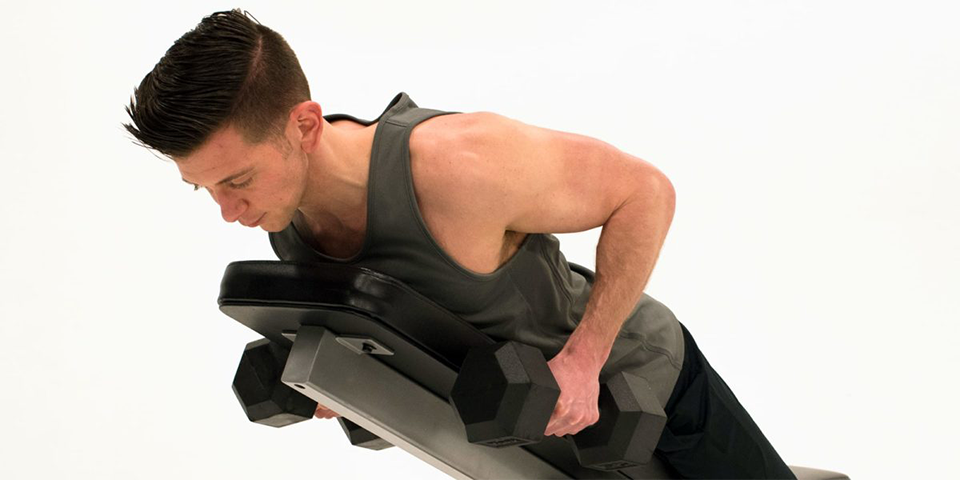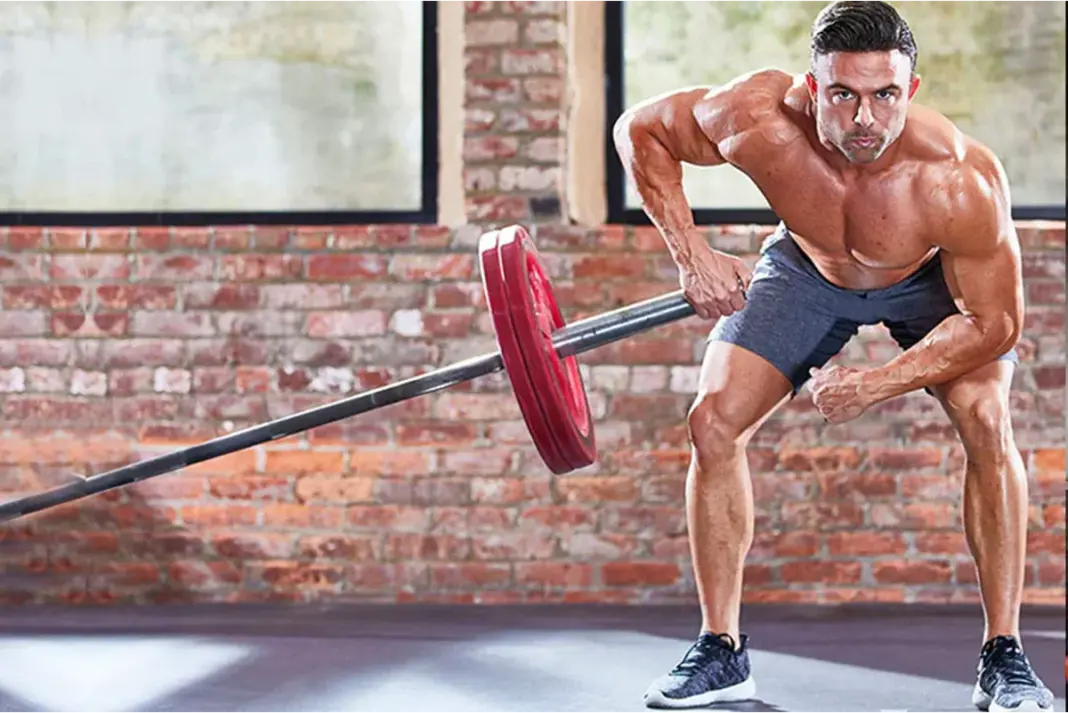
Meadows Row (Lat-Focused) — The Brutal, High-Output Row Popularized by John Meadows
Few back exercises in modern bodybuilding have the same reputation for brutality, effectiveness, and raw muscular output as the Meadows Row.
Named after the late bodybuilding legend John Meadows, this unique unilateral landmine row variation became a staple in high-level hypertrophy programming because it solves several problems traditional rows create—especially for lifters who struggle to “feel” their lats.
When executed correctly, the Meadows Row offers a rare blend:
- Deep lat stretch
- Enormous lat contraction
- High stability demand
- Strong anti-rotation stimulus
- Shoulder-friendly rowing path
- Massive loading potential
This isn’t just a row variation—it’s a mass-building weapon, designed specifically to torch the lats, teres major, rhomboids, and lower traps while sparing the lower back from over-fatigue. Let’s break it down in full detail.
What Makes the Meadows Row Unique?
- The Chest-Open, Elbow-Out Row Path
Because the barbell sits at an angle on a landmine, the pulling path is neither perfectly vertical nor horizontal. This forces the elbow to travel slightly away from the body, biasing:
- The upper lat fibers
- The teres major
- The mid-back thickness muscles
This gives the Meadows Row a hybrid feel—somewhere between a lat-biased row, a rear-delt row, and a machine row.
- Elevated Rear Foot Increases Stretch and Stability
The signature technique involves placing the foot closest to the bar on an elevated surface like a bumper plate or low platform.
This elevation:
- Opens the hips
- Allows for a deeper lat stretch
- Helps the torso stay hinged correctly
- Enhances stability through the stance
The position looks unusual, but it works exceptionally well.
- Immense Anti-Rotation Core Demand
Because the weight is loaded on one end of the barbell and only one hand is pulling:
- The body must resist twisting
- The obliques fire hard
- The lower back stabilizers engage without being overloaded
This helps build usable strength and contributes to a thicker, more stable torso.
- Perfect for Heavy or High-Rep Work
The movement accommodates:
- Heavy loading (low reps)
- Long mechanical-tension sets (moderate reps)
- Pump-style hypertrophy work (high reps)
John Meadows often programmed them for brutal 20–30 rep finishers.
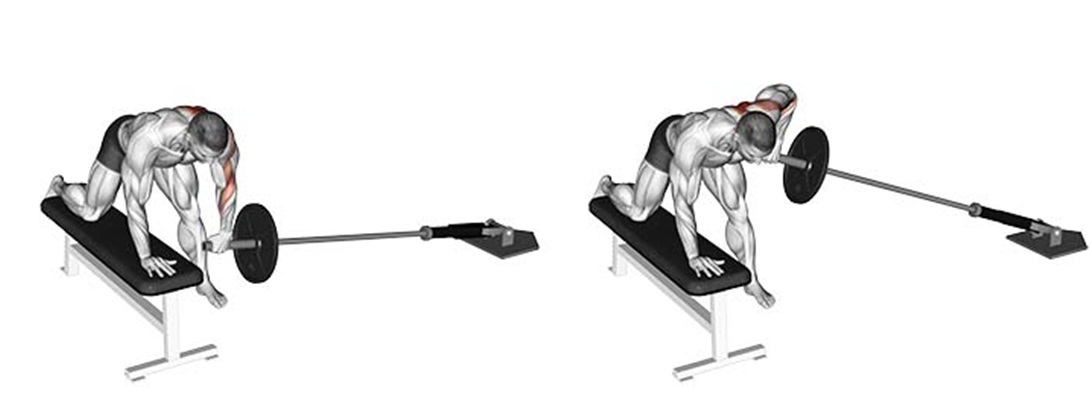
Muscles Worked
Primary:
- Latissimus dorsi
- Teres major
- Rhomboids
- Middle traps
Secondary:
- Rear delts
- Lower traps
- Erectors (stabilization)
- Obliques and deep core (anti-rotation)
How to Perform the Meadows Row (Step-by-Step)
Setup
- Load one end of a barbell in a landmine.
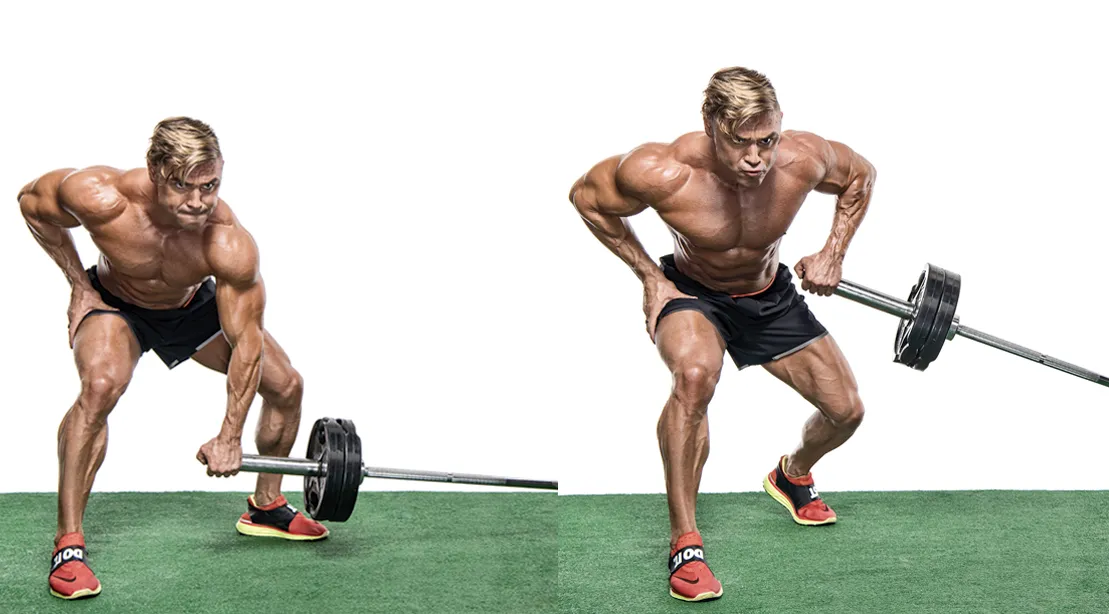
- Stand side-on to the barbell, the loaded end directly beside your front foot.
- Elevate your rear foot on a plate or low block.
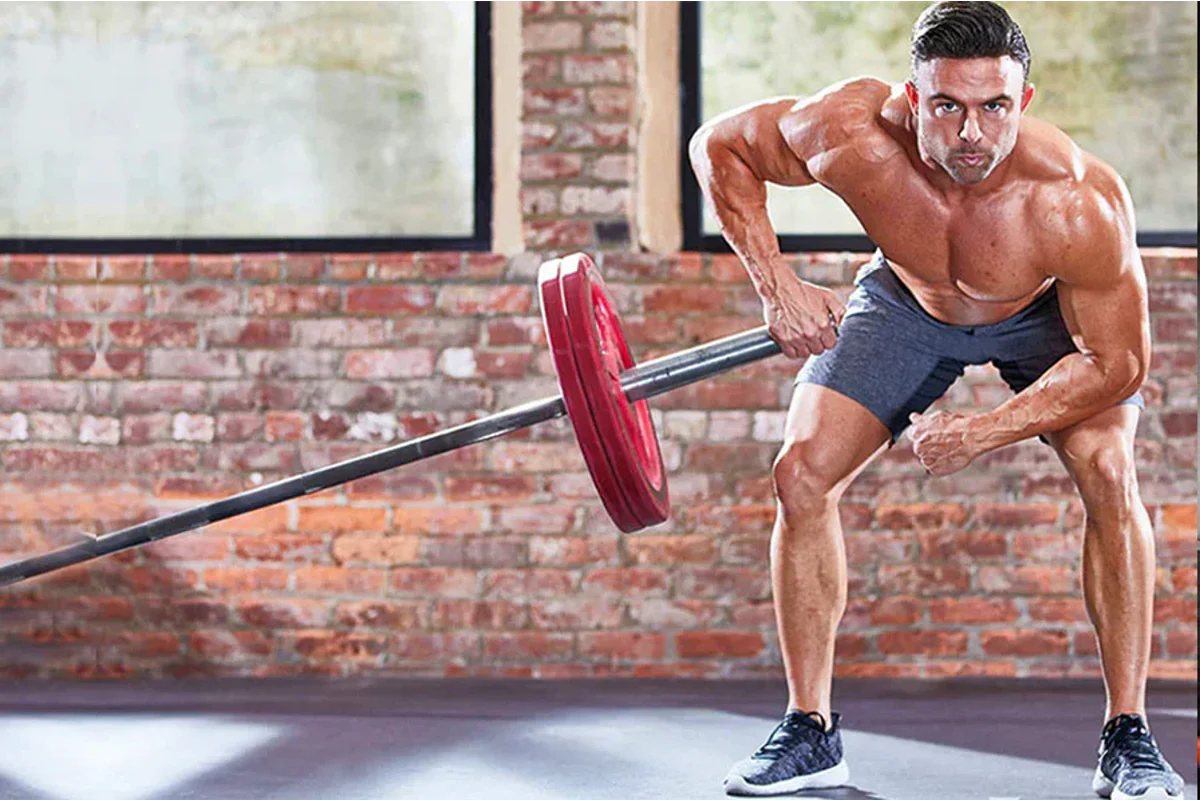
- Hinge forward until your torso is around 30–45 degrees above horizontal.
- Grip the barbell sleeve with a strapped, overhand grip.
Note:
Using lifting straps is highly recommended. The sleeve has no knurling, and the Meadows Row is meant to push beyond grip limitations.
Execution
- Let the shoulder blade stretch forward to feel the lat elongate.
- Initiate the pull by driving the elbow up and back, not straight up.
- Keep the elbow slightly flared—around 30 degrees from the ribs.
- Pull until the hand reaches your torso or slightly beyond.
- Pause for 1 second and squeeze the lat hard.
- Lower slowly, allowing a full stretch at the bottom.
Key Form Points
- Keep the torso fixed—no twisting to cheat reps.
- Think “drive elbow toward hip” for more lat bias.
- Keep shoulders low; don’t shrug up.
- Let the scapula move naturally: protract on the way down, retract on the way up.
Common Mistakes & How to Fix Them
- Rotating the Torso
Problem: Twisting your body to complete reps shifts the load away from the lats.
Fix: Keep a soft brace in the core and imagine pulling in a straight line.
- Pulling Too Upright
If the torso angle is too vertical, the movement becomes an upper-trap shruggy row.
Fix: Hinge more. Think “bent-over dumbbell row position.”
- Not Using Straps
The bar sleeve is smooth, which destroys grip prematurely.
Fix: Use straps so the back gets full stimulation.
- Rushing Through the Stretch
The stretch is half the benefit of this movement.
Fix: Allow a full bottom portion with shoulder protraction.
- Letting the Hips Shift
If the hips rotate or sway, tension leaks from the target muscle.
Fix: Drive the elevated foot firmly into the block and brace the obliques.
How to Program the Meadows Row
Because the movement can be heavy, medium, or high-rep, it fits almost anywhere—but shines in specific slots.
Hypertrophy Programming
Option 1 — Mid-Workout Primary Row
- 3–4 sets of 8–12 reps
- Controlled tempo, hard contraction at top
Best for progressive overload tracking.
Option 2 — High-Rep Finisher (Meadows Style)
- 2–3 sets of 15–25 reps
- Minimal rest
- Stretch emphasis
This creates enormous metabolic stress and back density.
Option 3 — Strength-Endurance & Stretch Work
- 3–4 sets of 12–15 reps, 3-second negatives
- Focus on expanding the lat at the bottom
Pure hypertrophy gold.
Where It Fits in a Back Day
A typical “Meadows-inspired” back workout might look like:
- Heavy pulldowns or pull-ups (lat activation)
- Meadows Row (primary row)
- Machine row or chest-supported row
- Pullover variation
- High-rep cable row or stretch-based finishing work
This sequence is ideal because the Meadows Row hits the mid-back and upper lats while sparing the low-back fatigue that heavy barbell rows create.
Benefits of the Meadows Row
- Superior Unilateral Back Development
Helps fix imbalances caused by:
- Dominant traps
- Overuse of one side during deadlifting
- Uneven lat engagement
You’ll develop more symmetrical lats and better mind–muscle connection.
- Better Lat Stretch Than Dumbbell Rows
Dumbbells hit the thigh before you achieve full elbow extension.
The angled landmine arc allows complete lat lengthening.
- Shoulder-Friendly
Because your hand is neutral and pulling at an angle, the Meadows Row reduces stress on the:
- Biceps tendon
- AC joint
- Rotator cuff
This is helpful for bodybuilders with long-term wear and tear.
- Enhances Grip Strength (If Not Using Straps)
Even with straps, the forearms work heavily due to the unstable sleeve.
- Easy to Load Progressively
If you’re chasing long-term hypertrophy, progressive overload is crucial—and the Meadows Row offers slow, steady loading because:
- Small plates can increase difficulty incrementally
- Reps can increase easily
- The movement doesn’t require technical precision like barbell rows
- Huge Mid-Back Thickener
The combination of stretch, hinge position, and hard contractions gives the Meadows Row a dense, grainy mid-back development few exercises match.
Variations and Modifications
- Meadows Row Without Elevated Foot
Good for beginners who struggle with balance.
Lat stretch is slightly reduced.
- Strapped Meadows Row with Pause Reps
Pause for 2 seconds at the top.
Vicious contraction.
- Double-Arm Meadows Row (using two landmines)
Rare but extremely powerful if your gym has two landmine stations.
- Heavy Cheat Meadows Rows (Meadows Style)
John occasionally recommended a small amount of body English for high-rep sets to push past failure.
Use sparingly.
Who Should Use the Meadows Row?
Perfect For:
- Bodybuilders wanting lats + mid-back thickness
- Lifters who can’t feel their lats during typical rows
- People who want big results without taxing the lower back
- Anyone needing unilateral correction
- Intermediate and advanced lifters seeking variety and depth
Not Ideal For:
- Complete beginners
- Anyone with mid-stage back rehab
- Someone with poor hip hinge mechanics
- Gyms with no landmine or barbell corner available
Sample Meadows Row Workouts
Mass-Building Back Day (Classic Meadows Style)
- Wide-Grip Lat Pulldown — 3×10–12
- Meadows Row — 4×10 (each side)
- Chest-Supported Row — 3×8–10
- Neutral-Grip Pulldown — 3×12–15
- Dumbbell Pullover — 3×15–20
- Hyperextensions — 2×20
Lat-Focused Hypertrophy Day
- Straight-Arm Pulldown — 3×12–15
- Meadows Row — 4×8–12
- Single-Arm Cable Row — 3×10–12
- Low Cable Row (Lat Path) — 3×12
- Stretchers / Overhand Lat Row — 2×15–20
High-Intensity Finisher Day
After your main rows:
Meadows Row Finisher:
- 1 set × 25 reps each side
- Add partials at the end
- Full stretch at the bottom
This pump is unreal.
Practical Tips for Maximum Results
✔ Use straps — this is a bodybuilding movement, not a grip test.
✔ Think “elbow toward hip,” not “hand upward.”
✔ Work in the 8–15 rep range predominantly.
✔ Use the stretch to your advantage—milk it.
✔ Don’t overload too quickly; form breaks easily.
✔ Consider pairing with a pulldown movement for complete back engagement.
Final Thoughts: Why the Meadows Row Should Be in Every Serious Back Program
There are very few exercises in bodybuilding that deliver massive hypertrophy while being:
- Safe
- Stable
- Unilateral
- Customizable
- Heavy-load capable
- Shoulder-friendly
The Meadows Row checks all these boxes.
Its unique angle, deep stretch, massive contraction, and anti-rotation challenge combine to create one of the most potent mid-back and lat builders ever created.
For lifters who have never felt their lats truly working, this movement often becomes the missing link. And for advanced lifters, it becomes a long-term staple that continues delivering results for years.
If you want a thicker, wider, denser back—the Meadows Row deserves a permanent spot in your program.