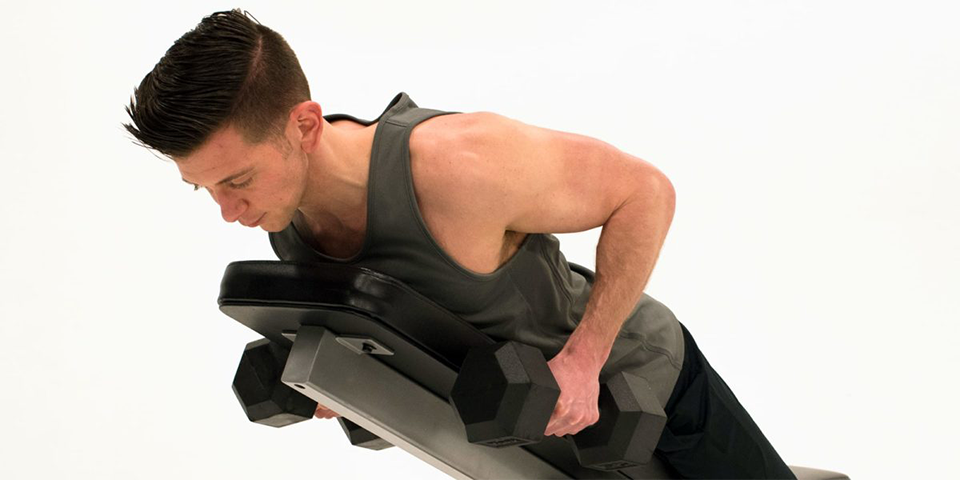
THE CHEST-SUPPORTED LAT ROW
The Ultimate Momentum-Free Lat Isolation Row for Width, Sweep, and Deep Stretch
Most lifters train their lats with pulldowns, pull-ups, and standard dumbbell rows—but very few unlock the full potential of the chest-supported lat row, a brutally effective variation performed on an incline bench with a lat-biased arm path.
This movement eliminates momentum, removes spinal stress, isolates each lat with high precision, and delivers one of the deepest lat stretches you can achieve with free weights.
If the lat-focused dumbbell row is the “fundamental,” the chest-supported version is the “precision instrument.”
It’s stricter, more controlled, more isolative, and arguably even more effective for advanced bodybuilding lat development, especially for the lower and mid lat fibers responsible for width, density, and taper.
In this long-form guide, we’ll dive into the biomechanics of the chest-supported lat row, exactly how bodybuilders should perform it for maximum growth, how it differs from upper-back rowing, and the programming strategies that make it one of the best muscle builders in the entire back arsenal.
Anatomy & Muscles Worked
Primary Target
- Latissimus dorsi (lower, mid, and outer fibers emphasized depending on elbow path)
Secondary Muscles
- Teres major
- Biceps brachii
- Brachialis
- Forearm flexors
- Serratus anterior
- Rear delts (minor)
Stabilizers (minimal)
Because your torso is braced against a bench, stabilizer demand drops dramatically. This increases lat isolation and allows for safer high-volume, high-tension hypertrophy work.
Why This Variation Is Superior for Some Lifters
- It eliminates cheating (no torso swinging).
- It forces strict elbow tracking, critical for lat activation.
- It allows consistent form across sets, even under fatigue.
- It reduces lower back fatigue, important in split routines or high-frequency back training.
Biomechanics: Why This Row Hits the Lats So Hard
To train the lats effectively, the elbow must:
✔ Stay tucked
✔ Move downward and backward
✔ Travel low toward the hip
✔ Pull with shoulder extension, not retraction
The incline chest support creates the perfect angle for this sweeping elbow path.
Compared to a standard row:
- Upper traps can’t take over
- Rhomboids can’t dominate the movement
- You can’t rotate your torso to cheat reps
- The lats remain the only muscle capable of completing the range
This transforms a simple dumbbell row into a laser-targeted lat isolation machine.
How to Perform the Chest-Supported Lat Row (Step-by-Step)
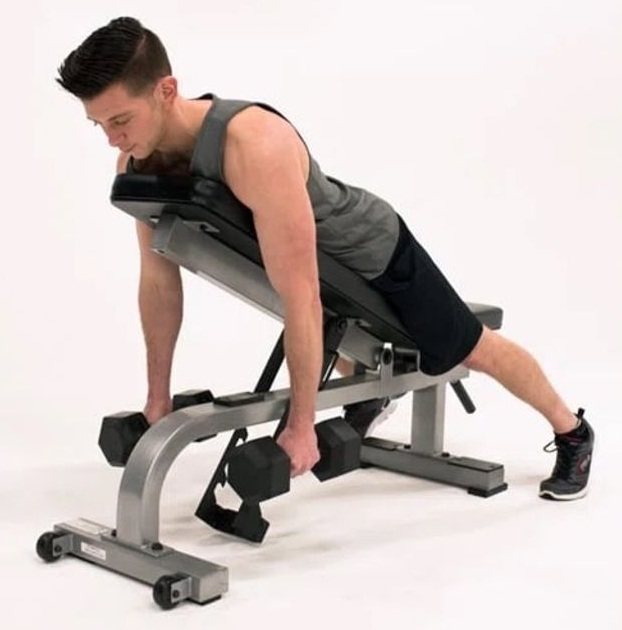
Set your incline bench between 30–45 degrees. A lower angle hits the lats harder; a higher angle shifts slightly toward upper back.
Step 1 — Set Up Your Position
- Lie chest-down on the bench with your sternum against the pad.
- Feet firmly planted for stability.
- Let your arms hang straight down with dumbbells in hand.
- Keep your head neutral—don’t crane your neck upward.
Your spine should be completely braced by the bench, eliminating the possibility of using momentum.
Step 2 — Establish the Stretch
Before even moving the weight:
- Allow your shoulder blades to “drift forward” slightly.
- Reach the dumbbells toward the floor.
- Feel the lower lats lengthen.
This pre-stretch is the key to full lat recruitment.
Step 3 — Initiate the Pull With the Elbow
Start the rep by driving the elbow:
✔ Down and back
✔ Close to your torso
✔ On a shallow diagonal toward your hip
Avoid letting the elbow flare outward—this shifts tension to the traps and rhomboids.
Step 4 — Row Toward Your Hip
This is the core of the lat-biased row.
Pull the dumbbells toward the very top of your hip bones, not your ribs. The dumbbells should not travel upward, but rather backward and slightly downward relative to the torso.

This is what makes it a lat exercise, not an upper-back exercise.
Step 5 — Peak Contraction
At the top:
- Squeeze the lats hard for 1 second.
- Do NOT over-retract the shoulder blades.
- Do NOT shrug.
- Keep your chest glued to the bench.
You should feel the deepest contraction in the lower and outer lat.
Step 6 — Lower With Control
- Let the dumbbells return slowly.
- Allow a full, deep stretch at the bottom.
- Maintain tension—don’t let the weights rest dead at the bottom.
Slow eccentrics amplify lat fiber recruitment and time-under-tension.
Common Mistakes (and How to Fix Them)
Mistake 1 — Rowing too high
This turns the exercise into an upper-back row.
Fix:
Pull toward your hip, not your ribs.
Mistake 2 — Flaring the elbows
This kills lat engagement instantly.
Fix:
Keep elbows tucked at a ~20–30° angle.
Mistake 3 — Lifting the chest off the bench
Momentum = no lat isolation.
Fix:
Keep sternum pressed hard into the pad.
Mistake 4 — Shrugging into the rep
This recruits the upper traps.
Fix:
Think “downward elbow drive,” not “upward pull.”
Mistake 5 — Using too much weight
If the dumbbell doesn’t travel low, the weight is too heavy.
Fix:
Drop weight until your lat controls every part of the rep.
Benefits for Bodybuilders
The Strictest Lat Row You Can Perform
No cheating. No momentum. No spinal extension.
Just pure lat tension.
Eliminates Lower Back Fatigue
The chest support saves your erectors, allowing more volume on back day without interfering with deadlifts or squats.
Perfect for High-Volume Hypertrophy
Bodybuilders need tension and time-under-tension—this variation provides both.
Evens Out Left–Right Lat Imbalances
Because you perform it unilaterally (or even bilaterally with identical tracking), this is one of the best tools for symmetry.
Creates the “Lower Lat Shelf”
That sharp sweep from the oblique to the mid-lat—the trademark of advanced bodybuilders—comes from movements like this.
Fantastic MMC (Mind–Muscle Connection) Builder
The chest support allows you to “turn off” stabilizers and focus all intention on the lats.
Rep Ranges and Set Structure
Primary Hypertrophy Range
- 3–5 sets
- 8–12 reps
- Controlled tempo
- Long stretch at the bottom
Pump/Expansion Work
- 12–15 reps
- Moderate weight
- Strong stretch focus
High-Stim MMC Work
- 15–20 reps
- Light–moderate weight
- Slow eccentrics, 1-second pause at peak
For Progressive Overload
Increase weight only when:
- Elbow stays tucked
- Dumbbell still travels toward hip
- No chest lifting
- No shrugging
- Full stretch is maintained
Advanced Training Strategies
1.5 Reps
Row → half stretch → row again → full stretch
Extends time-under-tension massively.
Dead-Stop Rows
Let dumbbells touch the floor (or nearly touch) each rep.
Improves control and pure lat drive.
Stretch-Pause Reps
At the bottom:
Hold for 1–2 seconds to maximize lat fiber stretch.
Mechanical Drop Set
Start with the strict lat-biased row →
When fatigued, shift to a more neutral elbow path →
Finish with a trap/upper-back row to complete the set.
Iso-Hold Finishers
At the end of a set, hold the contracted position for 5–10 seconds.
Programming Placement
Best placed:
- After pulldowns or pull-ups
- Before heavy barbell rows if you want MMC priming
- As your primary lat isolation row on back day
- Late in back workouts when you need strict contraction work
- In any program where lower back fatigue is a concern
PPL Split Example
Pull Day
- Weighted Pull-Up
- Chest-Supported Lat Row
- Barbell Row
- Cable Row
- Straight-Arm Pulldown
Who Should Use This Exercise?
Beginners
Helps them learn true lat activation early.
Intermediates
Corrects lat imbalances and refines technique.
Advanced Lifters
Perfect for contest prep or detail-focused training blocks.
Athletes With Lower-Back Limitations
A must-have lat movement when unsupported rows are difficult.
Practical Takeaways
- Pull toward the hip, not the ribs.
- Keep your chest glued to the bench.
- Tuck your elbow—never flare.
- Slow down the eccentric.
- Use moderate weight and perfect form.
- Focus on stretch → sweep → squeeze.
Conclusion
The Chest-Supported Lat Row is one of the most potent lat-building tools in bodybuilding. By eliminating momentum, reducing lower-back involvement, and forcing a strict elbow path, it transforms a simple dumbbell row into a finely targeted lat isolation exercise capable of carving in lower-lat detail, width, and thickness.
If you’re serious about building a back that looks wide, dense, and sculpted from every angle, this movement belongs in your program.